
What Surfaces Should Never Be Pressure Washed — and Why
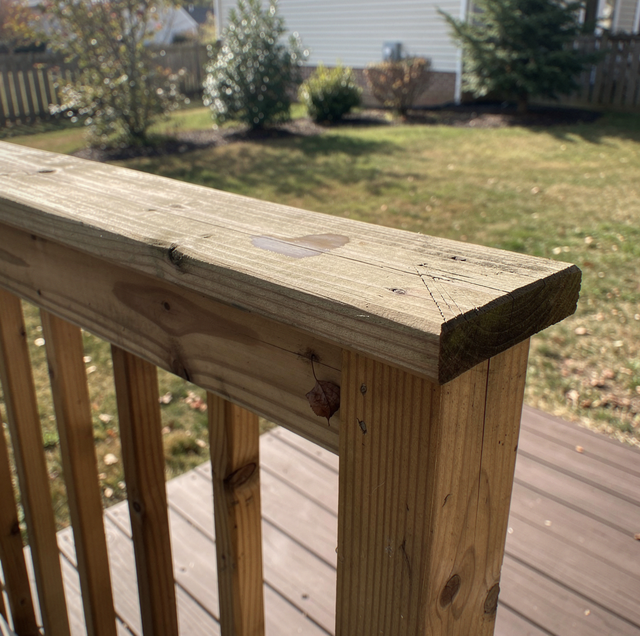
Point a pressure washer at a deck rail that has gone gray, and a few passes strip more than the old finish. The board's surface turns fuzzy exactly where the nozzle tracked back and forth, a texture the untouched wood a few inches away never picks up. Nothing washed off. Something wore away, unevenly, and the stain that goes on next will never lie flat on that wood again.
That board failed for a specific reason: wood has a defined weakness that a concentrated jet of water finds every time, and versions of that same weakness show up on roofs, siding, brick, paint, and metal trim. A pressure washer's whole design point is to take the force a rainstorm spreads across an entire roof and squeeze it into a stream a few inches wide. That concentration is what makes it useful on a driveway, and what makes it destructive almost everywhere else, for one of three reasons: the material is softer than whatever holds it together, its weatherproofing depends on a seal that only works in one direction, or a coating is doing the actual work of keeping water out. Remove any one of those three and the water finds its opening.
A Softer Material Erodes Before Its Frame Does
Every board is built from growth rings, and each ring carries two bands: a light, porous band laid down in spring when the tree grows fast, and a darker, denser band laid down later in the season when growth slows. The spring band is soft. The late-season band is hard. A pressure washer's stream doesn't distinguish wood from dirt, so it removes whatever gives first, and on a board that's the soft spring growth. Sweep a wand across the grain a few times and the spring bands erode down while the harder late-season ridges stand proud, leaving a rippled, furred surface where the wood used to lie flat.
That texture doesn't sand out easily, and it changes what the board does the next time it's finished. Stain works by soaking into wood and curing inside it, so uptake depends on how open the surface is, and a furred board is open in stripes: the eroded spring bands drink far more than they should and dry to a dark, blotchy line, while the raised late-season ridges stay nearly closed and take almost nothing. A single even coat reads heavy in the troughs and thin on the crests, and the torn fibers standing up off the surface hold pigment on their ends rather than in the wood, then weather off over the first season and take that color with them. Sanding it flat again means taking the whole face down to the deepest trough, more thickness than a deck board or a fence picket has to give.
Old masonry carries the same weak point in a different form. Mortar isn't meant to be as hard as the brick or stone it holds; a mason mixes it softer on purpose, so the mortar takes the weather and the masonry units don't have to. Concentrated water finds that softer joint the same way it finds soft spring growth in a board, and it can rake mortar out of a joint a few inches deep in the time it takes to walk a wand along one wall. What an open joint costs isn't obvious from the ground. Mortar transfers loads between the units above and below it and keeps the wall's face continuous, so rain runs down rather than in. Rake it back and water has a direct path into the wall's core, where it soaks the backing, freezes, and works the units apart from the inside over a single winter. The repair is repointing, which is slow, skilled work rather than a cleaning callback: the joint has to be cut back to sound material by hand, refilled in layers so it cures instead of slumping, and tooled to match the original profile, and on an old wall fresh mortar rarely matches the weathered joints beside it.
On masonry built before the mid-1900s, the mortar is often lime-based and intentionally softer than the brick or stone it holds, a sacrificial layer meant to wear first and protect the masonry, the reverse of what a pressure washer assumes.
A One-Directional Seal Fails When Pressure Reverses the Water
A shingle roof, lap siding, and window glazing solve the same problem the same way: they're built to shed water moving one direction, down, and none of them were sealed against water arriving from underneath or the side. An asphalt shingle overlaps the course below it by design, so rain runs off the top layer without reaching the layer underneath. Aim a pressure washer up the slope and the stream drives water backward, up under the course, past a seal the roof was never built to have on that side. The same force strips the mineral granules off the shingle's surface, the layer that blocks UV light, so the roof loses its sun protection at the same moment it takes on water it was never designed to hold. Getting rid of algae or moss already established on a roof is a question of its own, separate from why the shingles shouldn't meet a pressure washer in the first place.
Lap siding runs on the identical logic at wall scale: each panel overlaps the one below it, built to shed rain running down the face. It's never sealed against water forced sideways or up from a wand held at the wrong angle, and water pushed up under a lap goes into the wall cavity behind the siding, where it has no path back out. What that water does plays out over a season rather than an afternoon. The cavity behind siding is built to stay dry and to shed an occasional bit of damp slowly, as vapor, not to drain water somebody put there on purpose. Water forced in behind a lap sits against the sheathing and the building wrap, holding the wood at a moisture content where mold and decay fungi stay active for weeks, and any insulation it soaks presses that water back against the framing. The signs surface late and somewhere else: a musty smell in the room behind that wall, a stain bleeding through the interior paint, a nail head rusting through the siding. By then the washing is months behind, and nobody connects the two.
Window glazing works the same way at a smaller scale. The bead that seals the glass into the sash sheds water down and away from the sash below it. A wand held level or angled upward drives water up against that bead, the one direction it was never built to face, and the water works into the sash and frame long before any sign of it shows on the surface. The glass itself carries a separate risk: a concentrated stream at close range can crack or shatter a pane, especially in an older single-pane window, since a brittle material has no give to absorb that much force landing on one small point.
The Coating Is the Only Thing Standing Between Water and the Material
Paint is a film applied to the surface, keeping water and UV light off whatever's underneath. Pressure aimed at a painted wall removes the paint along with the dirt sitting on it, peeling and chipping a film that's often thinner and more brittle than it looks, especially on older coats that have spent years chalking and cracking in the weather. Once that film is gone in patches, the bare material underneath sits exposed exactly where the paint used to be doing its job, and repainting patch by patch rarely blends.
Homes built before 1978 may have lead-based paint beneath newer coats. If pressure fractures those older layers, it can release lead-contaminated dust into the yard and air, a hazard no amount of surface cleaning is worth risking.
A stained deck runs on the same logic as paint, just thinner: the stain is a sacrificial film, and pressure removes it along with whatever it was protecting underneath. Metal trim, railings, and fixtures finished with an anodized or powder-coated layer work on the same principle. Anodizing builds a thin, hard oxide layer on the metal through an electrochemical process, and powder coating bakes on a polymer film; both do their protective work only as long as they stay intact. A pressure stream can etch, dull, or chip either finish, especially at edges, corners, and screw heads, and once the coating breaks, the bare metal underneath is exposed to the corrosion it existed to prevent.
These Are Force Problems, Not Cleaning Problems
None of the failures above is a cleaning problem. The furred board, the raked joint, the water driven up behind a lap, the etched anodizing: in each case the surface came apart because force found the weakest solid in it, not because the soil sitting on top was stubborn. That rules out a gentler version of the same approach. Whatever cleans these surfaces has to lift the soil without force at all, so the water stops being the thing doing the cleaning and dwell time takes its place: a solution left on the surface long enough releases what it's sitting on, and the material underneath never takes a hit. On roofs and siding the case goes further still, because there the staining is a living colony rather than plain grime, and force knocks only the visible layer off while the roots and spores stay put.
This isn't a project most homeowners take on themselves. Mixing a cleaning solution to the right strength for the surface and the growth, controlling dwell time so it works without harming nearby plants or finishes, and reaching a roof or a second story safely all take equipment and know-how most people don't keep on hand.
Frequently Asked Questions
Rub a finger across a dry section of the paint. A chalky, powdery residue on your fingertip means the coating has already begun to oxidize and fail, and pressure will peel or feather that layer off the wall. A hard, glossy surface with no residue is holding up better, though age eventually works against any painted exterior.
Yes. Glazing putty stiffens and shrinks as it ages, and after a decade or two it often pulls hairline cracks away from the glass on its own, regardless of how carefully water is aimed. Those gaps let water in even during a properly angled rinse, which is worth knowing before assuming a careful angle alone keeps a window frame dry.
Not always. Moisture driven behind siding, under shingles, or into a wall cavity can sit unnoticed for weeks before it announces itself as a musty smell, a soft spot in the siding, or bubbling paint on an interior wall. By the time it's visible, the framing or sheathing behind the surface may already be affected.
Yes, at the edges more than the flat faces. Anodizing forms an oxide layer well under a thousandth of an inch thick on typical architectural finishes, and powder coating is a baked-on polymer film only a few thousandths thick; both are thinnest at corners, screw heads, and cut edges, which is where a concentrated stream first breaks through to bare metal and starts the corrosion the coating was there to prevent.
Those carry a different risk. Outdoor fixtures and panels are gasketed to shed ordinary rain, and a jet aimed at close range asks far more of that gasket than it was ever built to handle. Forcing water past it can reach live components, creating a shock or short-circuit hazard unrelated to the surface's material.
Two things the operator controls, neither of them the machine's rating: the fan angle of the nozzle and the standoff distance the wand is held at. A zero-degree tip keeps the whole flow in a single pencil-width point and can carve into wood or mortar on one pass, while a wide fan tip spreads that same flow across a band several inches wide, dropping the force on any one spot by a large multiple. Distance does the rest, since the stream loses energy fast as it opens up in air, so a wand held a few inches off a board does far more harm than the same wand two feet back. That is how two crews running identical equipment leave one wall clean and another damaged.
Get a soft-wash evaluation of the surfaces on your home — find out what's safe to pressure wash and what needs a gentler approach instead. Superior Power Washing serves Waldorf, La Plata, and Clinton. Call (240) 901-4252.
