
What Causes Black Streaks on Asphalt Shingle Roofs
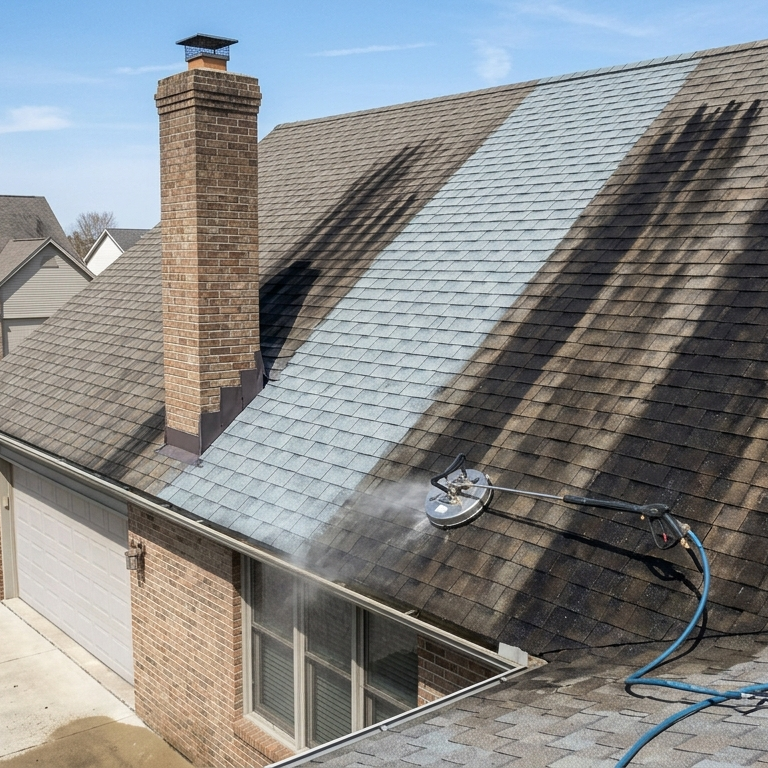
It's the first warm Saturday in April. You are standing in the driveway looking up at the roof, and they are back — those long dark streaks running straight down the shingles. They were not this bad last year. You can tell by how far they reach now, past the chimney, almost to the gutter line. The neighbor's roof has them, too. So does the one across the street.
It looks like dirt. Maybe runoff from the gutter. Maybe pollution that built up over the winter. Some people try to scrub it. Some try a pressure washer. The streaks come back within a season.
Here's what's actually happening up there.
Those streaks aren't dirt. They are alive.
The dark streaks on an asphalt shingle roof are an algae called Gloeocapsa magma — pronounced glee-OH-cap-suh — and it's been quietly spreading across roofs across most of the U.S. for the past thirty years. Before the early 1990s, you rarely saw streaked roofs. Manufacturers started using crushed limestone as filler in shingles to keep costs down. Limestone is calcium carbonate. The algae eat calcium carbonate. The math wrote itself.
The black color isn't the organism itself. It's the protective sheath that the algae produce to shield their cells from UV light. The algae is technically blue-green, but the dark casing makes it look like soot streaks running down the roof.
It's not coming from your yard. It's coming from the air.
How the algae got on your roof in the first place
Algae cells travel by wind. They land on every horizontal surface in your neighborhood — your roof, your neighbor's roof, the church across the street, the school down the road. Most of those cells dry out and die. The ones that land in the right spot — a damp shaded area where moisture sits long enough for the cell to take hold — start to colonize.
Birds carry them, too. So do squirrels and roofers walking the ridge from another job. Once a colony establishes on one roof in a neighborhood, every roof within a few hundred feet is downwind of a spore source.
The colonies grow at the top of the roof first because that's where moisture lingers longest after a rain. Water runs downhill, carrying detached cells with it. Those cells re-attach in vertical paths as they slide down the shingle. That's why the streaks always look like they are running from the peak down to the eave — not random splotches, not horizontal bands. Straight lines following the path of gravity.
| What you see on the roof | What's actually going on | How urgent it is |
|---|---|---|
| Light gray streaks just on the north or shaded slope | Early algae — first 1–2 years of growth | Cosmetic: Schedule a soft wash within a year |
| Dark black vertical streaks running from peak to gutter | Established Gloeocapsa magma colony | Schedule cleaning soon — it's eating granules |
| Green fuzzy patches between shingle courses | Moss colonies (not algae) | Don't wait — moss lifts shingles and traps water |
| Crusty, light gray-green spots that look painted on | Lichen | Soft wash this season — lichen has root structures |
Why the north side and the shaded eave are always the worst
Sunlight kills algae cells. Direct sun also dries the shingle surface fast enough that the organism can't establish a hold. The south slope of most roofs gets cooked by midday sun every clear day in summer, and algae has a hard time surviving there.
The north slope is different. North-facing shingles get hours of direct sun than south-facing ones. They stay damper, longer, after every rain. The shaded eave by the big oak tree never really dries out at all. Add tree debris dropping onto the shingles — leaves, twigs, pollen — and the shaded sections hold organic matter, the algae can feed on between meals of limestone.
If your roof has streaks on only one slope, that's the slope facing away from the sun. If the streaks run across the whole roof, the home is shaded enough that no slope gets the UV exposure to keep the colonies down.
What the algae is actually doing to your shingles
Here's the part that gets missed. The black streaks aren't just ugly — they're the sign of a living organism slowly breaking down the shingle. Algae feeds on the limestone in the shingle, the way termites feed on the studs in a wall. Slow. Quiet. But it's a living thing eating the material that makes up your roof.
As the algae feeds, it loosens the granules embedded in the shingle's asphalt layer. Those granules are what shield the asphalt below from UV light. UV light is what destroys asphalt. So, a roof with established algae loses granules faster than a clean roof, the asphalt underneath gets more UV exposure, and the shingles age years faster than the manufacturer rated them for.
A 30-year shingle that's been hosting algae since year five may need replacement at year fifteen. That's not a manufacturer’s defect. That's biology eating your roof.
Heat is the other part of it. Dark streaks absorb more solar heat than clean shingles do. A streaked roof in July runs noticeably hotter than a clean roof of the same color and material, which puts more stress on the asphalt and pushes more heat into the attic. Higher cooling bills are a real downstream cost most people never connect back to the algae.
If you want to see how far it's gone, look at the gutter trough after a heavy rain. A roof in the early stages drops a handful of granules per storm — expected, manageable, no real concern. A roof with established algae sheds granules by the cup. The trough fills faster than it should, and the dark grit piling up at the corner of the splash block grows visibly weaker from week to week. The other tell is the texture of the shingle itself: a healthy shingle feels gritty, like fine sandpaper. A shingle that's been hosting algae for years feels smoother — that's the bare asphalt showing through where the granules used to be.
A real fix looks nothing like what most people try first
A pressure washer is the wrong tool for an algae problem. The pressure knocks the organism off the surface, sure — for a few weeks. The cells embedded in the asphalt and underneath the granules survive. The colony repopulates from the roots. Worse, high-pressure water blasts the granules off the shingle, along with the algae, stripping the UV protection from the asphalt and shortening roof life. Most shingle manufacturers will void the warranty on a roof that's been pressure-washed.
The real fix is a soft wash. Low-pressure application of a biocide solution — usually sodium hypochlorite combined with a surfactant — that kills the algae at the cellular level. The dead organism dissolves over the next several rains. The roof gradually returns to its original color. No granule loss. No shingle damage. No warranty risk.
A proper soft wash also slows regrowth. The dwell time of the biocide kills not just the visible colonies but the spores in the shaded crevices that haven't started growing yet. A roof cleaned correctly will stay clean for two to four years before noticeable regrowth starts — sometimes longer on sunny, exposed roofs.
What about copper or zinc strips? The metal strip at the ridge releases trace amounts of metal ions every time it rains, which inhibit algae growth on the slope below. They work — slowly, and best as a preventative on a clean roof, not a treatment for an established problem. Pair them with a soft wash, and they extend the time before the next cleaning.
Frequently Asked Questions
The black streaks are a warning, not a paint problem.
The thing to understand about a streaked asphalt roof is that the visible streaks aren't the problem — they're the symptom of a problem that's been working quietly for a few years. The algae was eating the granule bond and the asphalt underneath long before the dark color caught your eye in the driveway.
The first time you notice the streaks, you've got time. A soft wash this season clears the colony, slows regrowth, and protects the roof's rated life. The second or third time you notice the streaks getting worse, the math starts shifting. Every year you wait is a year of accelerated wear you can't undo by cleaning later.
Wait long enough, and the cleaning won't help because the granules are already gone.
Superior Power Washing soft washes asphalt shingle roofs across Waldorf, MD, and all of Charles County and Southern Maryland — including La Plata, Clinton, Fort Washington, White Plains, and Brandywine. Owner-operated, fully insured, low-pressure method that won't void your shingle warranty. Call (240) 901-4252 for a free on-site assessment.
