
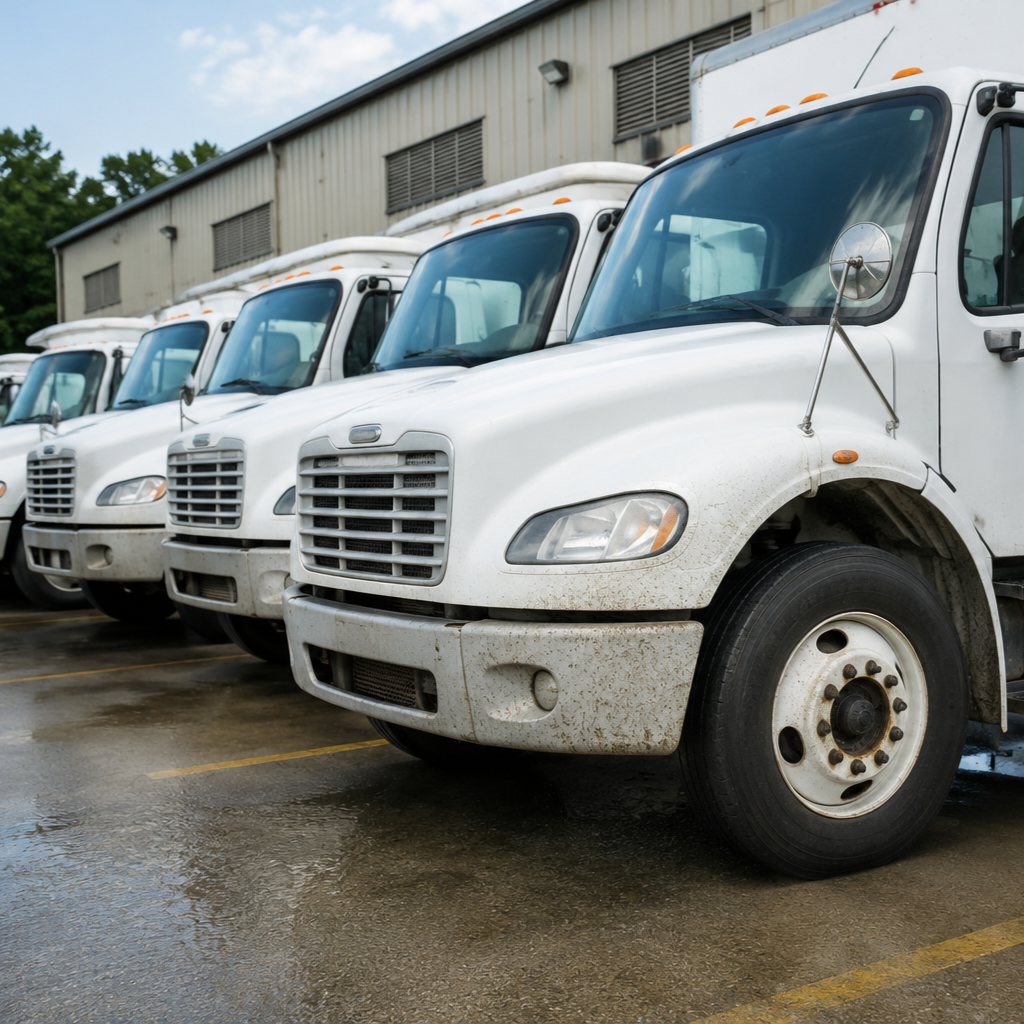
Monday at six in the morning, the yard is quiet and the trucks are staged for dispatch. Six pickups, two box trucks, a tandem dump in the corner. The lower three feet of every body panel is gray-brown from last week's storm runs. The cargo doors carry a smudge from a dozen morning openings. The company logo on the side of the cab is two shades duller than it was when the wrap went on eighteen months ago.
The first customer of the day pulls into the lot at seven. The first thing they see is what you've stopped noticing.
A clean fleet isn't a vanity expense. It's the rolling sign that puts your phone number in front of thousands of drivers a day. And yet quotes for fleet washing run from $12 a pickup to $250 a tractor, which makes it one of the harder line items to budget honestly. Here's how the per-truck math actually shakes out.
What a fleet wash includes per truck — and what gets skipped
A "fleet wash" isn't one service. It's a bundle of small tasks per vehicle that together make a truck look like it belongs to a company that runs a tight operation. A complete per-truck pass covers the exterior body — cab, hood, fenders, and box or trailer — soaped, soft washed where the surface needs it, and rinsed back to original color. The wheels and tires get a separate degreaser pass because brake dust and road grime cook into the alloy. The cargo doors get hand attention. The windshield, mirrors, and glass get a streak-free finish. The decals or wrap get a careful low-pressure pass that won't lift the edges.
A wash that skips three of those is a body rinse, not a fleet wash.
Worth knowing what isn't in a standard pass. Engine bay cleaning is extra and quoted by the hour — about $40 to $90 per truck. Interior cab detail runs $25 to $75 per truck, usually a different crew. Undercarriage washing — the high-pressure flush of frame rails, axles, and underbody — is its own line item, typically $15 to $40 per truck and worth every penny if your trucks see road salt in winter.
Per-truck pricing usually lands between $15 and $200 in Southern Maryland
A pickup truck on a recurring contract runs $15 to $35 per visit. A box truck or cargo van costs $30 to $75. A Class 7 single-axle straight truck — yard dump, mid-size flatbed, smaller refuse — lands at $45 to $110. A Class 8 tractor without a trailer runs $65 to $135. A combination tractor-trailer, dump truck with pup, or concrete mixer can hit $150 to $250.
Standalone one-time visits — no recurring schedule — typically run 30 to 50 percent more per truck, because the crew is paying for mobilization on a single trip instead of amortizing it across a year of stops.
| Vehicle class | Per-truck, recurring | One-time | What it covers |
|---|---|---|---|
| Light pickup (F-150, half-ton) | $15–$30 | $35–$60 | Body, wheels, glass |
| Service pickup with utility body | $25–$45 | $50–$85 | Body, bins, ladder rack |
| Cargo van or Sprinter | $25–$45 | $45–$80 | Body, doors, glass |
| Box truck (16–26 ft) | $40–$75 | $70–$135 | Cab, full box, roll-up door |
| Class 7 single-axle straight truck | $50–$110 | $90–$185 | Cab, body, dual wheels |
| Class 8 tractor (no trailer) | $65–$135 | $115–$225 | Cab, sleeper, fairings, wheels |
| Tractor + 53-ft trailer | $135–$225 | $235–$375 | Full combination, all wheels |
| Dump truck + pup trailer | $150–$250 | $250–$400 | Both bodies, hoists |
| Concrete mixer or specialty | $125–$225 | $200–$350 | Drum, chute, cab, wheels |
| Tanker (food-grade or fuel) | $135–$235 | $225–$385 | Exterior, dome lids, valves |
| Refrigerated trailer washout (interior) | $95–$175 | $150–$275 | Interior food-grade sanitation |
| Refuse / waste hauler | $175–$300 | $275–$425 | Sanitized pass on body and packer |
These are real Southern Maryland numbers in 2026 dollars. The spread within each row tracks vehicle condition, decal complexity, and the prior week's route.
Vehicle type drives the price more than fleet size does
A grading contractor with eight Class 7 dumps and a delivery company with eight Sprinter vans have the same headcount. Their fleet wash bills can sit 40 percent apart.
The Sprinters carry tools and clean cargo. Soap, low-pressure rinse, glass, doors, wheels — the crew is in and out in 12 minutes per van. The dumps carry mud, mulch, and stone dust cooked into every horizontal surface. The bodies need a presoak. The hoists need detail attention because the soil packs into the corners where the box meets the frame. The tires are caked with dried clay that takes a second pass with a stiff brush. Each dump takes 25 to 35 minutes, sometimes longer if the crew is preparing the truck for a DOT inspection.
A quote that gives you one number for "any truck in the fleet" is either rounding way up on the easy vehicles or way down on the hard ones — and either way, somebody is getting cheated.
What drives a fair fleet wash quote up or down
| Cost driver | Adds or subtracts per truck | Why |
|---|---|---|
| Wrap or full-color decal work | $5–$25 | Low-pressure pass, longer rinse, more careful soap |
| Heavy mud or construction-site soil | $15–$50 | Presoak before the main wash |
| Road salt residue (winter) | $10–$30 | Salt brightener pass on body and wheels |
| Aluminum or polished wheels | $10–$25 | Separate alloy-safe chemistry |
| Undercarriage flush | $15–$40 | High-pressure underbody pass on a flush bar |
| Engine bay cleaning | $40–$90 | Degreaser, hand work around electrical |
| DOT inspection prep | $25–$60 | Detail pass to make the truck inspection-ready |
| After-hours scheduling | $10–$35 | Crew premium for evening, overnight, or weekend |
| First wash on a heavily soiled truck | $25–$100 | Restore pass before the maintenance baseline begins |
| Fleet bundling (8+ trucks) | -$3 to -$15 | Setup cost amortizes across more vehicles |
Most regional fleet wash crews publish volume-discount tiers along the same logic. A fleet of 8 to 19 trucks usually sees a 5 to 10 percent per-truck discount. Twenty to 49 trucks lands at 10 to 15 percent. Fifty and up moves to custom contract pricing.
Mobile washing and cadence change the math more than anything else
There are two ways to wash a fleet. Send each driver to a commercial wash bay on the route home, or have a mobile crew come to your yard with a truck, generator, hot-water unit, and reclamation setup.
Drive-in bays look cheap on the sticker — $15 to $40 for a touchless run, $40 to $90 for a brush wash. The hidden cost is driver time. A 25-minute detour at the end of a 10-hour day is 25 minutes of overtime, plus the fuel, plus the fact that the bay rinses the body and skips the wheels, the cargo doors, and anything not visible from the brush gantry. The truck looks clean from a distance and looks the same as before from three feet away. Mobile washing trades a higher per-truck rate for time savings, soil-by-soil attention, and a wash done at your yard while the drivers are off the clock. For fleets of six or more, mobile almost always wins on total cost per clean truck.
Cadence matters as much as method. A pickup washed once a month costs $30 to $45 per visit. The same pickup washed weekly costs $15 to $22.
| Cadence | 10-truck fleet, per visit | Annual total | When it makes sense |
|---|---|---|---|
| Weekly | $325–$475 | $16,900–$24,700 | Branded service fleets, customer-facing delivery |
| Biweekly | $385–$575 | $10,000–$14,950 | Most contractor and trade fleets in busy season |
| Monthly | $475–$725 | $5,700–$8,700 | Light-route fleets, professional services |
| Quarterly | $625–$950 | $2,500–$3,800 | Backup vehicles, seasonal equipment |
| One-time | $750–$1,200 | $750–$1,200 | Pre-photo, post-construction, sale prep |
A weekly crew arrives at a lightly soiled fleet and is gone in 90 minutes. A monthly crew arrives with four weeks of grime baked on, and the same fleet takes three to four hours. For branded fleets where the truck is the advertising, the right cadence is almost always weekly or biweekly. The fleet pays for the wash twice over in the calls it generates.
Stormwater reclamation is the line item most fleet quotes hide
This is the part of fleet washing nobody puts on the bid sheet, and it's the part that costs property owners and fleet operators the most when it goes wrong.
Washing trucks in a paved lot sends soap, road grime, brake dust, oil, and degreaser into whatever the lot drains to — almost always a storm system that empties into a creek, a river, or the bay. The EPA's stormwater rules and Maryland's MDE regulations treat that runoff as a regulated discharge. A wash crew without a recovery system is either dumping it into the storm drain or asking the property owner to take the liability. The fine, when an inspector or a neighbor reports it, sits on the property owner, not the wash crew.
A real fleet wash setup includes a containment berm or boom around the wash zone, a vacuum recovery system that pulls the wastewater off the pavement, and a written disposal path — usually a permitted treatment facility or the local sanitary sewer with a discharge agreement. The crew should be able to hand you a one-page wastewater handling description on request.
The cheap quote skips all of it. The truck looks clean, the lot looks rinsed, and three months later a code-enforcement notice arrives because somebody saw a soap rainbow running down the curb to the storm grate.
Where cheap fleet wash quotes cut corners
A $9-per-pickup quote isn't a discount. It's three or four scope items short of a real wash.
The wheels and tires. The cheap quote rinses the body and walks past the wheels. Brake dust stays. Road grime stays. Two weeks later the trucks look like they were never washed.
The decal preservation. A high-pressure pass at 3,000 psi will lift the edge of a vinyl wrap inside six washes. A cheap crew runs the same wand pressure on a wrapped Sprinter that they run on a dump body, and the wrap edges curl by the end of the first quarter. The replacement wrap costs three to five times the year of wash savings.
The reclamation, as covered above. The honest crew has a vacuum recovery system. The cheap crew doesn't, and the property owner holds the bag when the stormwater complaint comes in.
The DOT-inspection-ready finish. A truck still showing dried mud in the wheel wells, brake dust on the rims, and a hazy windshield won't fail a DOT inspection — but it'll cost you points on a Compliance, Safety, Accountability vehicle maintenance score over time. A real fleet wash includes the kind of detail that makes the inspector tick the boxes fast and move on.
Frequently Asked Questions
The fleet wash quote that holds is the one that names every truck and every scope item
A fleet wash quote isn't a per-truck number on a single line. It's a vehicle list, a per-vehicle scope, a cadence, and a written reclamation protocol. The cheap $9-per-pickup number hides everything that isn't being washed and assumes the property owner will eat the stormwater liability when the inspector shows up.
The math that matters isn't the per-wash dollar. It's the cost of each visit divided by the days of clean-truck appearance you're buying between visits. A weekly wash on a branded contractor fleet protects 30,000 daily impressions for $35 a truck. A quarterly wash for $75 a truck lets the next ten weeks drift into the kind of dirty that loses you the next call.
A fleet that looks finished every morning is a fleet that's earning its wraps.
Superior Power Washing handles mobile fleet vehicle washing across Waldorf, MD, and all of Charles County and Southern Maryland — including Clinton, Fort Washington, Upper Marlboro, Bryans Road, and Accokeek. Owner-operated, fully insured, on-site stormwater reclamation included, certificates of insurance available on request. Weekly, biweekly, monthly, and one-time contracts available. Call (240) 901-4252 for a free on-site assessment.