
How to Prep a Home's Exterior for Sale: What the Camera Sees
The outside of a listed house gets judged twice, and the two judgments do not agree. The first happens in a photograph taken from a fixed distance, usually from across the street or the foot of the driveway, wide enough to hold the whole front of the house in one frame. The second happens from the curb, at walking speed, close enough to read texture. A lens flattens the house into broad areas of light and dark, throwing away the fine detail. A buyer on the front walk sees that detail and barely registers the broad areas. Prep that satisfies one view can miss the other completely.
That split decides what to clean and in what order. Working down the house from roof to slab, each surface does one thing to the photograph and something else to the person standing in front of it.
Quick Answer: Clean from the roof down so nothing gets dirtied twice, finish every surface before new plantings go in and before any painting starts, and leave calendar room so everything is dry and weather delays absorbed before photo day.
The Roofline in a Wide Shot
On most single-family houses, the roof is the largest unbroken area in a straight-on photograph of the front. Streaking runs down the slope from ridge toward gutter, in the same direction on every course, and repeated parallel darkness is the kind of pattern a camera holds onto while it loses grain and shadow. The plane stops reading as one color and starts reading as a fade from clean at the top to dirty at the bottom.
A roof that fades reads as old, so shingles with years of service left look tired. The biology behind the darkening has its own explanation, and the piece that belongs to a listing is narrower: the pattern is dark, vertical, high in contrast against light shingles, and sitting where the eye lands first.
From the end of your driveway you see that roof at a sharp angle, foreshortened, the streaks compressed into a thin band. It looks better from your yard than in a straight-on photograph, which is why the roof surprises people. Shingles are soft-washed at low pressure, and pressure washing has no place on a roof. For selling, the roof outranks everything below it because no photographer can improve it with a crop, a lens choice, or a better time of day.
Siding on the Shaded Runs
Growth does not spread evenly across a wall. It builds where the surface stays damp longest: north-facing runs, the side shaded by tree canopy at midday, the band under the eave overhang where rain never rinses, and panels behind foundation shrubs.
Siding dirty all over photographs as slightly darker siding. Siding clean on the sunny half and gray-green on the shaded half photographs as two different walls with a seam between them. The camera renders that seam as a hard edge, and a buyer scrolling a gallery has no way to read it as growth. It looks like water staining, or a panel replaced after a repair, which is a worse conclusion than dirt.
That is the argument for washing the whole house rather than just the front. Listings carry a rear view and at least one side view, and the gable end nobody looks at from the street gets a frame to itself.
The Driveway, Walkway and Porch Slab
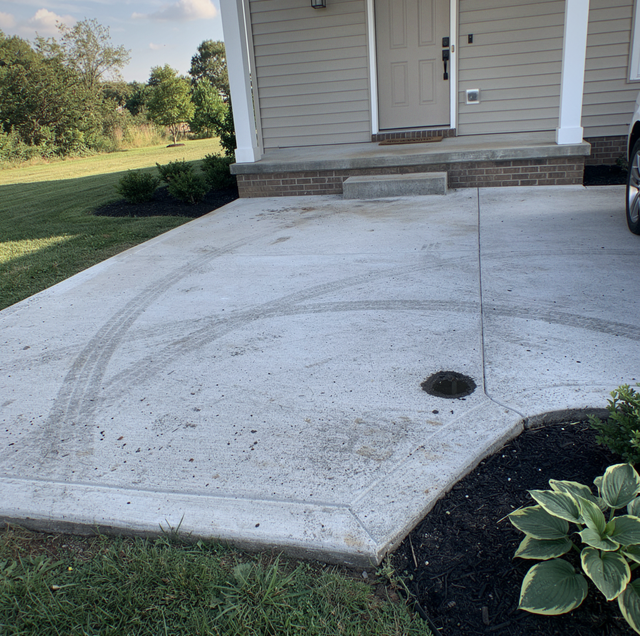
Concrete fills the bottom third of a standard front-of-house shot, and the driveway runs from the bottom edge of the frame toward the door, pulling the eye with it. On a clear day it is also the brightest thing in the picture, which means it sets the tone of everything above it. A clean slab throws light back onto the lower siding and the porch ceiling. A slab gone gray and blotchy stops throwing that light, and the whole front of the house goes flat without the viewer knowing why.
The marks themselves photograph as shapes: the darkened rectangle where a car parks, the ring under each downspout splash block, the blotching under a tree, the worn traffic path down the middle of the front walk. A camera renders those as deliberate-looking patches, and patches read as damage. A buyer standing there reads them as upkeep, because the walk is the one surface they stand on before the door opens.
This is the largest light-colored plane in the frame, and its brightness and evenness carry the rest of the picture.
Gray Wood on the Deck and Fence
Weathered wood photographs as a flat gray field with almost no grain in it. A deck is usually the whole backyard shot, and a gray deck fills that frame with a low-contrast rectangle that gives the viewer no sense of the material. Clean wood puts contrast back between grain and background, and a camera reads that as texture from across the yard.
What no photograph shows is what the surface feels like underfoot. A buyer stepping onto a deck registers slickness immediately, before any conscious thought about upkeep, and no listing photo undoes that reaction.
The fence acts on the frame. From the street, a fence line draws the boundary of the yard, and a straight line is what makes a yard read as kept. When the shaded run has gone dark, and the sunny run has bleached out, the line breaks into segments, and the yard behind it reads as smaller and less tended. Deck and fence are the surfaces whose photograph and in-person impression disagree most, so each has to be earned separately.
Gutters and the Fascia Line
The gutter face and the fascia board behind it form one horizontal band running the full width of the house, directly under the roof edge. A straight, high-contrast line is the strongest thing an eye will follow in a photograph.
Dark vertical striping down a white gutter face breaks that band into a dashed line, and the eye follows it anyway, tracking the roofline while it should be taking in the house. The same photograph also catches overflow staining on the siding under a blocked section, and any run that has begun to sag, because a camera is unusually good at showing a line that should be level and is not.
The roofline is where most homeowner injuries in this work happen: ladder work at gutter height, on soft ground, with a hose or a tool occupying one hand. It is the clearest case for hiring the job out for the whole house.
Windows, Frames and the Interior Shots
Interior photographs are shot toward the windows because that is where the light is, which makes the outside of the glass part of the interior gallery, whether anyone planned it that way. A haze of pollen and film scatters light before it reaches the room, and the photo comes back gray and flat. A single exposure that holds the room blows the window out to white and throws away the view through it, and that view is often why the room was shot from that angle.
Frames do their damage at close range. Sills and the inside corners of white vinyl frames hold dark grime, and in an interior shot the frame sits in the foreground, rendered sharply while the room falls away behind it. From outside, grime along the bottom rail and the trim below the sill draws a dark line under every opening across the front of the house. One dirty sill is invisible. Eight in a row is a pattern, and patterns are what a viewer notices without being able to name.
Windows are the only surface in both galleries, exterior and interior.
Sequencing the Work Before the Photos
Everything on a house rinses downward. Washing a roof sends what came off it over the siding, the gutter faces, the windows, and finally the slab at the base of the wall. Any surface cleaned before the one above it gets dirtied again the moment the upper one is washed. The order runs roof, siding, gutter exteriors, glass, then concrete and deck. Run it the other way, and you clean the same driveway twice.
Wash before the yard work: Fresh mulch, new plantings, and pine straw sit directly beneath the walls that get rinsed, and rinse water carries whatever came off the siding down into the beds. Cutting foundation shrubs back first also opens the strip of wall behind them, where growth is heaviest and where a photographer gets close on the walk-up to the door.
Wash before painting: A coat rolled over a chalked or growth-covered surface does not bond well, so paint applied to unwashed siding wears off early. Washing first also tells you how much painting there is to do: boards that look failed under a gray film often come back looking sound once the film is gone, and the ones actually spent become obvious. Scoping a paint job on a dirty house is guesswork.
Leave room before the shoot: Surfaces have to be dry in the pictures, and concrete is the slow one: a slab still giving up moisture photographs as dark blotches that look very much like the stains just removed. Exterior washing is also weather-dependent, so booking it with real space ahead of the photo date means one rained-out day does not put a wet driveway into the listing. Set the wash first, then the photographer.
Book the wash before you book the photographer, and schedule mulch, plantings and any paint work after it. Each of those is a task you would otherwise do twice, and the second pass never comes out looking as clean as the first.
Walk the property once the work is done: from the street, from the end of the driveway, then from the front door looking back. Those positions are close to where the camera will stand, and anything still catching your eye from one of them will be in the pictures.
Frequently Asked Questions
They matter more than their size suggests, because almost every listing includes a close shot of the entry. At that range, the camera resolves what it drops in a wide shot: insect debris inside a porch light globe, webbing in the corner of the fixture, and the hazed lower panel of a storm door where glass meets aluminum frame. The globe comes down for cleaning with the switch off.
Screens hold a fine gray dust in the mesh that is nearly invisible from a few feet away and very visible through a lens. Shooting a room through a screen costs contrast and softens everything outside the glass, so screens on the rooms being photographed are worth pulling and rinsing first. Label them by room as they come out.
That is efflorescence: mineral salts carried through masonry by moisture and left on the face as the water evaporates. It shows up on brick steps, foundation block, and retaining walls beside a driveway. It photographs as a pale wash over the brick color, flattening the texture, and because it comes from inside the masonry, it can return if the moisture behind it remains active.
It changes the list considerably. A drone shot shows the full roof plane rather than the slice visible from the street, plus the back of the house, the flat roof over a porch or garage where debris settles, the shed roof, and any part of the yard hidden behind a fence. If aerials are planned, the back half of the property needs the same attention as the front.
Rain mostly rinses. What re-dirties a clean house quickly is a heavy pollen fall, which lays a yellow-green film over glass and horizontal trim, or irrigation spray hitting the house, which dries into hard mineral spotting on windows and on the bottom few feet of siding. Turn any zone that reaches the walls off ahead of photo day.
They sit in the corners of yard shots and along the walk-around a buyer takes. A condenser cabinet mats its fins with pollen and seed fluff and goes chalky on the top grille; pull the disconnect beside it first, and rinse gently from the inside out with a fin comb, never a pressure wand, because the fins bend under real pressure. Shed doors and trash enclosures collect the same growth the shaded side of the house does. None need to look new, but none should be the darkest object in an otherwise clean frame.
Set the pre-listing wash before your photo date — the house gets worked top down, roof and siding soft washed first, then gutters, glass, concrete and deck, so everything is clean and dry when the camera arrives. Superior Power Washing serves Waldorf, La Plata, and Clinton. Call (240) 901-4252.
