
Is Concrete Sealing After Pressure Washing Worth the Cost
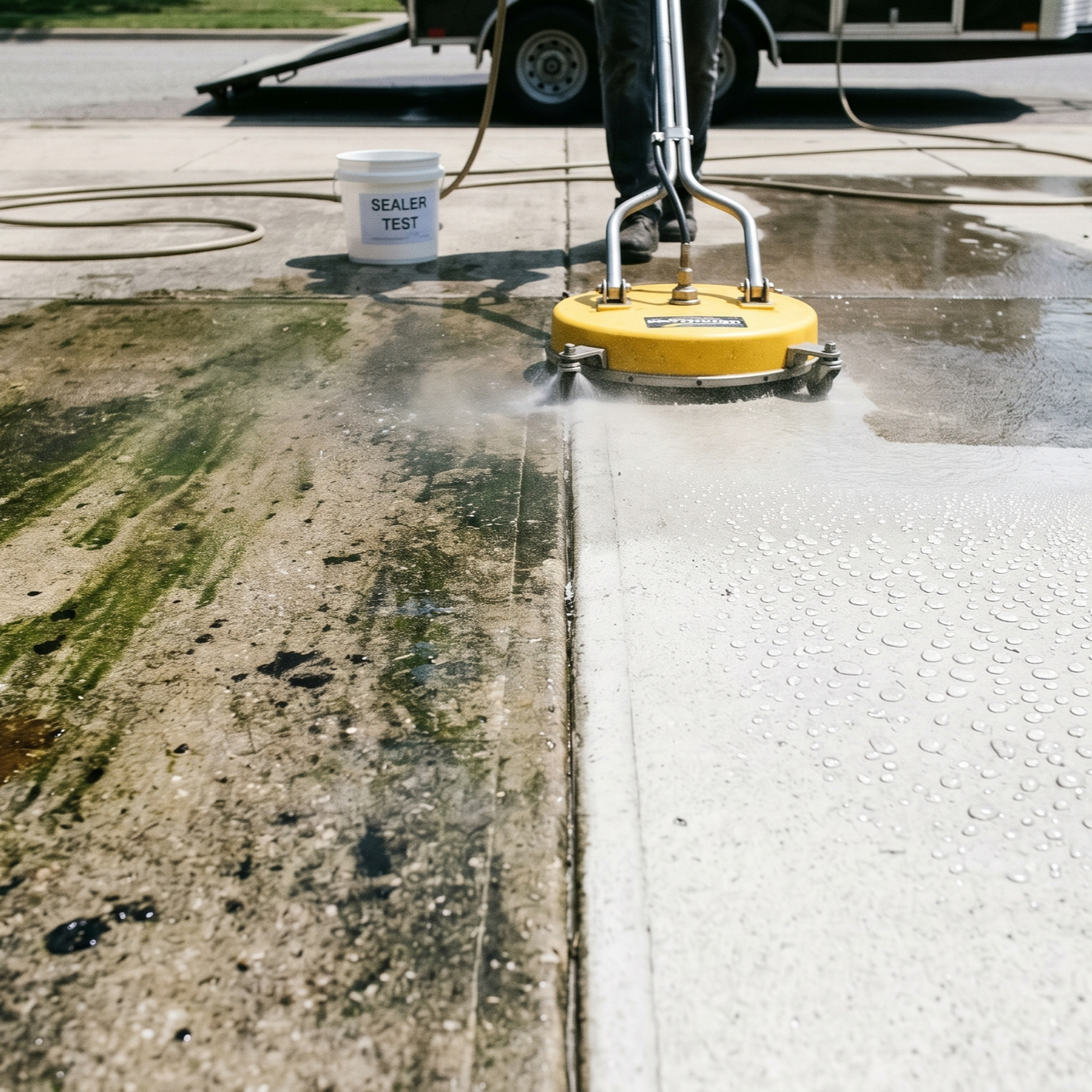
The crew is packing up the hoses. Your driveway is dark with water and a shade lighter than it's looked in years. The owner stands at the edge of the slab and asks a question you weren't ready for: do you want to seal it before we leave? It's another six hundred dollars. He says today is the day to do it, not next month. The truck is running. You're staring at concrete you barely recognize. And you have about three minutes to decide.
That's the moment this question gets asked. Not after research. Standing in a wet driveway with a guy asking yes or no.
Here's the math behind the answer.
What sealing actually does to clean concrete
Bare concrete is porous. Closer to a kitchen sponge than a kitchen counter. You can pour water on a freshly poured driveway and watch most of it sit on the surface for a second, then disappear into the slab. That absorption is what wrecks concrete over the long run — water gets in, freezes, expands, and pops chips off the surface. Oil gets in and won't come back out. Rust from a dripping car part gets in and stains permanently. Road salt gets in over a hard winter and eats the cement paste from the inside.
A sealer fills those pores. Either by soaking into them (a penetrating sealer) or by laying a clear film across the top (a topical sealer). Once sealed, water beads instead of soaking in. Oil pools instead of staining. Salt sits on the surface and rinses off with the next rain.
The pressure wash is what makes this possible. A clean slab has open pores ready to receive sealer. A dirty slab has pores clogged with old grime, motor oil residue, algae, and dust — the sealer can't penetrate any of that. It dries on top, peels off in months, and the homeowner concludes that sealing doesn't work.
Sealing doesn't fail. Sealing applied to dirty concrete fails.
Why the timing window is shorter than most people think
A freshly washed driveway needs to dry before sealer goes on. Not damp. Not surface-dry with water still hiding in the pores. Fully dry, all the way through. In dry summer weather that's usually 24 to 48 hours. In spring or fall with cool, humid air, it can take 72.
The window then closes fast. Within a week of cleaning, the slab is already picking up airborne dust, pollen, and the first algae spores on the shaded sections. By a month in, fresh oil drips have started rebuilding the layer that just got washed off. Seal at week one and you're sealing in a clean surface. Seal at week six and you're sealing in early grime — visible through the sealer for the next five years.
That's why a contractor offers sealing while the truck is still in your driveway. Not as an upsell. Because the slab will never be cleaner than it is in that exact window.
Say no in the moment and decide later, and you're paying for either another light wash before the seal job or a sealed-in grime layer. Both add cost. Both reduce the result.
If your slab is already sealed and the old coat is flaking, the pressure wash itself lifts most of the failing layer along with the dirt — useful, since the old sealer has to come off before a recoat. If the original coat is still bonded, the wash leaves it alone, and a contractor can test a corner with mineral spirits to decide whether to recoat over the top or strip first.
The sealers contractors actually use, and what they cost
There's no single "concrete sealer." There are four families, and the price gap between them is wider than the sticker on the big-box shelf suggests. The cheapest sealer at the big box store is not the same product a pro applies after a deep clean.
| Sealer type | What it does | Typical lifespan | Material cost per sq ft | Best for |
|---|---|---|---|---|
| Acrylic (water-based or solvent) | Forms a thin film on top; gives concrete a slight wet look | 1–3 years | $0.20–$0.50 | Decorative concrete, stamped patios, short-term protection |
| Penetrating silane/siloxane | Soaks in 1/8" to 1/4"; invisible finish; blocks water at the pore level | 7–10 years | $0.40–$0.90 | Driveways, sidewalks, anywhere freeze-thaw matters most |
| Polyurethane | Tough top-coat film; high-gloss or matte; resists chemicals and abrasion | 4–7 years | $0.80–$1.50 | High-traffic garage floors, decorative patios needing real protection |
| Epoxy | Thick, glossy film; bonds aggressively to concrete | 5–10 years (indoor) | $1.00–$2.00 | Garage interiors, basement floors — not exterior because UV destroys it |
Once you add labor, the total installed cost runs roughly $1.00 to $3.00 per square foot, depending on type. A 600-square-foot driveway lands somewhere between $600 and $1,800 for the seal alone. That's the number staring back at you in the wet driveway.
Plan on resealing, too. Acrylics need a recoat every one to three years. A penetrating silane or siloxane runs five to ten before the water-bead test starts failing. Sealing is a maintenance schedule, not a one-time purchase, and the recurring cost is part of the real math.
The wide range matters. A homeowner who hears "I got my driveway sealed for $400" and someone who paid $1,500 didn't get the same product. The $400 driveway probably got a coat of acrylic that'll be flaking by the second winter. The $1,500 driveway got a penetrating silane that'll still be working in year seven.
Always ask the contractor what specific product they're using before you say yes. The name of the sealer tells you which row of the table above you're paying for.
When sealing pays back the cost
Sealing isn't worth it on every slab. There are five conditions where the money clearly comes back:
The slab sees freeze-thaw cycles. A typical Mid-Atlantic winter delivers roughly 70 freeze-thaw events — water gets into the concrete during a 40-degree afternoon, freezes that night at 28, expands 9%, and pops a little piece off the surface. The pieces are small. The damage isn't. Spalling, scaling, and surface pitting all start with water in the pores. A sealed slab keeps water out and skips the freeze-thaw damage entirely.
The slab is decorative — stamped, colored, or exposed aggregate. Decorative concrete costs more to install than plain gray, so the cost of letting it degrade is also higher. Color fades faster on unsealed stamped concrete because UV light reaches the pigment directly. Sealer slows that fade and locks the embedded stones of an exposed aggregate driveway in place.
The slab is near vehicles. Driveways, garage approaches, parking pads — anywhere a car parks for hours at a time, oil drips happen. A sealed driveway lets you wipe the drip with a paper towel. An unsealed driveway has a black spot you'll be looking at five years from now.
The slab is new or freshly restored. Fresh concrete (under two years old) and freshly pressure-washed older concrete are at peak condition. Sealing locks in that condition. Sealing a slab that's already spalling and pitted is closer to putting paint on rust — the damage continues underneath.
The slab is going to stay. If you're planning to tear out the driveway in three years to put in pavers, don't seal it. If you expect this concrete to be there for the next ten to twenty, sealing is one of the cheapest things you can do to extend its life.
When sealing isn't worth the money
The honest answer doesn't always get you to yes. Several situations where most contractors will quietly tell you to skip the seal:
The slab is already failing. Spalling, deep pitting, popouts, or visible cracks wider than a credit card mean the concrete is past the point where sealer can help. Sealer is protection — it doesn't reverse damage. If the surface is flaking off in flat chips, budget for replacement in three to five years instead. Hairlines and narrow joint cracks are different — a concrete crack filler first, then the seal coat locks the patch and stops water from working the crack open.
You're using the wrong sealer for the surface. A high-gloss acrylic on a pool deck creates a slip hazard the first time it rains. An epoxy on an exterior driveway turns chalky and yellow within one summer because UV destroys it. A film-forming sealer on a steep grade peels in sheets. Wrong product, wrong surface, failed job — no matter what you paid.
The slab will be re-stained or coated within the next year. If you're planning to put down an epoxy garage floor system or have the patio re-stained with a concrete acid stain, an interim sealer is just an extra step that has to come off again.
The contractor is offering an unnamed sealer. "Premium concrete sealer" is not a product. If the answer to "what brand and what chemistry?" is vague, you're probably looking at a $0.20-per-square-foot acrylic being sold at penetrating-silane pricing. Skip it and find a contractor who can name the product.
What you're actually paying for, line by line
The bill breaks into three pieces. Material is the smallest — roughly $150 to $300 of product for a 600-square-foot driveway sealed with a quality penetrating silane, at trade pricing.
Labor is the middle number. One or two hours for a single coat applied with a roller or low-pressure sprayer, double if the product needs a second coat after a 30-minute dry time.
Margin and equipment is the rest: truck, sprayer, drop cloths to shield siding and grass, and the experience to apply without roller marks or pinholes. That's the difference between a $600 seal and a $1,500 seal on the same driveway.
A fair quote names the product, specifies one coat or two, lists the square footage, and includes a written warranty (typically two to five years on penetrating sealers). A vague quote is a red flag.
The freeze-thaw math nobody talks about
Here's a calculation worth doing once. A 600-square-foot driveway costs roughly $8,000 to $12,000 to tear out and replace in this region. Concrete that gets attacked by freeze-thaw cycles without protection typically loses a year or two of usable life per winter once the surface starts spalling.
A $1,200 penetrating sealer extends usable life by five to ten years. That's a one-time spend paying back five to ten times its cost in deferred replacement. The reason it doesn't feel like a deal in the moment is that the alternative — replacement in year twelve instead of year twenty — is invisible until it arrives.
For post-wash concrete sealing, pairing the wash with the seal in a single visit is the standard recommendation for this exact reason. Two trips means double the mobilization cost, and the seal won't be as clean because the slab has had time to pick up grime.
Frequently Asked Questions
The honest answer when the truck is still in your driveway
The question isn't really "is sealing worth the cost." It's "is sealing worth the cost on this slab, in this climate, with this product, with this contractor." For a driveway in decent condition, sealed at the right window after a pressure wash, with a penetrating silane or siloxane product applied by someone who can name what they're using — yes. The math works.
For a slab that's already spalling, in a region without freeze-thaw cycles, with an unnamed acrylic priced like a premium product — no. The math doesn't.
What makes the decision feel hard is that the homeowner usually doesn't know which of those two situations applies. The contractor in the driveway does. Ask three questions: what product, how many years of warranty, and would you skip it on this slab if it were your own driveway. The answers tell you everything.
If those answers come back clear and the slab is in good shape, the seal coat is one of the cheapest things you'll ever do to your driveway.
Superior Power Washing handles concrete pressure washing and post-wash sealing across Waldorf, MD, and all of Charles County and Southern Maryland — including Upper Marlboro, Accokeek, Clinton, Fort Washington, and Prince Frederick. Owner-operated, fully insured, named-product sealer with a written warranty. Call (240) 901-4252 for a free on-site assessment.
