
How Much Does Commercial Storefront Exterior Cleaning Cost
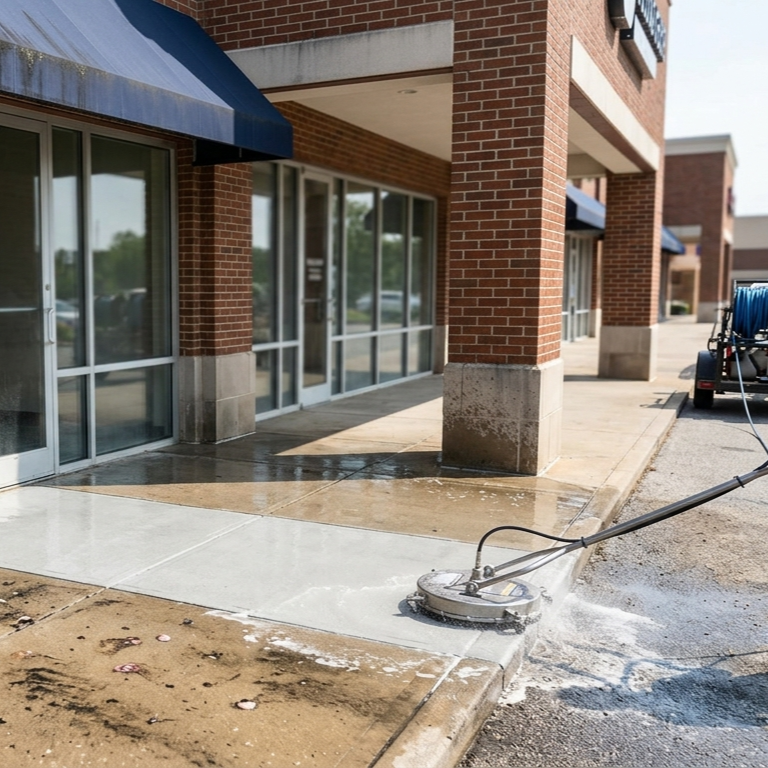
You walk up to your front door at six in the morning, keys in hand. The sidewalk under the awning has gum stains from last weekend's foot traffic. The lower three feet of the glass has fingerprints from kids and a coffee splash someone never wiped. The awning has black streaks along the top edge. And the lights under the canopy show greasy halos around each bulb.
By nine, your first customer walks in. The first thing they notice is what you just walked past.
A clean storefront isn't a vanity line on the budget. It's the first ten seconds of every customer's experience. And yet pricing for commercial storefront cleaning is one of the murkiest line items in the property-services world — quotes from $89 to $850 for what looks on the surface like the same job.
Here's how that math actually breaks down.
What a fair storefront cleaning visit covers
A "storefront cleaning" job isn't one service. It's a bundle of small jobs that together restore the curb-facing twenty or thirty feet of a retail property. A complete visit usually includes the concrete sidewalk, surface-cleaned and rinsed back to its original color, with spot treatment on gum, oil drips, and organic staining. The awning or canopy washed down with the right chemistry for its material — fabric, vinyl, or metal each need different treatment. The exterior glass cleaned to a streak-free finish. The lower wall or column bases, where shoe scuffs, splash mud, and rust streaks from anchor bolts collect. The entry threshold and any signage that's part of the storefront elevation.
A visit that skips three of those elements is a sidewalk pass, not a storefront cleaning. The price reflects the difference.
Worth knowing what isn't in a standard exterior visit. Interior window cleaning is almost always quoted separately — different crew, squeegee work, access coordination with whoever is inside. Screen removal, cleaning, and reinstall is also typically extra, usually $5 to $12 per screen. If your storefront has half a dozen mullioned windows with screens, ask for screens on the line-item sheet up front instead of finding out after the bid is signed.
Per-visit pricing usually lands between $150 and $600 in Southern Maryland
A typical 25-to-40-foot retail storefront on a standard commercial strip — coffee shop, salon, boutique, small restaurant — costs $175 to $325 per visit on a recurring schedule. A larger storefront, an anchor tenant slot at 50 to 80 feet, or a corner unit with two exposures runs $300 to $550. A standalone one-time job — no contract — typically runs 25 to 40 percent more because the crew is paying for the mobilization once instead of amortizing it across the year.
Here's how the math sorts out by storefront type:
| Storefront type | Frontage | Per-visit, recurring | One-time job |
|---|---|---|---|
| Small retail (boutique, salon, gift shop) | 20–30 ft | $150–$250 | $225–$375 |
| Mid-size retail or café | 30–45 ft | $200–$325 | $300–$475 |
| Restaurant or fast-casual | 35–50 ft | $275–$475 | $400–$700 |
| Anchor tenant, large showroom | 50–80 ft | $375–$600 | $550–$900 |
| Bank, drive-up, or two-exposure corner | varies | $400–$650 | $600–$1,000 |
| Multi-tenant strip (per door, in a bundle) | varies | $125–$200 | n/a |
These are real Southern Maryland numbers in 2026 dollars. The spread within each row reflects awning material, glass count, sidewalk condition, and how far back from the curb the actual storefront sits.
Storefront type changes the price more than square footage
A 40-foot coffee shop and a 40-foot fast-casual restaurant on the same strip can quote 50 percent apart. Same frontage. The work isn't.
A coffee shop produces foot traffic — gum, spilled drinks, fingerprints on glass, a fabric awning that rarely gets greasy. A fast-casual restaurant produces grease — cooking-oil drift from the rooftop kitchen exhaust, condensed onto the awning and dripping down to the concrete, plus greasy film on the glass from inside-out humidity and splash mud on the lower wall from cleaning the rubber mats. The dumpster pad around back, usually scoped into the storefront contract, has its own grease halo problem.
Different chemistry, different dwell, different rinse. Different price.
What drives a fair storefront quote up or down
| Cost driver | Adds (or subtracts) | Why |
|---|---|---|
| Sidewalk concrete condition | $25–$125 | Heavy gum or oil staining needs spot pre-treatment |
| Awning material | $30–$150 | Fabric needs gentle chemistry; metal handles a full pressure pass |
| Glass square footage | $20–$100 | Beyond the first 60 sq ft, glass is its own line item |
| Two exposures (corner unit) | $75–$200 | Twice the perimeter; the crew has to set up twice |
| Drive-through or pickup lane | $50–$175 | Tire marks and grease on a separate concrete surface |
| Outdoor seating or patio | $40–$150 | Furniture moved, deck or patio surface cleaned |
| Lighting fixture cleaning | $25–$75 | Canopy lights and signage halos add a careful ladder pass |
| After-hours scheduling | $50–$150 | Crew premium for evening or overnight work |
| First visit on a heavily soiled property | $75–$200 | Initial "deep wash" before the maintenance baseline kicks in |
| Multi-tenant bundling discount | -$25 to -$75 per door | Setup cost amortizes across more units |
The recurring discount is the line item most property managers miss. A monthly contract pays for a 45-minute visit. A one-time call covers that same 45-minute visit plus the full mobilization cost — truck, crew, water, chemistry, drive time — for a single job. That difference is where the 25-to-40-percent recurring savings lives.
Monthly, quarterly, or one-time: how frequency changes the unit price
A small retail storefront cleaned once a year costs $325 to $475 per visit. The same storefront cleaned monthly costs $150 to $225 per visit and stays visibly cleaner all year. Annualized, the monthly contract is more total dollars — but per square foot of clean storefront, per customer who walks past it, it's the cheapest option a retailer has.
Frequency math for a typical 35-foot retail front:
| Frequency | Per-visit price | Annual total | When it makes sense |
|---|---|---|---|
| Monthly | $175–$225 | $2,100–$2,700 | Restaurants, high-traffic retail, food-service tenants |
| Bi-monthly (every 8 weeks) | $200–$250 | $1,300–$1,625 | Most retail in a busy plaza or mall |
| Quarterly | $225–$300 | $900–$1,200 | Boutiques, professional services, low-traffic retail |
| Semi-annual | $275–$375 | $550–$750 | Lower foot traffic, mostly office or service business |
| One-time only | $325–$525 | $325–$525 | Pre-opening, post-construction, post-event recovery |
Monthly looks expensive on the annual line until you see what each visit actually fixes. A monthly crew arrives at a lightly soiled storefront and is out in 35 minutes. A quarterly crew arrives with twelve weeks of grime baked on, and the same job takes 75 minutes. Annual cleaning almost always means the crew is doing a small restoration, not a maintenance pass — the unit price climbs, and the result is still visibly worse a month later than monthly is on its worst day.
Where cheap storefront quotes cut corners
A $89 quote on a 30-foot storefront isn't a discount. It's three or four scope items short of a real cleaning. Here's where the gap usually lives.
The awning. The cheap quote rinses the awning with water and a brush extension, no chemistry. Black streaks along the top edge stay. Six weeks later they're worse.
The glass and the gum. A cheap crew rinses the glass with a hose and walks. The streaks take three days of dust to show — long enough for the invoice to be paid. Hardened gum needs a freeze stick or degreaser pre-treatment and a hot-water pass; the cheap crew skips both and drags a flat-surface tool over the spot, leaving a ring.
The lower wall. Splash mud, foot kicks, and rust streaks at the base of the wall sit closest to a customer's eye line at the door. The cheap quote skips everything below the awning line.
The water reclamation. In a parking lot, in a strip mall, on a sidewalk that drains to a storm system — wash water carrying degreaser is regulated. A crew without reclamation equipment is either dumping into the storm drain or asking the property manager to take the liability. The honest crew has a vacuum recovery system. The cheap crew doesn't, and the property manager finds out the first time the property gets a stormwater notice.
The pedestrian safety setup. A storefront cleaning during business hours puts pressurized hoses across the sidewalk customers walk on. A real crew runs hose protection covers, places a spotter at the work zone, and reroutes foot traffic around the wet area while the chemistry dwells. A cheap crew drags a yellow hose across the entry, walks back to the truck, and hopes nobody trips. The first slip-and-fall on that sidewalk costs more than ten years of legitimate wash visits.
How to read a storefront cleaning quote
A fair storefront quote has scope, not just a number. Look for line items — sidewalk square footage, awning material, glass count, lighting elements, lower wall. Look for the cleaning frequency on the same document. A quote that lists "$175 monthly" without describing each visit is a placeholder, not a contract.
Two specifics worth asking about. First, what's the dwell time on the chemistry — and is it the same on every surface? It shouldn't be. A real soft wash mix on brick or stucco needs four to six minutes of contact to break down algae in the pores; glass takes two or three minutes before the squeegee pass; painted metal sits around three or four. A crew that sprays everything once and rinses in under three minutes is doing a single rinse, not a surface-by-surface clean. Second, what's the protocol for the glass? A squeegee finish on storefront windows isn't optional — the wash chemistry needs to come off as a single sheet, not be left to spot-dry.
The third item is the certificate of insurance. Any storefront wash on a commercial property should come with a current COI naming the owner as additional insured. If the crew can't produce one the day they bid, they don't have it. Don't sign.
What recurring storefront cleaning actually buys you
A storefront on a real maintenance schedule looks the same in October as it did the day the lease was signed. The crew shows up before the property opens, runs the visit in 30 to 50 minutes, and leaves. The customer walking in at 9 AM never sees the work, only the result.
The hidden value is what doesn't happen. The awning doesn't have to be replaced at year three because algae ate the seams. The concrete doesn't develop a permanent grease halo. The glass doesn't trap the hard-water film that eventually requires a CR-2 acid restoration. The signage stays legible from the parking lot.
For tenants whose lease names exterior maintenance as the tenant's responsibility — most retail leases — a recurring storefront cleaning contract is usually the cheapest way to satisfy the obligation.
Frequently Asked Questions
The quote that holds is the one that names the scope and the schedule
A storefront cleaning quote isn't a single number. It's a scope, a frequency, and a written description of what each visit does. The cheap $89 number hides everything that isn't being cleaned. The fair $300 number tells you what gets washed, with what chemistry, on what schedule, by a crew that's paid to come back the same day next month.
The math that matters isn't the per-visit dollar. It's the cost of each visit divided by the customer impressions you're protecting between visits. A monthly cleaning on a busy retail front protects 25,000 impressions for $200. A one-time annual job protects three weeks of impressions for $475 and leaves the next forty-nine to drift.
A storefront that looks finished every morning is a storefront that's earning its rent.
Superior Power Washing handles commercial storefront cleaning across Waldorf, MD, and all of Charles County and Southern Maryland — including Upper Marlboro, Accokeek, Clinton, Fort Washington, and Prince Frederick. Owner-operated, fully insured, certificates of insurance available on request for property owners and landlords. Monthly, quarterly, and one-time contracts available. Call (240) 901-4252 for a free on-site assessment.
