
What Causes the Yellow Halo Around Pool Deck Drains
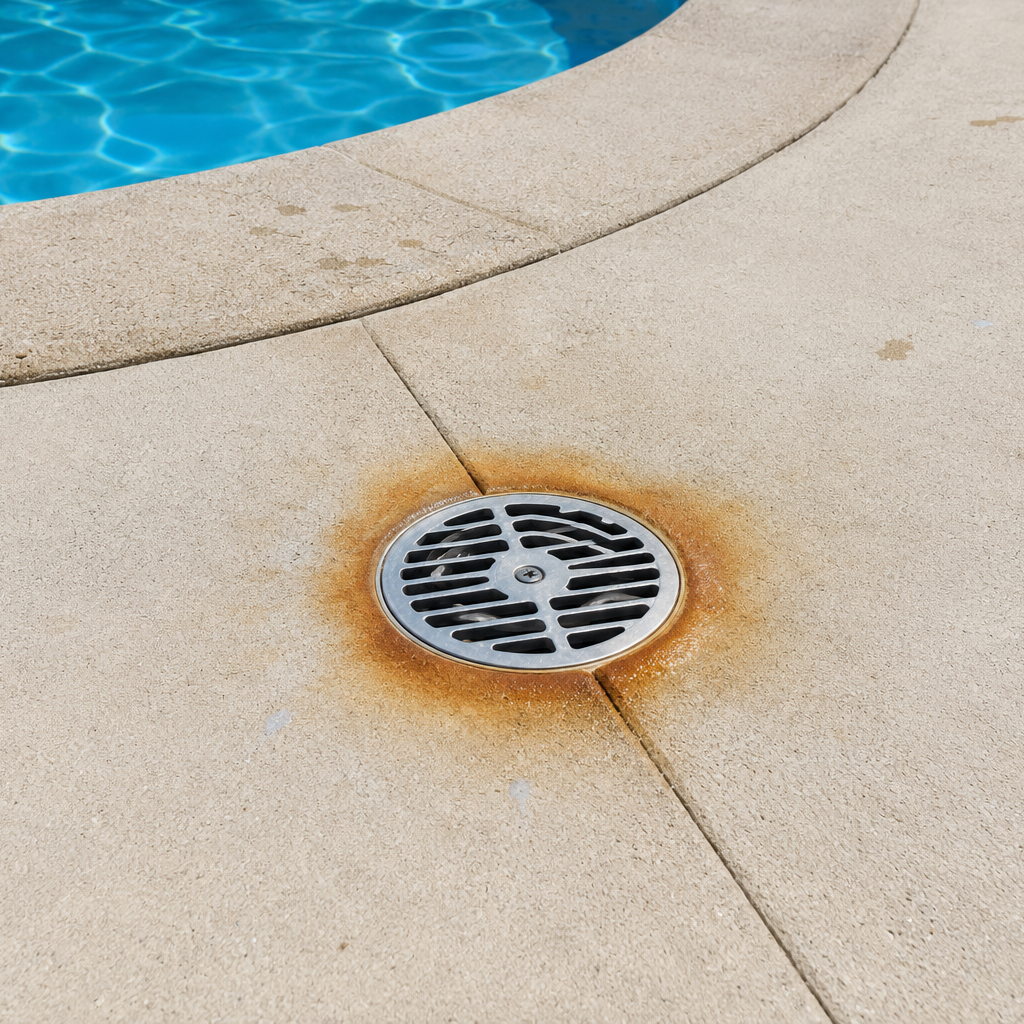
You pulled the cover off for the season, walked the perimeter with the skimmer net, and stopped at the main deck drain. There's a brown-yellow ring around it. Maybe two inches wide, maybe four. The grate itself looks fine. The concrete a foot away looks fine. But that ring sits there like someone spilled a cup of tea and let it dry.
It's not dirt. It's not a cleaning problem you fixed last spring and forgot.
It's rust. Slow-deposited iron, sitting in the pores of the concrete.
That ring is rust. But it didn't come from the drain itself.
The first instinct is to blame the drain grate. Most pool deck drains are stainless steel or chrome-plated, and they look clean enough up close — no flaking, no obvious corrosion at the surface. So the source of the iron is somewhere else.
Most of the time, the iron came in through the water.
Pool water carries dissolved minerals from whatever fills the pool — municipal water, well water, hose water from a spigot tied to old galvanized plumbing. Trace iron rides in solution where you can't see it. When pool splash-out lands on the deck and pools around the drain, that water sits longer than it does anywhere else on the deck. The drain channel is a low spot. The water evaporates there last.
As the puddle dries, the dissolved iron has nowhere to go but down — into the porous concrete or paver surface around the drain — and onto the surface itself as a precipitate. After a season of that pattern, the iron crystallizes as iron oxide in the pores. That's the halo you see. Rust deposited by the cup at a time, dried in place, locked into the concrete the same way a coffee stain locks into a paper napkin.
The drain grate itself is usually fine. It's the water that found the drain that left the stain.
How iron ends up around a pool drain in the first place
Iron in pool water comes from four common sources, and most decks see at least two of them at once:
The fill water itself. Well water in southern Maryland often runs 0.3 to 2.0 parts per million iron. Anything over 0.3 ppm and you'll see staining within a season. City water is lower but not zero — most municipal supplies show trace iron, and aging cast-iron mains can spike it after a water main repair down the street.
The pool equipment. Old heaters, copper-iron alloy fittings, steel-bodied pumps, even a corroding pool light niche can shed iron into the water as it cycles through filtration. The iron rides the return jets back into the pool, then into the splash zone around the deck.
Garden hose top-offs. The brass spigot on the side of the house is fine. The galvanized pipe behind the wall feeding it isn't, in a lot of older homes. Top-off water from that line carries iron sediment that goes straight to the pool.
Algaecides and stain-and-scale products. The cheaper chelating agents in some pool chemicals release iron back into solution as they break down. The pool stays clear. The deck around the drain doesn't.
A fifth source worth checking on the deck itself: metal hardware sitting in contact with the surface. Pool ladders, lounge chair legs, metal umbrella bases, anchor points for safety lines. Anywhere a steel or iron component sits on wet concrete for long stretches, you can get a localized rust transfer that mimics a halo. The tell is usually the shape — square outlines from chair legs, narrow streaks from a ladder anchor — not the round ring around a drain.
Symptom, cause, and urgency in one glance
| What you see | What's actually there | How urgent |
|---|---|---|
| Light yellow-orange ring, fades slightly with brushing | Fresh surface iron deposit, less than a season old | Low — treatable with rust remover |
| Brown-yellow halo, doesn't lift with scrubbing | Iron locked in the top millimeter of concrete pores | Medium — needs oxalic acid dwell |
| Dark red-brown ring with crusty edge | Heavy iron, multiple seasons, possible underlying scale | High — may take two treatments |
| Rust streak running outward from the drain | Iron source still active, deck still being fed | High — fix source before treating stain |
| Greenish-blue ring instead of yellow | Copper, not iron — usually from algaecide | Medium — different chemistry, treatable |
| Halo plus loose tile or popped grout near drain | Drain fitting itself is rusting from underneath | High — structural, get under the grate |
The two patterns that need fast action are the active streak and the loose tile. Both mean the source is still feeding the stain, or the deck around the drain is taking on water. Cosmetic treatment of either one is wasted work until the source gets shut off.
Why the halo shape — not the puddle shape
Look at any pool deck drain that's been splashed for a few seasons. The stain isn't a solid disc filling the entire splash zone. It's a ring — a thin halo at the outer edge of where the puddle used to sit, with the inside of the ring lighter than the outside.
That's not a coincidence. It's the same physics that makes a dried coffee spill leave a dark ring around its edge instead of a uniform brown disc.
When a puddle of water with dissolved solids in it starts to evaporate, the edges dry first because the water is thinnest there. As the edge dries, capillary action pulls more water from the middle of the puddle outward, carrying dissolved minerals with it. By the time the puddle's gone, almost all the dissolved iron has been transported to the outer edge and deposited as a concentrated ring. The middle of the puddle dried last, with the cleanest water — so it leaves the lightest stain.
That's why scrubbing the middle of the halo with a brush doesn't fix the problem. The middle isn't where the iron is. The iron's at the edge. And it's not sitting on top of the concrete waiting to be wiped off — it's wicked down into the pores at the exact spot where the evaporation gradient pulled it.
What pressure washing and bleach do to a yellow halo
Two things people try first that don't work. One that actively makes it worse.
A pressure wash hits the surface but doesn't reach the iron. The stain isn't sitting on top of the concrete — it's locked into the pores by the same capillary process that put it there. A few thousand PSI of water passing over the surface doesn't have anywhere to grab the precipitate. The deck looks brighter for a day from the surface clean, and the halo is still there once it dries.
Bleach is worse. Sodium hypochlorite — the active ingredient in pool chlorine and household bleach — is an oxidizer. Iron stains are already oxidized iron. Adding more oxidizer doesn't dissolve them. It pushes the iron deeper into the oxidation state that bonds hardest to concrete. People dump pool chlorine on a yellow halo, watch the surface bubble, and walk away thinking the chemistry's working. They come back the next morning to a stain that's now darker and bonded harder than it was before. That's not a cleaning failure. That's a chemistry mistake.
What dissolves iron stains is acid. Specifically, oxalic acid — the same acid in rhubarb leaves and the active ingredient in most over-the-counter wood bleaches and concrete rust removers. Oxalic acid chelates iron, meaning it bonds to iron atoms and pulls them out of the surface as soluble iron oxalate, which then rinses away. Phosphoric acid does the same job for heavier stains. Hydrochloric (muriatic) acid will work on some stains but eats the concrete itself, so a pro avoids it on decorative finishes.
The treatment works in reverse order of how the stain formed. Apply the acid. Let it dwell — usually fifteen to thirty minutes, depending on stain age. Agitate gently with a soft brush. Rinse. The acid pulls the iron out of the pores the same way the puddle pulled it in.
How a pro actually removes a yellow halo
Here is what pool deck cleaning looks like in practice for a halo job, on a typical Charles County deck.
First, the source check. Before any acid touches the deck, the crew runs down the iron sources. Was the pool filled recently with well water? Is there a galvanized pipe feeding the hose bib? Has the heater been replaced in the last five years? If iron is still in the water, the halo will come back within a season regardless of how well it's cleaned.
Second, the surface prep. The deck around the drain gets a low-pressure rinse to clear any loose grit and biofilm. Anything sitting on top of the stain has to come off so the acid can reach the iron directly. Soft brushing, not pressure.
Third, the application. Oxalic acid solution gets brushed onto the halo at a concentration matched to the stain age. Light surface staining might take 4–6% oxalic. Multi-season halos take 8–10% with a second application after the first dries. The acid sits and works — typically fifteen minutes for a fresh stain, up to thirty for older ones. The fizzing isn't dramatic, the way muriatic acid bubbles. Oxalic works quietly.
Fourth, the rinse and neutralization. The dissolved iron oxalate gets rinsed off the deck with controlled-volume water, not blasted. Any residual acid gets neutralized with a baking soda or soda ash wash so it doesn't continue eating into the deck after the crew leaves. The plant beds around the deck stay wet through the whole job to keep runoff from concentrating on them.
A fresh halo lifts in one pass. A two-season halo sometimes needs a second pass a week later — the first pass pulls out the surface iron, the second reaches what was deeper in the pores. Some halos that have been there since the deck was poured turn out to be permanent, locked too deeply into a porous decorative finish to fully remove. Those get blended down to where the discoloration is even across the surface and resealed.
One other failure mode worth ruling out before treatment: rebar bleed. On older pool decks where the steel reinforcement is sitting too close to the surface, moisture reaches the rebar, and the rust travels up through hairline cracks to bloom at the surface. That's not a water-chemistry stain — it's a structural one — and no amount of acid treatment will fix it because the rust source is inside the slab. A pro can usually tell the difference within the first few minutes on site by where the stain originates and whether it tracks a crack line. If rebar bleed is the cause, the deck needs a different repair, not a wash.
For prevention after the halo is gone: a penetrating concrete sealer cuts the rate the deck absorbs water in the first place. Iron-rich water sitting on a sealed surface evaporates without wicking into the pores. A good sealer doesn't make the deck look glossy or change its color — it just makes the surface less porous. Reapplied every two to three years, it can stretch a clean halo-free deck almost indefinitely between treatments.
Frequently Asked Questions
The halo isn't a cleaning problem — it's a water problem with a cleaning fix.
A yellow halo around a pool deck drain is the last step of a process that started months earlier in the pool water, the fill line, or the heater. The stain itself is treatable. The cause has to be found and shut off before the treatment holds.
A pressure wash doesn't reach it. Bleach makes it worse. The acid that removes it has to dwell, agitate gently, and rinse in a controlled way the deck slope and the landscaping can handle.
Do all that, and the halo lifts in one or two passes. Skip the source check, and the same ring is back by the next pool opening.
The fix isn't in the drain. It's in the water that finds it.
Superior Power Washing handles pool deck rust removal and oxalic acid treatment across Waldorf, MD, and all of Charles County and Southern Maryland — including Clinton, Fort Washington, Upper Marlboro, Bryans Road, and Accokeek. Owner-operated, fully insured, source-checked work that holds for years. Call (240) 901-4252 for a free on-site assessment.
