
A garden hose gets a house wet. Getting a house clean is a different job, and what separates the two is what's mixed into the water and how carefully everything around the house gets handled first. A professional house wash starts with a cleaning solution chosen for the surface in front of it, gives that solution time to work before any rinsing begins, and keeps the rinse itself gentle enough to carry the loosened growth and grime away without forcing it into a seam or a lap. Part of the job happens around the house rather than on it: beds, fixtures, and openings get protected before the first surface is treated. This covers the house exterior itself, siding, trim, soffits, fascia, gutter faces, windows, and entry areas; a roof, a deck, and concrete surfaces like a driveway or a patio are cleaned with the same care but are their own separate services, each suited to its own solution and rinse. Each surface and item on the exterior has its own treatment, and each goes wrong in its own way when that step is skipped:
| Surface or Item | How It's Treated | What Goes Wrong If Skipped |
|---|---|---|
| Vinyl siding | A cleaning solution matched to the panel, given time to work, then a low-pressure rinse | Growth left in the laps and the panel texture stays on the wall after the rinse |
| Painted wood trim and siding | A gentler solution and a careful, low-pressure rinse | The paint film lifts or peels, leaving bare wood exposed |
| Brick | A solution suited to masonry, dwell time, then a rinse | An absorbed stain stays in the brick face after a plain rinse |
| Stucco | Solution worked into the texture, dwell time, then a low-pressure rinse | Concentrated pressure chips thin spots in the textured finish |
| Soffits and fascia | The same solution pass as the wall below, rinsed at an angle that clears the corners | Growth left in the corners reseeds the siding underneath |
| Gutter faces | A solution for the film on the face, dwell time, then a rinse | Dark stripes stay on the gutter after the wall below is clean |
| Windows and screens | Rinsed clean; no direct wand on the mesh or the sash seal | A stretched screen tears, or water is forced past the seal |
| Plants and beds | Pre-wet before the wash starts, rinsed again after | Runoff concentrates in the soil, and the foliage takes damage |
| Exterior outlets | Avoided or covered, never sprayed directly | Water intrusion in a live receptacle |
| Light fixtures and vents | Avoided or covered, never sprayed directly | Water driven into the housing or the duct behind it |
Protecting Plants, Fixtures, and Openings First
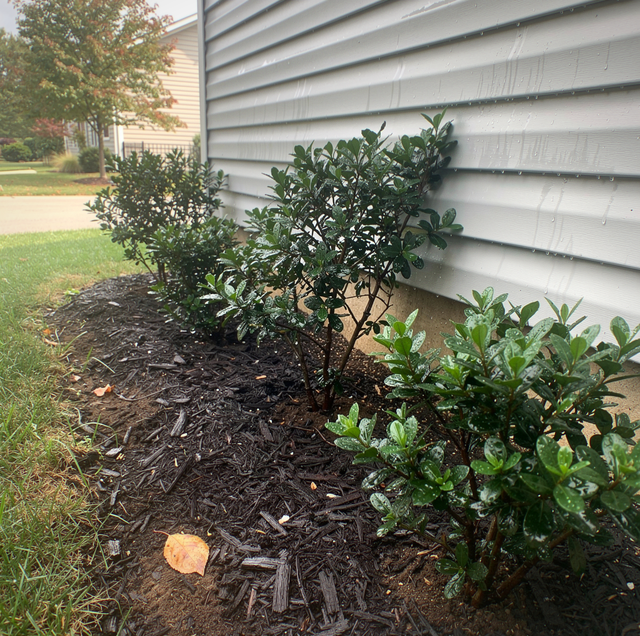
Before any solution goes on a wall, the ground and the openings around it get handled first. Beds and foliage near the house are soaked with plain water in advance, because a plant already carrying water takes up less of the solution that drifts onto it. The same beds get a second rinse once the wall is done, clearing whatever drifted down during the wash rather than letting it sit in the soil. Exterior outlets, meters, and light fixtures are handled differently: rather than wetting them first, they're left alone entirely or covered when they sit close enough to the spray pattern to catch overspray by accident. A direct hit can push water into a housing or box with no way to drain it. Windows and vents get closed ahead of time too, since an open window or a vent hood gives water a straight path indoors that a closed one doesn't.
Water driven into an exterior outlet, a meter base, or a light fixture can reach live parts and shock anyone who touches the wet fixture or outlet afterward, so the soft-wash crew keeps the wand off those points entirely.
Matching the Solution and Dwell to the Surface
Every exterior surface gets a solution chosen based on what it's made of and what's growing on it. A painted panel that's already thin from years of sun gets a lighter solution and a shorter dwell than a stretch of vinyl carrying a heavy patch of algae, because the goal on each is the same: let the solution sit long enough to kill what's growing there and loosen what's bonded to the surface, without leaving it on so long it starts working on the material underneath instead. The low-pressure rinse after that dwell is what separates a soft wash from a pressure wash on siding, trim, and painted surfaces, and concrete flatwork is cleaned as its own service. Brick and stucco get a solution built for masonry rather than for painted or vinyl surfaces, since what lifts algae off a panel isn't what a porous masonry face needs to release a stain it has absorbed rather than one sitting on top of it. Reading the surface first, then matching solution and dwell to it, keeps the wash from under-treating a bad patch of growth in one spot and over-treating a panel that only needed light attention in another.
The Rinse, and Why Pressure Stays Low on Siding and Trim
The rinse that follows dwell time carries the loosened growth and residue off the wall before any of it has a chance to dry back in place, since the solution has already done the cleaning. That's why the rinse itself stays close to the pressure of a garden hose on siding, trim, and anything painted: enough to move water down the face and off, not enough to drive it sideways into a lap or a seam. A concentrated stream does the opposite on a painted surface or a run of vinyl siding: it can strip the finish or drive water into a seam instead of carrying grime away, which is exactly why some surfaces should never see one at all. The rinse starts at the top of each section and works down, so runoff from above never lands on a stretch already cleared, and it finishes low on the wall rather than climbing back up into a lap the water has already run clear of.
Detail Areas a Quick Wash Misses
A wash that only covers the flat run of wall leaves untouched the spots where growth sits in shade and still air. Soffit corners, where two planes meet under the roofline, trap enough shade and still air that a general pass over the eave ceiling can leave the corner itself still carrying a dark patch. The same goes for the strip of siding directly behind a downspout, which catches splash and drips from the downspout and collects whatever it sheds on the way down. Window frames get missed for a different reason: a wash aimed at the glass and the siding around it can skip the narrow return where the frame meets the wall, and that seam collects grime that a pass over the glass does not reach. Working these areas on purpose, rather than assuming a pass over the main wall reached them too, is what keeps a house from looking clean from the yard while still showing patches up close.
A soffit corner still dark after a wash calls for a second, focused pass rather than more pressure. Going over it again with the same solution and dwell time reaches the growth where turning up the force would only mark the paint.
Preparing the Yard and Entry Points Before the Crew Arrives
A homeowner's part in a house wash happens before the crew turns on the water. Outdoor furniture, cushions, grills, and anything else sitting close to the walls move away from the spray pattern, and a car parked in the driveway near the house moves too, since runoff carrying siding grime can leave the same residue on a hood or windshield that it lifts off the wall. Pets do better indoors during the wash, both because the noise and movement near the walls can spook them and because a wet solution on a paw or a nose is best avoided, even after it's been rinsed thoroughly. Windows get shut ahead of time rather than left cracked, and any door on the side being washed stays closed until that section is finished, so water and runoff have nowhere to reach but the wall and the ground below it. Gutters, upper-story glass, and anything above head height are left alone rather than reached from a ladder ahead of the crew, and nobody goes onto the roof to help; people stay clear of the spray and keep the wet solution off skin and eyes, and pets stay clear of it too.
Judging the Result Once the Water's Off
A finished wash reads the same from across the yard as it does standing at the wall. Siding and trim come out streak-free, without the blotches that uneven pressure leaves, and gutter faces and soffit corners match the rest of the exterior instead of standing out as the one spot the wash didn't reach. The beds underneath tell the other half of the story: soil that got pre-wet and rinsed again afterward shows no scorched or spotted foliage, and mulch hasn't been pushed around by a stream aimed too directly at the ground. A wash that leaves streaking on the siding, a corner still dark with growth, or stressed plants along the foundation didn't happen by accident. Those can be signs that a surface, a dwell time, or a piece of the protection around the yard didn't match what that section of the house needed.
Frequently Asked Questions
It does not need to be known ahead of time. Siding that looks alike from the yard reads differently up close: vinyl flexes when pressed, aluminum sounds hollow when tapped and can dent, fiber cement stays rigid, and painted wood shows grain or brush marks under the paint. That reading at the wall sets the solution family.
Runoff from the wall above lands on the porch floor and the entry steps, and a surface wet with rinsed solution stays slick until it dries. Mats lifted out of that path stay dry, and the entry is safe to walk once the surface has dried.
Screens can stay in their tracks during a soft wash, because the low-pressure rinse runs down past the mesh without the wand aimed into it. A screen already loose, bent, or torn in its frame is worth pointing out before the wash starts, since water can push a loose one out of its track.
Yes. Water from a low-pressure rinse can run behind a loose panel or through an open seam and wet the sheathing behind it, so a known gap is mentioned to the crew before the wash starts. The repair itself is siding work, separate from the cleaning.
From the ground. A soft-wash system sends the solution and the rinse up the wall through a long-reach nozzle or an extension pole, so a two-story face can be treated without a ladder set against the siding.
Not on the side being washed. Children and pets stay indoors or away from that side until the treated walls and the beds below them have been rinsed and have dried, and a shaded wall can take longer to dry than a sunny one.
Reserve a soft-wash house washing — siding, trim, soffit and gutter-face cleaning, with mold, algae and stain removal where growth is present. Superior Power Washing serves Waldorf, La Plata, and Clinton. Call (240) 901-4252.