
What to Do When a Storm Leaves Mud and Debris Across Your Property
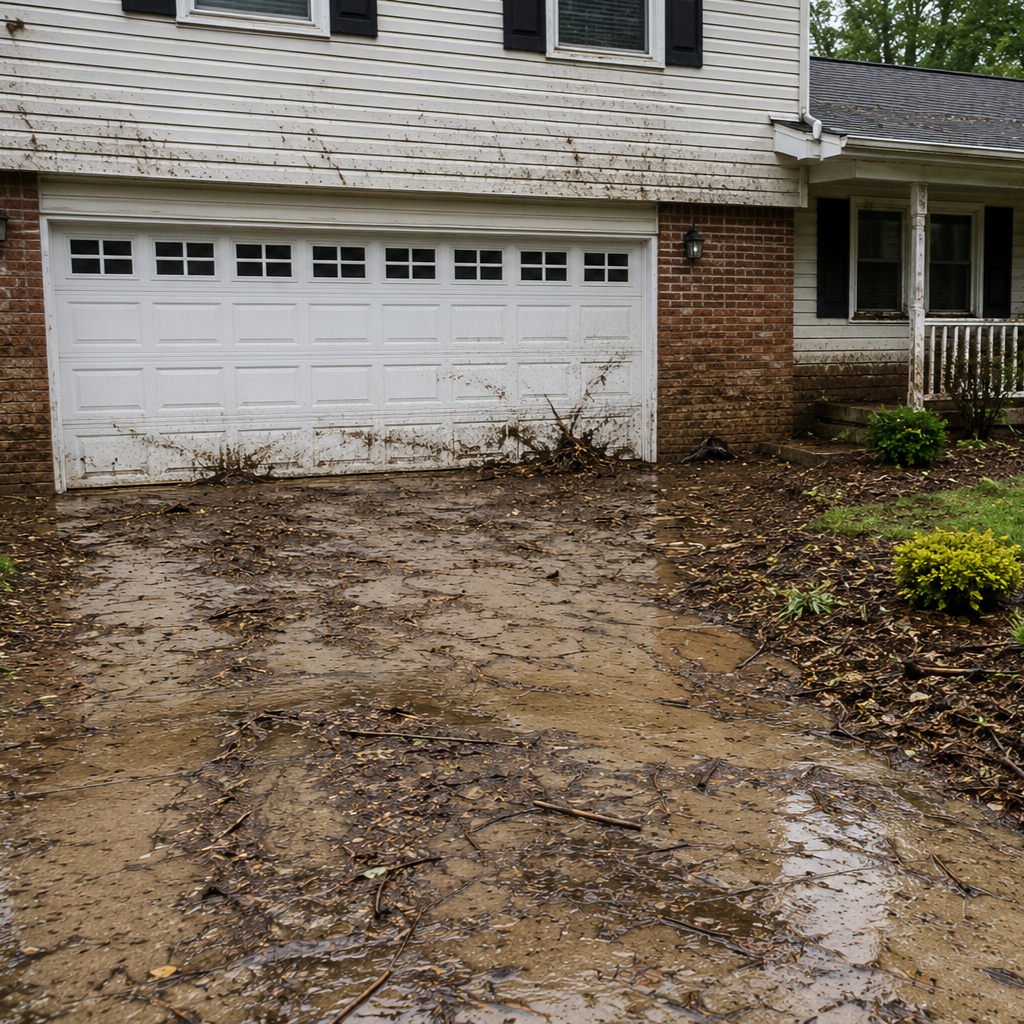
It's the morning after. The wind dropped sometime around 3 a.m., and you finally fell asleep. Now you're standing on the front step in yesterday's shoes, coffee in hand, looking at a lawn that doesn't look like your lawn. There's a brown tide line across the driveway where runoff carried mud from the side yard. A branch the size of your leg is wedged into the gutter. Mulch from the front beds is plastered against the lower siding. Leaves are stuck flat to the patio like wet stamps. The porch ceiling has dirty splatter halfway up the soffit.
You don't know where to start. Most people don't.
Here's the order it actually has to happen in — and why the first 48 hours matter more than anything you do later.
First, walk the perimeter before you touch anything
Phone in hand. Camera open. Walk the whole property — front, sides, back, around the AC unit, around the deck, under the porch. Take photos of everything: the mud line on the siding, the debris piled against the foundation, the gutter sagging from the branch, the deck boards covered in leaves and silt, the AC compressor with twigs jammed into the fins. Don't sort or move anything yet. Don't even pick up the small stuff.
The photos are for two reasons. First, your homeowners' insurance carrier will ask for proof of storm-related damage, and a cleaned-up yard is a yard with no claim. Second, you need to know what's actually there before you start moving things, because the order you clean things matters, and you can't plan the order if you're already three branches into the wrong job.
Watch the ground while you walk. Downed power lines look like loose rope. Standing water near outlets or the meter base is a different problem from standing water on the lawn. If you see either, you don't walk closer — you call the utility from the front step, and you wait.
Gloves on if you start touching debris. If any of the runoff came from a flooded street, a backed-up storm drain, or a creek that jumped its bank, the mud on your siding isn't just mud — it carries whatever was in the water. Bacteria, fuel sheen, sewage backflow, and pesticides washed off the road. None of that is paranoia. It's basic post-storm hygiene. Boots and gloves at minimum, long sleeves if the water was visibly contaminated, and wash your hands before you eat or touch your face.
Mud is a clock — every hour matters before it sets into porous surfaces
The thing most people don't realize about storm mud is that it doesn't stay mud for long. Fresh storm mud is mostly water with suspended fines — clay, silt, organic matter, particles of whatever was in the runoff path. While it's wet, it rinses off concrete and siding with simple water pressure. Once it dries and sets, the fines wedge into the pores of the concrete and the texture of the vinyl, and the bond gets exponentially harder to break.
Concrete is the worst offender. Concrete acts like a sponge: hold a stain a few days and it soaks in. A driveway with mud sitting on it for one rainy afternoon usually washes clean. The same driveway four dry days later has a brown shadow that no garden hose will take off. By day ten the discoloration is permanent without chemistry.
Vinyl siding is faster than concrete but slower than glass. Mud on vinyl wipes off easily within 24 hours, sticks within 48, and bonds to the textured surface within a week. Once mud bonds to vinyl, plain water won't lift it — you need a surfactant and contact time.
Mulch and grass clippings that get plastered against painted wood or composite trim are a different problem entirely. Their tannins leach out as they sit wet against the surface and leave a yellow-brown stain behind even after you remove the debris. The mulch comes off easily. The stain it left behind doesn't.
Mold is the other clock. Mold and mildew spores activate within 24 to 48 hours of a surface staying wet, and shaded siding pressed under wet mulch or leaves is the textbook environment. You won't see it that fast — the visible growth shows up a few weeks later. By then the spores are anchored and the cleanup is no longer just rinsing dirt off a wall. Standing water in the same window starts breeding mosquitoes inside roughly a week. Both clocks are running the moment the rain stops.
The cleanup sequence — top down, large to small, dry before wet
The order matters because everything that comes off a higher surface lands on a lower one. If you wash the siding before clearing the gutters, you push gutter debris onto a clean wall. If you clear the gutters before walking the roof for debris, the next rain washes new shingle grit and twigs back into the trough you just emptied.
The correct sequence is roof and gutters first — but only if it's safe and only if you have the equipment to do it without being on a wet roof. Then siding. Then the deck, porch, and any covered hardscape. Then the driveway, sidewalks, and open hardscape last. Lawn debris and downed limbs run on their own track — clear what's blocking access, leave the rest until the hard surfaces are done.
| Cleanup task | Safe to DIY | Needs a pro | Why |
|---|---|---|---|
| Picking up branches under 4 ft on lawn | Yes | — | Light work, ground-level, no equipment |
| Bagging leaves and mulch off open lawn | Yes | — | Rake, blower, ground-level |
| Rinsing fresh mud off concrete within 48 hrs | Yes | — | Garden hose handles wet mud |
| Clearing gutters on a single-story home | Cautious yes | — | Stable ladder, dry conditions, spotter |
| Walking a wet or steep roof to clear debris | — | Yes | Fall risk; soft wash trucks reach safely from the ground |
| Set-in mud on textured concrete | — | Yes | Needs surfactant + correct pressure; hose alone won't lift it |
| Mud splatter on siding above one story | — | Yes | Ladder work plus chemistry; bleach-safe plants and pets |
| Downed limbs touching power lines | — | Utility crew | Never homeowner work — even after the storm |
| Standing water near the electrical service | — | Utility crew | Same |
| Storm-staged mold or mildew on shaded siding | — | Yes | Visible within 2–3 weeks of wet debris contact |
Why hosing it off looks easy but pushes the problem sideways
The garden hose is the obvious move. It works on fresh mud on smooth concrete. It does not work on textured concrete, vinyl siding above eye level, painted trim, brick, soffit, or anything the spray bounces back from. What the hose actually does on those surfaces is two things: it dilutes the mud and spreads it across a wider area, and it drives the fines deeper into the pores of the substrate where they can't be flushed back out.
The pressure washer at the hardware store is worse. A consumer pressure washer at the wrong distance and the wrong tip strips paint off trim, etches concrete, and can drive water up under vinyl siding into the wall cavity. Storm cleanup is the single most common time we get called for damage caused by a homeowner trying to handle the cleanup with a rented machine. The mud comes off. The siding comes off, too.
A real storm cleanup uses low-pressure soft washing on siding, trim, and roofs — water at garden-hose pressure mixed with a surfactant and a mild biocide that lifts the mud and kills the mold spores the wet debris left behind. Hardscape gets surface-cleaner pressure where it's safe and chemistry where it's not. The difference shows up the next time it rains: a real soft wash leaves a surface that stays clean for months, while a hose-rinsed wall streaks within the first storm.
There's a second clock running in the opposite direction. Surfaces that just took a soaking need time to dry before any pressure — soft wash or otherwise — touches them. Wet concrete chips under high pressure. Saturated wood splinters and gouges. Vinyl with moisture trapped behind it grows mold if you blast it clean and seal the water in. Most pros wait 24 to 48 hours after a heavy storm before any actual cleaning starts. The mud sets fast, but the surface underneath needs to breathe first.
Photographing damage for insurance before you wash anything away
Before you remove a single debris pile, take wide shots of the whole property from four sides. Then close-ups of any visible damage: the dented gutter, the cracked window, the section of siding that was hit by something flying. Note the date and time. If your phone strips metadata, write it on a notepad.
Homeowner's insurance policies usually require notification of storm damage within a defined window — sometimes 30 days, sometimes 60. Calling the carrier early starts the clock in your favor even if you don't yet know what the repair will cost. The adjuster will want to see what was there. Cleaned-up properties tell no story. Photographed ones do.
If you're hiring a contractor for the cleanup and any of the damage looks like it'll be claimable, ask the contractor to provide a written estimate that itemizes storm-related work separately from routine maintenance. Insurance carriers will pay for the storm portion. They won't pay for the algae you've been meaning to clean off the deck for two years.
A realistic timeline from storm-passing to back-to-normal
Saturday is what most people are hoping for. Real recovery takes longer.
The first 24 hours are walk-and-document and clearing access — moving branches off the driveway so cars can move, opening the path to the meter, picking up anything that's a tripping hazard. The next 48 hours are when fresh mud comes off easily and when the smart homeowner gets a contractor on the calendar before the neighborhood books up. After a real storm, every reputable pressure washer within twenty miles is booked solid for two to three weeks. The people who call first get the early slots.
Days three through ten are for the actual hardscape and siding cleaning, ideally by a pro who can handle the chemistry and the height. Days ten through thirty are when storm-related mold starts to bloom on shaded siding that stayed wet under debris, and when set-in stains become obvious. A second appointment six to eight weeks out catches both. Anything still showing at the sixty-day mark is permanent without aggressive intervention, and that's the appointment to schedule when you book the first one.
The homeowners who recover cleanest are the ones who make two phone calls in the first 48 hours — one to insurance, one to a storm cleanup contractor — and then let each track run on its own.
Frequently Asked Questions
Mud sets in days, not weeks — start clean while the window is open
The reason storm cleanup feels overwhelming is that everything looks like it has to happen at once, and most of it doesn't. The clock is on the fresh mud, the documentation, and the contractor's calendar. Everything else can wait a few days.
Take the photos before anything moves. Make the two phone calls inside 48 hours. Stay off the wet roof. Let the cleanup happen in the right sequence — top down, large to small, chemistry where the hose won't do it.
Storms don't pause for your schedule. The cleanup window does.
Superior Power Washing handles post-storm cleanup across Waldorf, MD, and Charles County and Southern Maryland — including La Plata, Clinton, Fort Washington, White Plains, and Brandywine. Owner-operated, fully insured, soft wash and surface-clean methods that won't drive mud into your siding or etch your concrete. Call (240) 901-4252 for a free on-site assessment.
