
Window Cleaning Is More Than Cosmetic — Dirt Scratches Glass
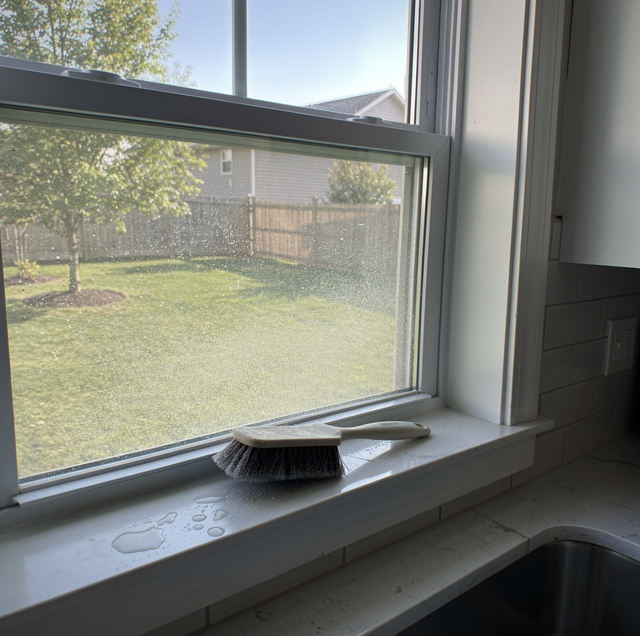
Press a fingertip into the joint where the bottom of the glass meets the frame, on any window you can reach from the ground. It comes away with a dense, gritty packing, still damp hours after the pane itself dried. It is the same material that lay thinly across the glass before the last rain carried it down and left it where the water stopped.
The mineral fraction of it is harder than the glass carrying it. Everything a window has at stake beyond its appearance follows from that. Sitting still, it does nothing: glass is chemically stable, and a grain on a vertical surface has no energy of its own. Damage, where there is any, arrives with whatever comes to take the grain off.
The Soil on a Pane Is Harder Than the Pane
Whatever lands on the outside of your windows arrives by air and stays because the air against the glass stops moving. Wind lifts fine mineral particles off bare soil and road surfaces, carrying them until the flow is interrupted. Pollen and fine carbon from combustion settle into the same film.
The mineral part of that mixture is the one with consequences. The Mohs scale ranks minerals by which one scratches which, and quartz, the mineral in ordinary sand and windborne grit, defines position 7 on it. A plate of ordinary window glass is the field reference for roughly 5.5.
So part of what settles on your windows is harder than the window itself, and it can sit there for months without leaving any marks.
The energy comes from the cleaning. A cloth or the edge of a squeegee presses against your pane and travels across it, and every particle beneath is either floating in liquid or trapped between two hard surfaces. Everything else about washing a window follows from that difference, which is why professional cleaning practice is built mostly around handling particles rather than soap.
What Comes Off the Glass, and What Only Moves?
The sequence a professional follows has a fixed order for a reason: flood the glass first with water and a mild non-abrasive solution, agitate next with a brush or strip washer, then squeegee it all off before it dries. Flooding comes first because the agitation cannot occur in dry conditions.
The mechanism is plain: sufficient water prevents abrasive particles from being trapped between the glass and the cleaning tools. Liquid holds the grain in suspension and lifts it clear, so the tool travels over water rather than sand, and the squeegee takes the suspension off in one pass.
Run the same tool over your dry pane, and none of that happens. A dry cloth has nowhere to lift a particle into, so it presses it against your glass and drags it. The pure-water method also used to reach windows above your head sends deionized water up a pole to a soft brush. That water carries 20 parts per million of total dissolved solids or less, because it is left to evaporate instead.
The Marks That Do Not Wash Off
A scratch in glass is permanent, and it does not announce itself the day it happens. Viewing conditions matter for spotting one: daylight is needed to evaluate a glass surface for damage, and a scratch invisible under a gray sky can be obvious when the sun is low. Marks surface weeks later, long after the visit that made them. That is also why steel stays off your pane: razor blades and metal scrapers are not part of routine cleaning.
Where a blade is used, it belongs to non-routine work such as lifting paint or mortar left by another trade, and the rules are narrow. One direction only, with a new blade, never back and forth, because a back-and-forth stroke traps a particle under the edge and carries it. Never on a coated surface. Behind those rules sits a long-running concern called fabricating debris: the idea that particles fuse to heat-treated glass in the tempering furnace and a blade dislodges them. Later testing found that fusing was close to impossible to reproduce. The handling rule did not change, because the safe method never put steel on your glass.
The Twice-a-Year Interval and What Shortens It
There is a standard interval for this. Glass should be cleaned as dirt and residue appear, with twice a year generally sufficient; some areas may need it more often due to environmental factors and pollutants. The premise underlying that interval is simple: glass can be permanently damaged if it is cleaned infrequently or improperly. Both halves of that are live, and a pane left alone too long ends up in the same place as a pane cleaned badly.
What shortens the interval at your house is exposure, and exposure works from the air downward. The wall the prevailing wind reaches takes airborne grit head on, while a sheltered wall gets what drifts around the corner. Below that, glass under a tree line collects leaf drip, which carries dissolved organics that dry into a film plain water will not release. Lower still, ground-floor glass takes splash off the slab beneath it in heavy rain. Your windows will not all be on the same schedule, so the practical approach is to clean one representative window, stop, and examine it in daylight before continuing.
Water That Stays in the Bottom of the Frame
An hour after the rain stops, water is still standing in the channel at the bottom of your window frame, and the sash sits in it. The channel drains through openings that are no longer open.
The channel is the sill track, the trough across the bottom of the frame the sash closes into. The openings are weep holes, small slots along the exterior bottom edge of the sill. Window manufacturers call that arrangement a contain-and-drain sill on windows that have one.
Manufacturers name what stops them: dirt, debris, or sealant. Water standing on your sill during heavy rain is normal and temporary; water that has gone nowhere afterward is not.
What fills the track settles wherever moving water slows. Once it packs a slot, the trough holds a standing bath against the bottom of the sash and the lower edge of the glass until the weather dries it.
Clearing one is short work. Lift the weep hole cover on the exterior bottom edge of the sill and free the opening with a pipe cleaner or small brush, wearing safety glasses, at a window you can reach flat on the ground. The weeps above your head belong to whoever brought the ladder.
Frequently Asked Questions
Because the surface gets too hot for the solution to finish its work. Tinted and reflective glass should not be cleaned in direct sun, because the surface temperature may be too high for optimum cleaning. A solution that flashes off early leaves you agitating a half-wet pane, which is precisely the condition the flooding step is meant to prevent.
It gets into the glazing pocket, the recess in the frame holding the edge of the pane. Glazing materials, sealants, and gaskets, among them, do not form a sufficient barrier against cleaning agents entering that pocket, and weep holes do not resolve it. Chemicals reaching a sealed unit's edge can affect the seal, which is one reason your cleaner picks a mild solution over the strongest one on the shelf.
No, and nothing done to either face will touch it. In a sealed insulating unit, the two panes enclose a cavity sealed at the factory, so the film inside it sits behind the seal, where no tool of yours or your cleaner's can reach. If your pane stays cloudy once both surfaces are clean and dry, the haze is inside the unit, and your question has moved from cleaning to glazing.
It wets the soil on your pane and leaves the bonded part of it where it was. A hose provides no agitation and supplies tap water, whose dissolved solids remain on your glass once the water evaporates. That is why rinse water meant to dry on a pane has to be treated first. Knocking loose debris off a frame before the real work starts is about the limit of what your hose contributes.
Corners are where two separate things slow down at once. Water crossing your sill loses speed where the channel turns and drops the heaviest of what it was carrying right there. Air eddies at a corner in much the same way, letting seed cases, insect fragments, and web silk settle out of it. So what you find in a corner is coarser than what you find along a straight run.
It changes what a cleaner may touch. A sealed unit's faces are numbered from the outdoors inward, one through four, and a low-emissivity coating normally sits on a cavity face, two or three, out of reach. Room-side coatings and applied films sit exposed on surface four. A simple test works for a reflective coating: touch a pencil point to your glass, and if the tip meets its reflection with no gap, the coating is on that side.
Book a window cleaning visit — someone works at the glass itself, checking which side of the pane a deposit sits on and whether it will lift or has already marked the surface. Superior Power Washing serves Waldorf, La Plata, and Clinton. Call (240) 901-4252.
