
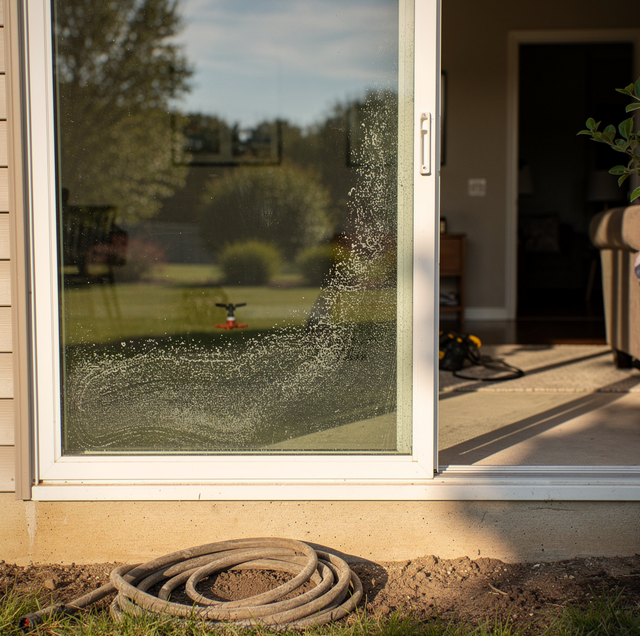
Your windows are dry, and the crew has gone. Stand square to one in late afternoon, with the sun low enough to rake across your pane instead of through it, and the marks come back: pale rings scattered across the lower third, a fan of them sweeping up from one corner, every one sitting where you saw it before the wash.
Nothing went wrong with the wash. What you are seeing was never lying on top of your glass the way dirt lies on it, and no soap you can buy and no pressure your cleaner can raise was going to carry it off. It arrived in your water, dried in place, and has been bonding to your window ever since you first noticed it.
The Spots Are Still There When the Glass Dries
Look closely, and the marks have edges. A squeegee streak runs the length of a stroke and fades at both ends. These do not fade. They are rings, some the size of a pinhead and some the width of a fingernail, each closed on itself with a paler middle, and they crowd the bottom third of the pane and whichever edge the water ran toward. Wipe one with a dry cloth, and nothing comes away.
They also come back in the same places. The pane beside a walkway takes them; the one on the sheltered side stays clear for years. On a property with a lawn system, one or two windows carry almost all of the marking and the rest carry none. A pattern that specific is not a missed spot in somebody's technique. It is a record of where water lands on your house, and how often.
What Coats a Pane After the Water Leaves?
Every drop of water that touches your windows carries dissolved minerals, and the deposits are mineral residue, calcium, and magnesium, left behind when the water evaporates. A drop landing on vertical glass does not run off. Surface tension holds most of it where it struck, and what remains shrinks inward as it dries. The mineral it carries does not evaporate with the water, so the concentration inside the shrinking drop climbs until the water can no longer hold it, and the mineral comes out of solution and fastens to the glass along the drop's retreating edge. The ring you find later is the footprint of a drop that dried where it landed.
One drop leaves a mark you would need low sun to see at all. The trouble is the same drops land in the same places week after week, each drying onto the residue of the last. What began as a faint outline builds into a raised crust with real thickness, and once there is thickness, the deposit holds its own moisture and dirt against the glass.
That is the difference worth holding onto. Dirt lies on your glass, held by nothing stronger than static and a film of grease, which is why washing works at all. Mineral does not lie on glass. It grows onto it, out of the water, in place, and takes the shape of whatever the water did on its way down the pane.
Why a Second Wash Moves Nothing
A wash is built around one idea: get enough liquid onto a surface to float what sits on it, agitate until the film releases, then take the water off before it dries. Every part of that assumes the soil is a separate thing resting on your glass with water able to get underneath. A mineral deposit has no underneath. It formed against the pane and is bonded to it, so flooding it only wets it; agitating it does nothing a wet cloth can do to a bonded solid, and the squeegee carries off clean water.
The instinct after that is to push harder, and that's where windows get hurt. A deposit that will not release under a cloth will not release under a scrubbing pad, and the pad finds the airborne grit beside it. More pressure does not act on a chemical bond at all. It acts on the surface around the bond, which is the surface you were trying to keep.
So the honest answer to a window that comes back spotted: standard cleaning does not remove hard water deposits. They require a specific mineral-dissolving treatment applied before cleaning, a different job with a different chemistry, booked ahead of the wash instead of repeated after it.
Where the Water Keeps Coming Back From
Two sources account for most of it. Marks of this kind are most common near sprinkler systems, where irrigation water repeatedly hits windows, and in areas with very hard municipal water. A lawn head throwing a fan across a bed clips the wall behind it, and because it runs on a timer three or four mornings a week, the same arc of glass takes the same water before the sun can dry it.
The second source is the water you already pay for. Hardness is a property of the supply, not the weather, so a house on hard water lays down mineral every time anybody rinses the deck, washes a car, or hoses pollen off a sill. None of those feel like they involve your windows. The overspray reaching the glass is the part that counts, and it dries where it lands.
Which panes show it first follows from that. Ground-floor glass within range of a head or a hose takes the most. East-facing glass dries fastest in morning sun and holds the crispest rings. A pane tucked under a deep eave, out of the spray but also out of the rain that would dilute it, can be the worst for your house.
Deposit, Scale, Etch: Reading Your Own Glass
Left alone, the mark on your glass does not stay the same kind of mark. It starts as loose residue a treatment lifts inside a single visit. Given months, it thickens into scale, still removable but slower, needing longer contact and more than one pass. Given years, what the pane looks like stops being the story: where deposits have sat for many years, and the etching is severe, the glass may be permanently damaged beyond what cleaning can address. The first two are deposits sitting on a pane. The third is a change in the pane itself, and no treatment reaches it because nothing remains on the surface to dissolve.
You can get partway to that reading from the ground and no further. A deposit with thickness catches low light and throws a faint shadow, and its edges stay crisp. Etching looks like a haze that does not shift as your eye moves across it. Glass carrying both is ordinary, and one sits on top of the other, so a mark that looks permanent can be a crust with clear glass underneath.
| Stage | What you see | What a wash does | What it takes |
|---|---|---|---|
| Fresh deposit | Separate pale rings | Nothing | One treatment, before the cleaning |
| Built-up scale | A continuous cloudy film | Nothing | Longer contact and repeat passes |
| Etched glass | Haze that stays once dry | Nothing | Replacing the pane |
This is why work on a spotted window starts with somebody at the glass rather than a quote from the driveway. Which of the three stages your pane has reached changes the method, the time on site and whether the work is worth doing, and a few square inches of test area separate the second from the third.
What Actually Lifts a Mineral Deposit
The treatment that removes hard water deposits is acidic, and the order matters as much as the chemistry: it goes onto the pane before the cleaning, never after. The acid releases the mineral from the glass, and the wash that follows carries it away, taking the ordinary dirt too. Run the two in the other order, and you have cleaned a window whose deposit is still attached, which is the visit many people have already paid for once.
Leave acidic glass treatments to the window cleaning technician who mixes and applies them in protective equipment, because these products burn skin and eyes, and eye injuries surface late.
Which is also why this is not a decision to make in a hardware aisle. The strength that dissolves a mineral crust is the strength that harms what surrounds the pane: frames, painted sills, gaskets, and the planting below all sit downstream of whatever runs off the glass. A technician applies it to a small area first, times it, then neutralizes and rinses on a schedule.
So a visit that is going to work starts small. One pane, or one corner of one pane, gets the treatment while the rest of the house waits. What comes off that test area predicts what your other windows will do, and where nothing comes off, you have your answer without anybody spending a morning on it.
When a Pane Is Past Treating
Some glass has gone too far. Where deposits have sat for many years, and the etching is severe, the pane may be damaged past anything cleaning can address, and replacement is the route left. Nothing dissolves out of a surface already cut into.
That is a smaller group of windows than the worry around it suggests. In most cases, even significant hard water staining can be removed or greatly improved, and the panes that cannot be saved are usually ones nobody has looked at in years.
Keeping the Clock From Starting Over
Whatever caused it will cause it again, so the cheapest fix anybody makes about hard water is to move the water. Turn down or rotate the head reaching the wall, shift a zone to a rotor that throws lower, or change the run time so your glass is not sitting wet through the hottest part of the morning. None of that costs a service call.
On the interval itself, twice a year suits most houses: spring to clear the pollen and fall to clear summer grime before winter. Where a property carries heavy tree pollen, or hard water coming through the irrigation, quarterly is closer to what your glass needs.
Frequently Asked Questions
Household acids are weak in the one dimension that matters, which is breaking a bond you cannot see. On a fresh, thin deposit, you may lighten it a little. On anything with thickness, you will spend an afternoon and finish with one slightly better patch, plus the risk of acid running down the frames, the sills, and the planting under your window.
Because the water only reaches some of them. Spotting traces of repeated wetting, so glass nearest a sprinkler head or a spray zone takes the load while the rest of your house sits outside it. Plot your marked windows on your own site plan, and you are usually looking at an irrigation layout. The exception is sheltered glass, which keeps what it collects because no rain rinses it clear for you.
It depends on what the rain does after landing. Rain is soft, so a heavy fall that runs a sheet of water down your pane and keeps moving dilutes and carries off loose residue. A light shower that wets your glass and stops is worse, because it redissolves a little of what is already there, spreads it, and dries in place. You most often get the second, which is why your marks widen over a season.
New glass resolves the damage and not the cause. A replacement pane arrives with an unmarked surface, which is the right move where your old one was etched past saving, but the sprinkler head or the hard supply that marked your first window still points at the second. Unless you handle the water, you are buying a clean surface and restarting your clock. Handle the head or the supply first, and the new glass gets the clean start the old never had.
There is no date on it, because the clock runs at the speed of your own exposure. A window of yours that takes irrigation four mornings a week in hard water is a different case from one that catches occasional overspray, and both can sit on the same wall of your house. What holds across both is the progression: loose residue in weeks, scale in months, etching only after years of contact. Once your separate rings have run together into a continuous film, you are past the easy end of that range.
Ask for hard water treatment by name and describe the pattern you are seeing, because a standard window cleaning booking prices a wash, and a wash is not what your glass needs. Name the elevations that are marked and whether irrigation reaches them. On the day, the work opens at one test pane, not the whole house: the treatment goes on, sits for a measured period, and comes off, and what it lifts shapes the plan for your remaining windows. Where the pane clears, that elevation follows, and the wash closes the job. Where it clears partly, you will hear how many repeat passes you need. Where nothing shifts, your surface is etched, and the conversation moves to glazing. Ask about the runoff plan for the beds beneath your windows.
Book a hard water assessment before the next wash goes on the calendar — a technician at the pane can tell a deposit that will still lift from glass already etched, and that reading is the thing a second pass over the same window cannot reach. Superior Power Washing serves Waldorf, La Plata, and Clinton. Call (240) 901-4252.