
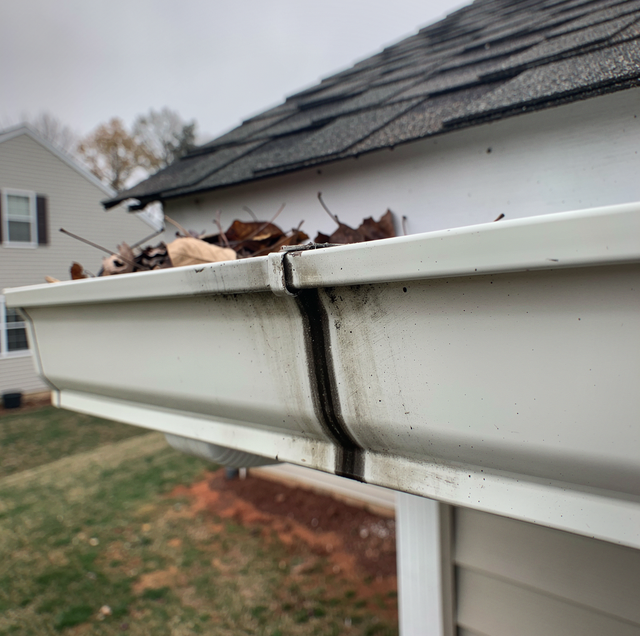
Dark stripes running down the face of a gutter form because of where the water went: instead of draining through the downspout, some of it left the trough over the front lip, carrying oils and grit picked up from the roof straight down the metal face. That leaves a residue the inside of the trough never touches, which is why a house rinse or a garden hose does little to it. Black streaks on the shingles above are from growth on the roof itself, while a gutter stripe is left by water leaving the trough. Matching what the stripe looks like against where it sits points to what put it there.
| What you see | Likely source |
|---|---|
| Vertical stripes running the length of the face | Overflow at the front lip, carrying grime down as it falls |
| Streaks concentrated under one corner | A local overflow point, such as a seam, miter, or a downspout mouth carrying more flow than the rest of the run |
| Green film versus black film | Green is algae or mildew growing on the residue; black can be the dried residue alone or dark mildew in it |
| Stripes that come back after a wash | The overflow source was never addressed, the wash only rinsed the surface, or wind-driven rain is still sheeting over the lip |
How Overflow Carries Roof Grime Over the Lip
A roof sheds more than water. Every storm carries shingle granules, airborne grit, pollen, and a thin film of oil off the asphalt down toward the gutter, all suspended in the runoff. As long as the gutter can move that water into the downspout, the grime rides along inside the trough and drains away with it. The stripe appears at the point where that system breaks down: a section running slightly full, a corner catching more flow than it can pass, or a length that briefly can't keep pace with a hard downpour. An inside corner set under a roof valley takes the water from two roof planes at once, so a stripe can start right at that miter. Water spills over the front edge instead of the spout, and it carries the suspended grime with it, leaving a thin film along the face in the exact path the water traveled. How much grime reaches the face follows the weather a roof takes. Heavy rain and storm winds load the roof with debris and grit, and a downpour hard enough to outrun the downspout sends that loaded runoff over the lip in one pass; where storms stay mild, little debris reaches the trough, and the film left on the face stays slight. On a roof that withstands heavy storms, the face stays clean only as long as the trough and downspout stay clear.
A stripe on the face can appear on a gutter that shows no other signs of a clog.
What the Film Is Made Of
The film is a mix. Roof runoff carries oils and pollutants that settle out of the air onto the shingles between storms, then wash down with the next rain, along with fine mineral grit shed from the roofing surface. Once that mix lands on the gutter face and dries, it oxidizes into a dull, dark residue on the paint finish.
The residue adheres to the painted face rather than resting on it. Runoff from asphalt shingles carries a light asphalt residue along with airborne carbon and dust, and as that mix dries on the finish, it grips the paint tightly enough that a light going-over with plain water leaves it in place: the bond that formed as the film dried holds through a rinse the same way it held through the storm that put it there.
Mildew adds a second layer where moisture lingers on that residue long enough to support growth, which can happen on a shaded stretch of gutter or a corner that stays damp after everything else has dried. That's the practical difference behind a green film: green is a living colony using the residue as a foothold, while black can be the oxidized film alone or a darker mildew growing in it. The two can sit side by side on the same run.
Note where each stripe starts before the wash. A stripe that begins at the same seam, corner, or downspout mouth every time marks where that run overflows, and clearing that stretch of trough keeps the washed face clean.
Why a Plain Rinse or High Pressure Doesn't Lift It
Water alone beads on an oxidized film instead of breaking it loose. Because the residue is bonded to the paint finish, a stream of plain water passes over it without disturbing the bond underneath. That's why a house wash that leaves the siding and windows spotless can still walk right past the gutter stripe without touching it.
Turning up the pressure instead of changing the approach creates a different problem. Residential aluminum gutters are formed from sheet about .027 to .032 inch thick. A concentrated stream can dent that thin face and strip the baked-on paint finish right along with the film it was aimed at, leaving a bare or blotchy streak where the stain used to be. Bare aluminum left exposed that way stays dull against the painted finish around it, and a wash cannot restore that finish. Force alone can strip the paint without evenly lifting the film, so the result can be a damaged gutter face that remains stained in patches.
How Gutter-Face Cleaning Works
Clearing the film off a gutter face calls for a cleaning solution formulated for this kind of oxidized residue, applied at low pressure so it can dwell on the surface and chemically break the bond, rather than blasting it off. Once the solution has had time to work, a gentle rinse carries the loosened film away without putting stress on the aluminum or the finish beneath it. The crew keeps the solution from drying on the face, and it wets the plants in the beds under the gutter line before the cleaner goes on and rinses them again once the face is done, since runoff from the gutter lands right on them. The approach lifts the residue evenly across the whole run instead of leaving the streaked, patchy look that heavy pressure can create when it strips one pass and misses the next. Downspouts get the same pass, since water leaking at a downspout joint or a clogged elbow leaves the same film down their faces.
The gutter line runs along the roof edge, and reaching it requires ladder work on an uneven roofline. A soft-wash crew works that height with equipment built for it, so leave the climbing to them.
Keeping the Stripes From Coming Back
A clean gutter face and a gutter that still overflows are two separate problems, and cleaning only the first leaves the second to reload the stain at the next storm. If the trough is carrying more water than it can pass through the downspout, whether from a partial clog, a section holding standing water, or a run that can't keep up during a hard rain, the next overflow event puts a fresh coat of grime right back down the same path. Keeping the gutter clear so water reaches the downspout rather than the front lip is what keeps a newly cleaned face from striping again.
Frequently Asked Questions
Yes. A darker factory finish hides the early stages of the film, so a stripe can build for a while before it's noticeable, while a white or light-colored gutter shows the same amount of residue at an earlier stage because the contrast is stronger against the finish.
Yes. Wind-driven rain can push a thin sheet of water over the lip even when the trough never fills enough to produce an obvious cascade, so a gutter can carry a faint stripe without ever showing the kind of overflow you'd notice from the ground.
Not always. A guard keeps leaves out of the trough, but a solid cover that feeds water around a curved lip can overshoot in a hard downpour, sending runoff over the front edge instead of into the gutter, and that overshoot lays the same film down the face a clogged gutter would.
Yes. A dry, oxidized film carries little odor on its own, so a musty smell alongside a stripe can point to a live mildew colony growing in the residue rather than the residue by itself, which is a separate reason to have that section looked at.
It can. A stripe concentrated tight against a seam or end cap sometimes traces back to a small leak at that joint pushing water out sideways, a different source than the front-lip overflow that produces a stripe running down an open stretch of face.
Yes. Water that clears the lip keeps falling, and where it lands on the siding or trim below, it can leave a matching dark band or a splash line, so the siding under a striped run gets the same low-pressure wash as the gutter face.
Set up a gutter and window cleaning with a soft-washed gutter face — low pressure and a gutter-face cleaner lift the oxidized film without denting aluminum or stripping its paint. Superior Power Washing serves Waldorf, La Plata, and Clinton. Call (240) 901-4252.
