
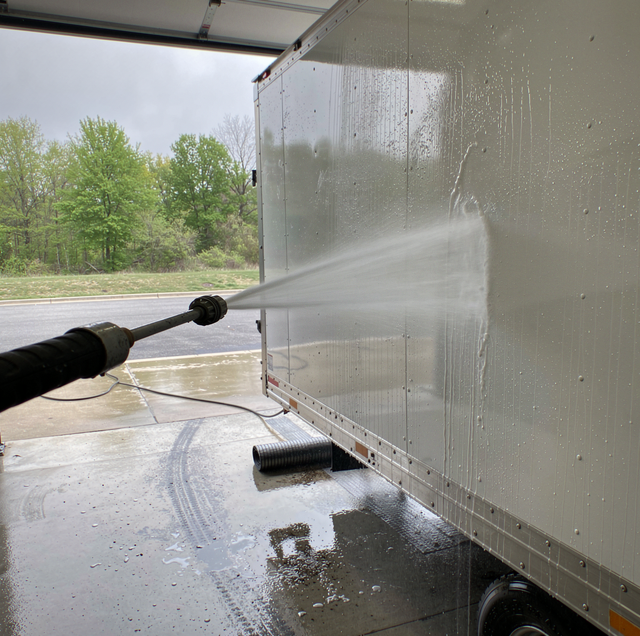
A truck fleet parked at the end of a route carries the same grime no matter which method eventually cleans it off, but the two methods reach that grime in different ways. Touchless washing relies on water pressure and chemistry alone, with nothing ever touching the paint. Brush washing adds physical contact to a detergent step, using soft rotating or drag brushes to scrub the film loose rather than dissolve it. Neither is the automatic right answer for a mixed fleet; each trades one kind of risk for another kind of cleaning power.
Set side by side, the two methods differ in how grime comes off, what the detergent has to do, what each risks on decals and trim, and where each fits.
| Touchless | Brush | |
|---|---|---|
| How grime is removed | High-pressure water plus chemistry breaks the bond between film and paint | Detergent plus brush contact; a milder soap can do the job because the brush supplies the scrubbing |
| What it asks of the detergent | The pre-soak chemistry has to do the loosening alone before the high-pressure rinse | Less concentration and dwell time are needed, since brush contact carries part of the load |
| What it can do to decals, paint, mirrors and lights | No contact, so decal edges and mirror housings aren't touched, though a long chemical dwell can affect some laminates | Contact lifts stubborn film fast but can swirl clear coat and catch on decal edges, mirrors, or light housings if not guided around them |
| What it leaves behind on heavy road film | Caked mud or dried road grime can resist chemistry alone and need a second pass | Mechanical contact is built to clear caked film that chemistry alone struggles with |
| Where it fits | Wrapped trailers, aluminum trim, and mixed paint conditions where contact risk is the priority | Heavier road film and fleets without delicate wraps or fresh graphics, where contact risk matters less |
How Touchless Washing Works
Touchless washing skips the brush entirely and asks water pressure and chemistry to do everything the contact would otherwise handle. A touchless system can pair an acidic step to loosen mineral grime with an alkaline step to cut the oily film, or run a single-step alkaline pre-soak for lighter film. The order depends on the system. High-pressure water carries each step on and off the vehicle and does the physical work of flushing the loosened film away.
Because nothing but water and chemistry ever contacts the paint, touchless washing carries no risk of scratching, swirling, or catching on a raised edge. That protection comes with a trade-off: the chemistry has to work harder without a brush to help it along, so touchless washing depends more on dwell time and the right concentration than a brush wash does, and a vehicle with heavier, caked-on grime can ask for a longer cycle or a repeat pass to get fully clean.
How Brush Washing Works
Brush washing adds mechanical contact on top of a detergent step and requires lower concentration and dwell time than touchless because the brush supplies part of the scrubbing action. Soft rotating or drag-style brushes made for vehicle finishes move across the panel after the detergent has had time to loosen the film, and the contact does what chemistry alone sometimes cannot: physically lift grit and bonded grime off the surface rather than waiting for a chemical reaction to release it.
That contact is also where the method's risk lives. A brush that is not kept clean, or one that is run without sufficient lubrication from the wash solution beneath it, can drag grit across the clear coat and leave fine swirl marks. Even a clean, well-maintained brush can catch a lifted decal edge or a loose piece of trim if a crew is not paying attention to where it runs. The contact is both an advantage and a liability, which is why brush results depend on the equipment and the crew running it.
Road Film and Why Chemistry Matters in Both
Bonded road film needs detergent dwell time before any pressure or brush contact, and that holds for both methods. A brush run over that film before the detergent has worked drags abrasive grit across paint with nothing to cushion it. Skip that dwell time and both methods end up asking force to do a job that belongs to the chemistry, and that is one way paint and trim take damage instead of the grime.
Protecting Decals, Lettering, Reefer Units and Mirrors
A commercial fleet carries more delicate surfaces than a plain paint job. Decals and lettering sit on top of the panel rather than baked into it, and their edges are the weak point: an edge that has started to lift is easier to catch and peel further, whether the cause is a brush passing over it or a stream of water finding its way underneath. Mirrors, antennas, and light housings stick out from the body, so a wand or a brush can strike them directly if it isn't guided around them deliberately.
Touchless washing reduces the risk of contact with those parts but does not eliminate all risk. The same pre-soak chemistry that loosens road film can affect certain decal laminates or trim finishes if it sits on the surface longer than it should, so concentration and timing are set for the laminate on a wrapped or lettered vehicle.
A pressure wand aimed at a reefer unit's electrical connections or control panel can cause a fault or a shock hazard, so a washing crew keeps the stream clear of those components and never lets a driver handle that step.
Matching the Method to the Truck and the Route
The choice comes down to what is on the vehicle and what is on it after a route.
A wrapped trailer, a vehicle with fresh lettering, or anything with polished aluminum trim leans toward touchless, because contact is the risk on a decal edge or a soft finish. A painted panel truck running a route that leaves it in heavy, caked film leans the other way, because brush contact clears that kind of grime in a way chemistry working alone can struggle to fully release. A mixed fleet, with some units wrapped and some plain-painted, can be split by vehicle rather than settled on one method: different vehicles in the same yard can reasonably be washed by different methods, based on what each is wearing and what it is covered in.
Grime type is the other half of the choice. A daily commuter-style route that leaves a thin, even film is a different problem than a construction or landscaping vehicle that comes back caked in dried mud, and the second case is exactly where brush contact earns its place even on a vehicle that would otherwise be touchless-only.
A crew washing on a paved lot can lay containment mats or run vacuum recovery so wash water and detergent stay out of a nearby storm drain.
Frequently Asked Questions
Chemistry alone can struggle with mud or road grime that has dried hard rather than just bonded as film. On a vehicle like that, a crew runs a separate high-pressure hand-wand pass over the wheel wells and lower panels before the main chemical cycle starts, breaking up the worst of the caked material so the touchless chemistry has less to work against.
Touchless washing's water and chemistry can reach into the rubber gasket around a roll-up door or side door, and a pre-soak that sits too long in the seal groove can leave a chemical residue trace once it dries. A low-pressure freshwater rinse over the seal immediately after the main cycle clears the residue without driving water past the gasket.
It can, but the adhesive edge is the vulnerable point. If a rotating or drag brush dwells in one spot rather than passing over it as it would on a flat panel, the tape's edge can start to lift, which is why fleets running brush equipment pass over a striped panel rather than working it the way they would the surrounding paint.
Yes. On a wrapped truck that also carries heavy road film, the wrapped panels stay on the touchless side, and only the unwrapped lower panels see contact, so no brush crosses a wrap seam.
It can. Mobile, on-site washing leans toward touchless, because a drive-through brush rig does not travel, so a mobile crew relies on pressure, chemistry, and hand work. A fixed wash bay can have brush equipment plumbed in alongside a water reclaim and drain system, making brush washing easier to run as a standing setup.
Yes, if it dries on the surface. A pre-soak film left to dry on a hot panel can begin to etch aluminum trim or wheels rather than clean them, whether the chemistry is acidic or alkaline. That is why a pre-soak on aluminum gets rinsed before it can dry, and a panel sitting in direct sun gets that rinse first.
Line up fleet washing for a yard of wrapped and painted trucks — pressure, dwell time and wand angle are matched truck by truck to panel type and grime level, with decal edges and reefer controls kept out of the stream. Superior Power Washing serves Waldorf, La Plata, and Clinton. Call (240) 901-4252.
