
Gutter Cleaning Signs You Shouldn't Wait to Notice
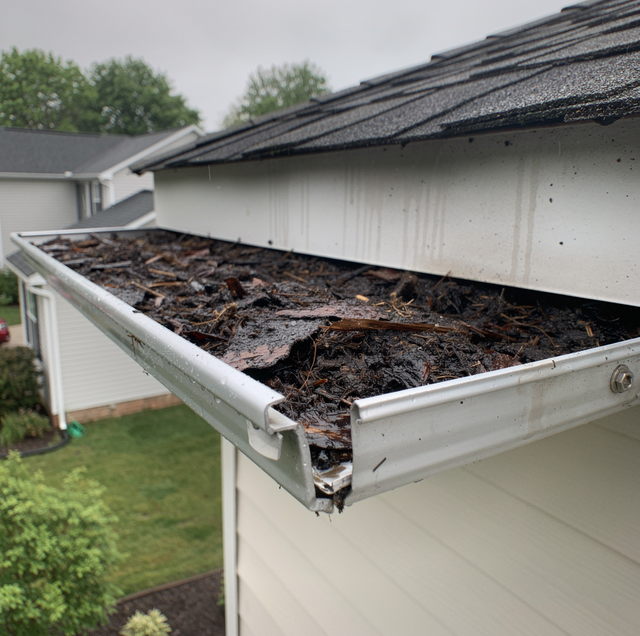
Homeowners tend to picture gutter trouble as a fall problem, something to deal with once the trees finish dropping leaves. That's only half the picture. A gutter can go from working fine to overwhelmed in a single spring pollen season, weeks before a single leaf falls, and the signs it leaves behind are easy to mistake for something else: a damp patch on the siding, a few extra ants near the foundation, a downspout that never seems to fully drain. Most homeowners only connect those dots after the gutter has been overflowing for weeks.
Why Gutters Clog Faster Than You'd Expect
A gutter is a simple trough, but the roof feeding it is anything but simple. Every valley, ridge, and slope funnels runoff toward the same channel, and everything that lands on the roof travels with the water: shingle granules, seed pods, pine needles, pollen film, and the fine grit that blows in during a windy afternoon. On a steep roof, debris and water arrive at the gutter with real force, packing material into corners and around the mouth of each downspout.
Hangers are spaced every 24 to 36 inches to hold the gutter's pitch, roughly a quarter-inch of drop for every 10 feet, so water gravity-feeds toward the downspout instead of sitting still. When silt and leaf litter settle in the low points, that pitch stops mattering. Water pools behind the clog, adds weight, and starts loosening the hangers. A gutter that's carrying an extra 20 or 30 pounds of wet debris is under a different kind of stress than an empty one, and the fasteners notice first.
Signs Your Gutters Are Already Overwhelmed
Some warning signs appear on the gutter itself; others appear on the house around it. Here's a quick way to match what you're seeing to what's actually happening above your head.
| What you notice | What's really going on | What to do |
|---|---|---|
| Water pouring over the front lip during rain | Channel is full or pitched wrong; water can't reach the downspout | Clear the run and recheck hanger spacing |
| Plants or grass growing out of the gutter | Decomposed leaf litter has become soil; roots have taken hold | Full clean-out, not a quick scoop |
| Dark streaks running down the siding | Overflow is washing dirt and tannins down the exterior wall | Clean gutters and rinse the affected siding |
| Sagging sections between hangers | Trapped water weight is pulling fasteners loose | Clear the debris; if the sag doesn't lift, flag it for a gutter repair specialist |
| Pooling water at the foundation after rain | Downspout is clogged at the elbow, or the extension is missing | Check downspout for full-length blockage |
| Mosquitoes near the roofline in warm weather | Standing water in a clogged gutter section is breeding habitat | Clear standing water and confirm proper drainage |
What Ignoring the Signs Actually Costs You
Fascia boards, the trim running behind the gutter, are usually thin wood or wood composite, and they were never meant to sit in standing water. When a gutter overflows repeatedly, the fascia absorbs moisture at the seam, the paint or primer starts to lift, and soft spots follow. Left long enough, the wood loses its ability to hold a nail, and that's the point where a simple gutter clean-out turns into a carpentry repair.
Soffit vents underneath the roofline are next in line. They're designed to draw dry air through the attic, but a steady drip from an overflowing gutter can saturate the vent screen and the surrounding wood, inviting the kind of trapped moisture that soft wood, mold, and insects all prefer. Around the foundation, water that should have traveled six feet away through a downspout extension instead lands right at the wall, softening soil and, over repeated storms, contributing to settling or erosion in flower beds and mulch borders.
Why Some Clogs Need More Than a Scoop
Fresh leaves scoop out easily. The problem is what's left behind after a few seasons: a compacted layer of decomposed organic matter that behaves almost like potting soil, packed tight enough to hold water and support small weeds. Gutter guards make this worse in one specific way: they stop large leaves but let fine pollen and seed fluff pass straight through, where it mats against the mesh from underneath and blocks flow without ever looking clogged from above. A downspout can also clog internally at the elbow, the 90-degree bend where debris naturally collects, and that blockage is invisible until you run water through it.
How a Professional Clean-Out Differs From a DIY Pass
A thorough gutter service does more than scoop the trough. It flushes each downspout with a hose to confirm the full run is open, not just the visible top few feet. It checks hanger spacing and pitch, because a gutter that's been overflowing for a season often has one or two sections that have pulled slightly out of alignment. It inspects seams and end caps for separation, since standing water finds the weakest joint first. And it rinses the surrounding roof edge and upper siding, since overflow rarely stays contained to the gutter itself. A window cleaning pass often gets bundled into the same visit, since the same overflow that streaks siding also leaves a film on nearby glass.
Why Gutter Style Affects How It Clogs
Most homes today have K-style gutters formed on-site from a single length of aluminum coil, with no horizontal joints along the run for debris to snag on, just the end caps and any corner miters. Older homes, or additions built at a different time, sometimes still have sectional gutters joined every 10 feet with a connector, and those joints are common spots for a slow leak or a debris snag to start, even when the rest of the run looks clear. Half-round gutters, more common on historic or higher-end trim packages, carry water in a rounder channel that holds slightly less volume than a K-style trough of the same width, which means they can reach capacity and overflow a bit faster during a heavy downpour. Knowing which style is on the house helps explain why a neighbor's gutters with a different profile might handle the same storm differently.
Setting a Rhythm Instead of Waiting for Signs
Two clean-outs a year, once after spring pollen drop and once after leaves fall, keep most systems ahead of the problem instead of reacting to it. Homes tucked under a lot of tree canopy, or with a steep, complex roofline, often need a mid-season check too. The goal isn't a spotless gutter every week; it's catching the compacted layer before it becomes soil, and catching a loose hanger before the next big storm tests it.
Frequently Asked Questions
As a general estimate, a moderately clogged gutter can start overflowing in as little as 15 to 20 minutes of steady rain, since even a partial blockage cuts the channel's carrying capacity well before it looks full from ground level.
Yes. Standing water backed up against the roof edge can work under the first course of shingles, especially on lower-slope sections, leading to soft decking at the eave long before the rest of the roof shows wear.
Yes, an extension that's disconnected or aimed the wrong way can dump water right back against the foundation even with a perfectly clear gutter run, so it's worth checking separately from the trough itself.
A very slight dip is common on longer runs, but more than about half an inch of sag between hangers usually indicates trapped debris or a loose fastener, not just age.
Guards are typically a solid cover with a curved lip that relies on water tension to funnel flow while shedding leaves, while screens are a mesh that sits over the top and blocks larger debris but still needs periodic clearing where fine material accumulates.
Not all guard styles fail the same way. Micro-mesh guards resist fine debris longer than perforated aluminum covers, but even mesh guards need an annual rinse-off, since pollen and grit that settle on top of the screen, rather than passing through it, still block water from filtering down. A guarded gutter also hides the compacted layer forming underneath, so it's common to go two or three seasons past the point where an unguarded gutter would have already shown obvious overflow, which is why a scheduled check still matters even when nothing looks wrong from the ground.
Gutters do their job in silence, which is exactly why the warning signs are easy to miss until water is already finding a new path down your siding. A quick seasonal check saves the fascia, the foundation beds, and the gutters themselves from having to do a job they were never built to do when clogged.
Schedule a gutter and window cleaning — restore proper drainage before the next storm rolls through. Superior Power Washing serves Waldorf, La Plata, and Clinton. Call (240) 901-4252.
