
Why Painted Metal Buildings Show Streaks Faster Than Brick Facades
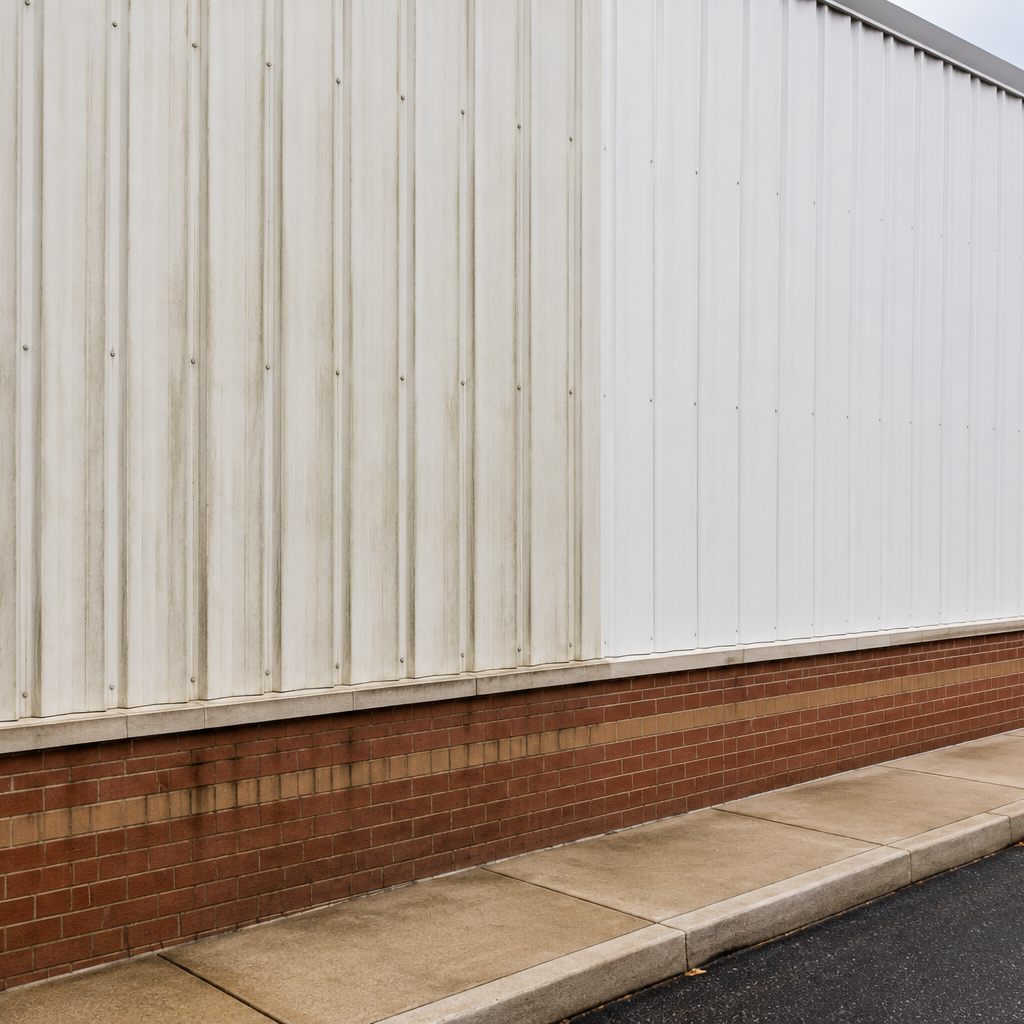
Two buildings sit shoulder to shoulder in the same shopping center. One is brick, built in the late nineties. The other is a painted metal-clad pharmacy that went up in 2018. Both were power-washed the same morning by the same crew. Six months later the brick still looks clean, and the metal panels already have vertical gray streaks running down from every screw line, every horizontal seam, every parapet. The property manager is staring at the difference and wondering what the cleaning crew did wrong.
The crew didn't do anything wrong. The two walls are made of different materials and they're failing in different ways.
Here's what's going on.
Two facades, two completely different aging clocks
The painted metal is a steel or aluminum panel coated with a factory-applied paint system — usually a polyester variant on lower-cost panels, or a fluoropolymer like PVDF (Kynar 500 / Hylar 5000) on the better commercial work. The brick is fired clay with mineral mortar in the joints. One is an industrial coating sitting on top of a metal substrate. The other is a stone-like material that is the surface, all the way through.
That difference shows up the first year and gets louder every year after.
| What you see | What's actually going on | How urgent |
|---|---|---|
| Vertical gray streaks running down from every screw, fastener, and seam on painted metal | Surfactant bleeding plus oxidation residue washing down the panel after rain | Cosmetic year one, structural by year three — the coating is losing the resin holding pigment to substrate |
| Chalky white film that comes off on a clean cloth when wiped | Resin breakdown at the surface of the paint — the binder is gone, the pigment is loose | Address within a season. Once chalk starts, dirt and algae stick harder, and the next wash is more aggressive |
| Vertical green streaks running down the same panel where the metal stays shaded | Algae colonizing the chalked-out resin layer using degraded polymer as a food source | Moderate. Re-cleans every 6–12 months without correction. Permanent staining within 2 seasons |
| The brick that looks dirty across the whole face after a long winter | Surface grime and atmospheric film sitting on top of the brick face — not in the brick itself | Low. A soft wash returns the brick to almost its original condition. Brick has decades before its own surface fails |
| Brick with white powdery patches near the base or under windows | Efflorescence — soluble salts migrating out of the masonry as water moves through it | Diagnose the moisture source first. The cleaning is easy; the underlying water intrusion is the actual job |
The painted metal needs help years before the brick does. That's not the cleaning crew. That's the chemistry.
What's actually breaking down on a painted metal panel
A factory-finished metal panel is a sandwich. The bottom is steel or aluminum. On top of that sits a thin primer layer that bonds to the metal. On top of the primer sits the colored topcoat — and that topcoat is where the streaking begins.
The topcoat is a resin (the binder), pigment (the color), and a few additives. The binder's job is to hold the pigment particles in place and keep them stuck to the primer below. UV light tears at the binder every day. The longer the sun hits the panel, the more the resin loses molecular weight, breaks into shorter chains, and migrates to the surface as a fine, dusty residue. That's the chalk.
Once the surface chalks, the pigment isn't bonded to anything stable anymore. Rain hits the panel, picks up loose chalk and surfactants that bled out of the resin during manufacture, and runs that mixture down the panel face in vertical lines. The streaks always start at fasteners and seams because that's where water concentrates after every rain. Every drip line is a chemical conveyor belt washing the front of the coating downhill.
A polyester paint system might start showing visible chalk at year three. A PVDF system on the same building might hold off until year eight or ten. The cheap stuff fails first. The math wrote itself the day the panel was specified.
There is a second thing happening on bare metal corners and damaged spots where the coating has chipped. Aluminum panels grow a self-protecting oxide layer that looks dull and grayish. Steel panels rust. Both bleed colored residue down the panel below the damage. That residue is mineral, not biological, and a standard wash won't touch it without an acid cleaner sized to the panel material.
Why brick takes the same weather and barely notices
Brick is fired at temperatures around 1,800 to 2,200 degrees Fahrenheit. What comes out is essentially a thin slab of ceramic — chemically inert, dimensionally stable, almost completely resistant to the UV degradation that destroys a paint film. The same daily sun cycle that strips a polyester topcoat in three years does almost nothing to the face of a brick.
What brick does pick up is surface contamination. Diesel soot from the road. Atmospheric grime from any nearby industrial activity. Pollen, dust, and the thin organic film that lands on every outdoor surface in a humid Mid-Atlantic summer. None of that bonds chemically to the brick. It sits on top, held loosely by the slight roughness of the brick face and the mortar joints. A soft wash with mild surfactants lifts the film, and the brick comes back to near-original color.
The mortar is where brick walls actually age. Lime-rich mortars in older walls slowly carbonate and lose strength. Modern Portland-cement mortars stay harder longer but get attacked at the surface by acid rain and freeze-thaw cycles. When a brick wall starts to fail, it's almost always the joints that go first, not the face of the brick.
Compare that to a metal panel, where the entire visible color is a sacrificial layer that begins decomposing the day it leaves the factory. Brick ages in decades. Painted metal ages in years.
Why pressure washing makes the metal worse and the brick fine
This is where most building owners get burned.
A standard pressure washer at 3,000 PSI knocks streaks off a painted metal panel for a few weeks. It also strips off whatever is left of the intact resin layer above the chalk, exposing the partially-degraded resin below to the next round of UV. The panel that was scheduled to start visibly chalking next year now starts visibly chalking next month. Pressure washing painted metal accelerates the failure clock — sometimes by a full year per wash on a polyester system.
On brick, the same 3,000 PSI does much less damage to the brick face itself but can blow out softer mortar joints, especially on older walls with lime-rich mortars. Done by a crew that knows brick, a pressure wash is survivable. Done at high pressure on tuck-pointed brick, it's a repair job.
The bigger issue on painted metal is what doesn't come off. The streaks are partly surfactant residue, partly oxidation, partly trapped organic film. Plain water at any pressure won't break the chemical bonds. The streaks lift slightly while the panel is wet, then darken right back as it dries. Building owners call the crew complaining, the crew comes back, hits the wall harder the second time, and the chalking accelerates a third time.
What a real cleaning sequence looks like on coated metal
Commercial building washing on painted metal is not the same job as a pressure wash. The right approach is a soft wash sized to the coating.
A trained crew tests an inconspicuous panel first to see how much chalk is present and whether the coating still has integrity. If the chalk is heavy, the wall needs an alkaline detergent with a surfactant package designed for oxidized coatings — something that will lift the chalk, the surfactant streaks, and the organic film in a single pass without scrubbing the underlying resin. Dwell time matters more than pressure. The cleaning happens through chemistry sitting on the panel for ten to fifteen minutes, then a low-pressure rinse from the top down.
Algae on shaded panels gets a separate sodium hypochlorite treatment with a clinging surfactant. That step kills the colony at the cellular level and prevents the regrowth that plagues panels cleaned with pressure alone.
After the wash, panels showing heavy chalk are candidates for a coating restoration product or, on older systems, a recoat by a commercial painting contractor. Once the resin is gone, no amount of washing puts it back. The cleaning preserves what's left and slows the next round of failure.
For brick, the same crew uses a much milder detergent, more dwell time, and very low rinse pressure on tuck-pointed sections. The two walls get the same cleaning visit, scheduled the same morning, but the chemistry and pressure choices are completely different at each one.
Budget-wise, a commercial soft wash on a low-rise building runs in the same general range as any other professional exterior cleaning — most quotes land somewhere between fifteen and seventy-five cents per square foot of facade depending on height, contamination level, and access. Heavily chalked panels and warehouses with lift-required elevations sit at the upper end. Brick at street level on a clean building sits at the lower end. A good crew walks the property and quotes from what they see, not a flat per-square-foot rate from a website.
One thing to avoid before the crew arrives: don't try to spot-clean the metal with whatever's under the kitchen sink. Abrasive pads, paint thinners, mineral spirits, or any solvent labeled "tough on grease" will tear straight through the topcoat. Mild dish soap and a soft cloth can lift fresh grime safely. Past that line, anything stronger usually creates the problem the next contractor has to fix.
Frequently Asked Questions
The metal and the brick are on different clocks. Schedule the work that way.
The mistake property managers make is treating the two walls as the same maintenance line item. A brick facade can run on a five-year cleaning rhythm and look respectable the whole time. A painted metal facade needs attention every one to two years just to slow the chalk-and-streak cycle, plus a coating restoration or recoat at year eight to twelve, depending on the original paint system.
Cleaning both walls the same way and on the same schedule guarantees one of two outcomes. Either the metal gets neglected, and the chalk accelerates, or the brick gets pressure-washed harder than it needs, and the mortar joints suffer.
Plan the cleaning around what each wall is actually made of, not what's easier to put on the invoice.
Superior Power Washing handles commercial building washing across Waldorf, MD, and all of Charles County and Southern Maryland — including La Plata, Brandywine, White Plains, Hughesville, and Charlotte Hall. Owner-operated, fully insured, soft wash methods sized to your specific facade — painted metal, brick, EIFS, stucco, or mixed-material buildings. Call (240) 901-4252 for a free on-site assessment.
