
How Much Does Roof Soft Washing Cost on a Typical Home
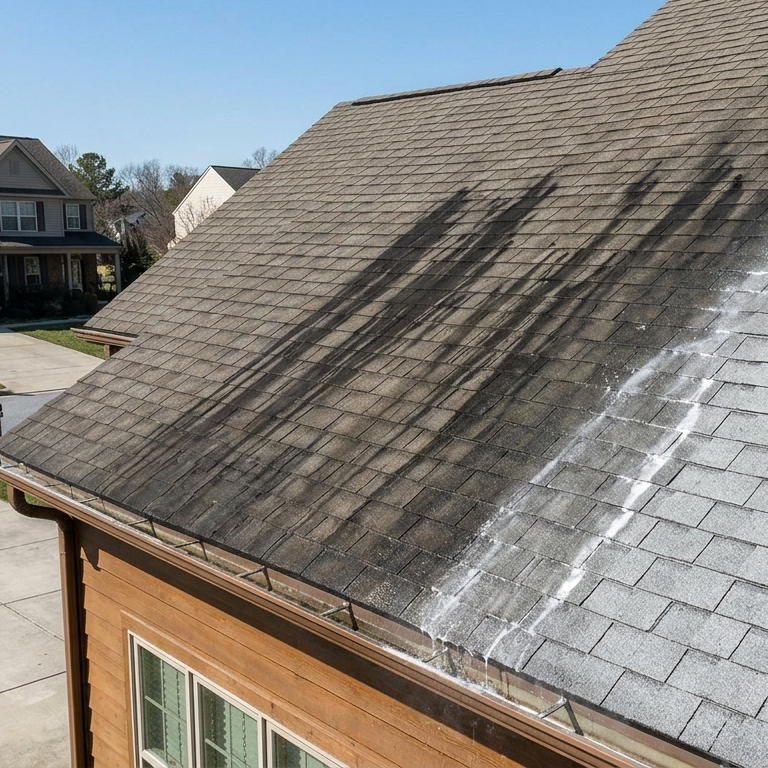
You are pulling out of the driveway when you look up. The roof has streaks. Long dark trails running off the ridge on the north side, fanning down the asphalt like rain that dried wrong. The south face still looks clean. You hadn't noticed because the angle from the porch hides it. From the street it's the first thing you see.
You make three phone calls that night. The numbers come back $249, $675, and $1,100.
Same roof. Three companies. Quotes that don't agree on what this work costs.
Here's how to read the math.
A fair roof soft wash on a typical home runs $450 to $900
For an asphalt-shingle roof on a single-family home in Southern Maryland, with average algae load and a standard 5/12 to 7/12 pitch, $450 to $750 is the usual range. Steeper roofs and bigger square-footage push toward the top of the band. A 3,500-square-foot two-story with a 9/12 pitch and heavy algae can fairly run $850 to $1,250. A 1,400-square-foot ranch with a low pitch and light algae sometimes lands at $400.
When the spread between quotes is wider than that, something's off. Either the low number isn't a real soft wash and the crew is going to roll up with a pressure washer — which voids most asphalt shingle warranties — or the high number is pricing for access challenges that don't exist on your roof.
Here's what a fair range looks like across roof footprints:
| Roof footprint (approximate) | Single-story, low to medium pitch | Two-story or steep pitch (7/12+) |
|---|---|---|
| Under 1,500 sq ft | $400 – $550 | $550 – $750 |
| 1,500 – 2,200 sq ft | $475 – $700 | $675 – $900 |
| 2,200 – 3,000 sq ft | $650 – $900 | $850 – $1,150 |
| 3,000+ sq ft | $800 – $1,150 | $1,000 – $1,500 |
Footprint isn't the same as actual roof surface area. A 7/12 pitch adds about 16 percent of surface over the footprint. A 12/12 pitch adds 41 percent. Crews that price by footprint and ignore pitch usually quote a roof too low — then look for ways to recover the labor once they're on site.
What actually drives the number
| Cost driver | Adds to the quote | Why |
|---|---|---|
| Roof footprint | $0.20–$0.40 per sq ft | More surface, more chemistry, more dwell, more rinse |
| Pitch above 7/12 | $100–$300 | Rope work, slower movement, fall-protection setup |
| Two-story vs single-story | $75–$200 | Higher ladder reach, longer hose run, gutter setup |
| Heavy algae or moss load | $75–$200 | Higher biocide concentration, longer dwell, possible second pass |
| Complex roof line (valleys, dormers, multiple ridges) | $50–$200 | More edges to chase, more flashings to work around |
| Skylights or solar panels | $50–$150 | Pre-rinse, taping, careful application around glass |
| Gutter pre-soak and post-rinse | $40–$100 | Keeps biocide from damaging downspout splash zones |
| Heavy plantings under the eaves | $50–$150 | Pre-soak beds, cover shrubs, post-rinse — real labor |
| Distance from truck to back of house | $25–$75 | Hose runs over 150 feet add equipment and time |
| Wooded lot with debris on roof | $50–$125 | Soft brush or blower pass before chemistry can dwell |
| Tile, metal, or wood shake roof | $100–$300 | Different chemistry and dwell, sometimes a brush-off pass |
These are Southern Maryland numbers in 2026 dollars. They aren't list prices — they're the line items that move the bottom number on a fair estimate. A quote that doesn't reflect any of them is either ignoring conditions on your roof or making it up on shortcuts later.
Why pitch is the biggest variable
Roof footprint matters. Pitch matters more.
A 5/12 pitch is walkable. The crew moves across the surface, applies biocide with a low-pressure pump, lets it dwell, rinses, repositions. The same crew on a 10/12 pitch is no longer walking — they're rigging an anchor at the ridge, running a lifeline, and working in slow steady passes from the gutter line outward. The chemistry is identical. The labor isn't.
A 12/12 pitch is its own job. Many older Southern Maryland homes have a steep front gable on the original section with a lower pitch on the back addition. The steep section can run double the per-square-foot rate of the addition. A crew that prices the whole roof at one rate is usually undercharging the steep one and skipping rope work to make it back.
Watch what a crew does on the walk-through. If they're quoting Google Maps without seeing the roof, expect a number that won't hold up to reality.
What cheap quotes leave out
A $249 quote on a typical roof isn't a discount. It's a different product. Here's what usually isn't in the scope:
The soft wash chemistry. The $249 crew typically pulls up with a pressure washer and a downstream injector, mixes a little detergent, and blasts the shingles at 1,500 PSI. The visible black comes off. So does a fair portion of the granule layer that protects the shingles from UV damage. Pressure washing voids most asphalt shingle warranties — the moment a wand goes on the roof, you've traded a clean look for years of remaining shingle life.
The dwell time. A real roof soft wash applies a biocide containing 1.5 to 4 percent active sodium hypochlorite and lets it sit for 12 to 20 minutes before rinsing. That's the part that kills the gloeocapsa magma — the black-algae organism that causes the streaks. A rushed crew sprays and rinses inside four minutes. The streak comes off the way a stain comes off a wet rag. Nothing under the surface dies. The algae regrows from the same colonies in eight to twelve weeks.
The plant and gutter protection. Roof runoff during a soft wash is concentrated — every drop of biocide that hits the roof ends up in your gutters or your foundation beds. A trained crew pre-soaks every plant within fifteen feet of the eaves, dilutes the gutters with clean water during application, and flushes the downspouts and beds with thousands of gallons before leaving. The cheap quote skips that step. Two weeks later, the hostas start dropping leaves, and a bleach line appears on the patio next to the downspout. The cleanup is on you.
Soft wash vs DIY: what the math actually says
Renting a pressure washer and climbing onto the roof yourself sounds like a $150 weekend. The math falls apart in three places.
First, the shingle warranty. Pressure washing — at any setting — voids most asphalt shingle warranties. A wand strips granules off the shingle surface. Granule loss accelerates UV damage and shortens shingle life by years. The manufacturer's first question on any warranty claim is whether the roof has been cleaned with pressure. If yes, the claim is denied.
Second, the chemistry. Pool chlorine at 5 percent has no surfactant package to dwell on a sloped surface. It runs off in twenty seconds without killing anything below the granule layer. A real soft wash mix uses a non-ionic surfactant that holds the biocide on the shingle long enough to penetrate the algae colonies. Without it, you're rinsing the visible black off and leaving the organism alive.
Third, the fall risk. Falls from a roof are the second-most-common source of homeowner-injury claims after ladder work. A trip to the ER for a fractured ankle runs $8,000 to $15,000 in the Southern Maryland market. That's twenty fair-priced soft wash jobs.
The DIY math works on a one-story flat-pitch outbuilding with nothing planted under the eaves. It doesn't work on the house.
How to read a quote and tell whether it's fair
A fair roof soft wash quote has line items, not just a total. Look for the roof square footage or footprint the crew measured. Look for the pitch they noted. Look for what's included — algae treatment, moss treatment if applicable, gutter pre-soak, downspout flush, plant protection are all separate scope items. Look for the chemistry the crew is going to use. A quote that says "roof cleaning" without naming sodium hypochlorite or a biocide concentration is sometimes a pressure wash in disguise.
The per-square-foot rate is another way to read the math. A real roof soft wash on residential asphalt runs roughly $0.25 to $0.50 per square foot of roof surface. A pressure rinse with detergent sits closer to $0.10 to $0.20. If two quotes both say "soft wash" but one is priced at $0.12 a square foot, the chemistry isn't what the invoice claims. A fair quote also calls out warranty compliance and plant protection without being asked — if it doesn't, the crew hasn't thought through application.
What a quality roof soft wash actually looks like
The crew arrives, walks the property, photographs the algae load on each elevation, and confirms the scope before mixing chemistry. They pre-soak every shrub and flower bed within fifteen feet of the eaves and cover outdoor electrical, condenser units, and deck furniture in range of overspray.
They mix the biocide to suit the surface — typically 1.5 to 3 percent active sodium hypochlorite on asphalt, with a surfactant package that helps hold the mix on the slope. They apply with a low-pressure pump at around 200 PSI — closer to a garden hose than a pressure washer. The chemistry dwells twelve to twenty minutes, then gets rinsed off with low-pressure water from a soft wash tip.
On steeper pitches the crew works tied off to an anchor at the ridge. On low pitches they work from the eave with extension wands. Either way the pattern is top-down with a pre-rinse so biocide running across lower sections doesn't streak as it dries. After the rinse, they run the downspouts until the foam stops, flood the beds, and check the foundation for runoff before leaving.
A roof soft wash done this way takes a two-person crew two and a half to four hours. A 75-minute job by one person isn't the same product, no matter what the invoice calls it.
What it costs to leave the algae alone
The streak isn't cosmetic. Gloeocapsa magma feeds on the limestone filler in asphalt shingles. Untreated, it works through the granule layer one summer at a time, sanding down the UV protection until the asphalt under it starts to crack. A roof that should hit year 25 of a 30-year shingle life starts looking tired at year 18.
Run the math against replacement cost. A new asphalt roof on a typical Southern Maryland ranch runs $9,000 to $16,000; a 3,000-square-foot two-story runs $16,000 to $28,000. Lose seven years of shingle life to algae damage and the spreadsheet doesn't need explaining. Four to six soft wash cycles over a 25-year shingle life — at $450 to $900 each — runs $2,000 to $5,500. That's the budget that buys you the back half of the warranty.
Annual maintenance plans run $275 to $425 per year — overkill on a sunny low-tree-cover roof, but often cheaper than standalone washes under a north-facing tree canopy. Bundle the roof wash with a house wash or driveway on the same visit and most crews knock 10 to 20 percent off the combined number.
Frequently Asked Questions
The quote that holds is the one that explains what it's actually doing
Three quotes from $249 to $1,100 don't represent three different prices for the same work. They represent three different products. The $249 product is a pressure rinse that strips granules and voids most shingle warranties. The $1,100 product is sometimes fair on a steep roof with heavy access challenges and sometimes padding on a routine roof. The $675 product is what most fair quotes look like on a typical Southern Maryland home.
The right question for the crew isn't "what's your price." It's "what's your application." If the answer is "sodium hypochlorite at X percent, twelve to twenty minutes dwell, low-pressure rinse, rope work above 7/12, gutter and plant protection included" — you're talking to someone who's done this a hundred times. If the answer is "we'll get those streaks off for you," keep dialing.
The wash that looks cheap on paper usually comes back as the next quote in three months — plus a new quote to replace the shingles you sanded down in the meantime.
Superior Power Washing handles roof soft washing on residential homes across Waldorf, MD, and all of Charles County and Southern Maryland — including Upper Marlboro, Accokeek, Clinton, Fort Washington, and Prince Frederick. Owner-operated by Cedric, fully insured, low-pressure soft wash with full plant and gutter protection included. Call (240) 901-4252 for a free on-site estimate.
