
How Much Does It Cost to Soft Wash a Two-Story House
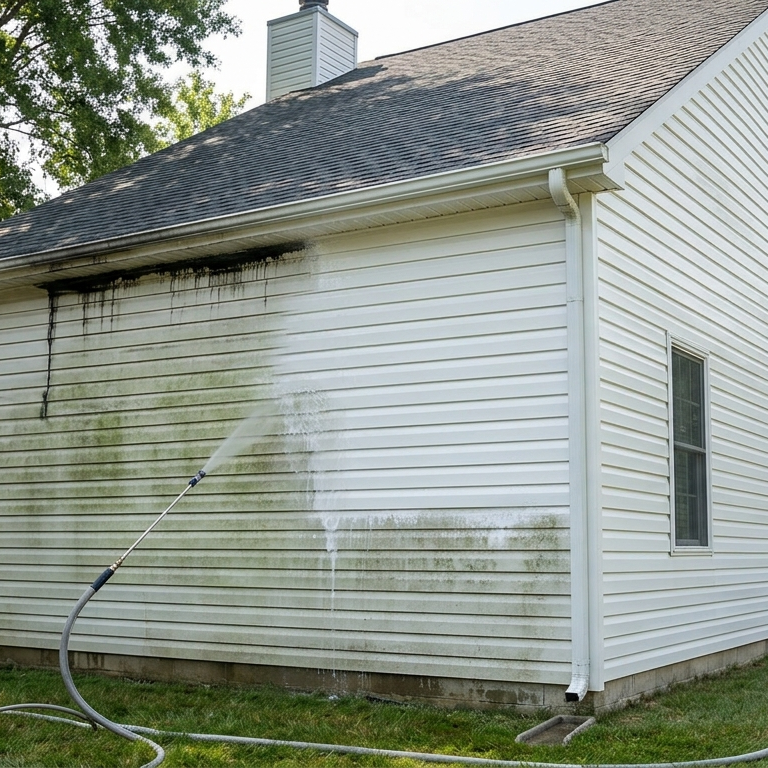
You walk the perimeter of the house with the quote on your phone. The vinyl on the north side has a green cast you can see from the street. There is a black drip line running below the gutter on the east elevation. The dormer above the front porch is too high to reach with a step ladder, and the back of the house faces a treeline that drops debris on the roof every fall. Three different companies have given you three different numbers. One came in at $279. One at $650. One at $1,150.
Same house. Same problem. Three quotes that don't agree on the order of magnitude.
Here's how to read the math.
A fair soft wash quote on a typical two-story house lands between $400 and $900
For a two-story soft wash house washing job in Southern Maryland with vinyl siding, average algae load, and standard access, $400 to $750 is the usual range. Brick or partial-brick exteriors run a little higher because the chemistry takes longer to dwell and rinse. Stucco and EIFS push the top end up because the cleaning crew has to slow down to avoid driving water behind the cladding. A 2,800-square-foot colonial on a wooded lot with heavy algae and a steep grade can fairly run $900 to $1,200. A 1,600-square-foot vinyl two-story on a flat lot in a sunny neighborhood is sometimes $375.
When the spread between quotes is wider than that, something's off. Either the low number isn't a real soft wash, or the high number is padding access cost beyond what the job needs.
Here's what a fair range looks like by home size:
| Home size (heated living area) | Two-story vinyl, average load | Two-story brick or stucco, heavier load |
|---|---|---|
| Under 1,800 sq ft | $375 – $525 | $475 – $650 |
| 1,800 – 2,500 sq ft | $450 – $700 | $575 – $850 |
| 2,500 – 3,500 sq ft | $600 – $900 | $750 – $1,150 |
| 3,500+ sq ft | $800 – $1,200 | $1,000 – $1,500 |
Living area is a proxy. The crew's actual measurement should be perimeter times wall height — that's how much siding gets washed.
What actually drives the price
| Cost driver | Adds to the quote | Why |
|---|---|---|
| Square footage of siding | $0.15–$0.35 per sq ft | More surface, more chemistry, more rinse time |
| Two-story access | $75–$200 | Extension wands, ladders, sometimes a small lift |
| Heavy algae or mildew load | $50–$150 | Higher concentration mix, longer dwell, possible second pass |
| Brick or partial-brick | $50–$100 | Brick holds biocide longer and needs more thorough rinse |
| Stucco or EIFS | $100–$250 | Slower technique to avoid driving water into the system |
| Soffit and fascia included | $40–$100 | Tighter angles, more careful work overhead |
| Exterior gutter face (tiger stripes) | $50–$125 | Different chemistry, brushed by hand on each linear foot |
| Heavy landscaping around foundation | $30–$75 | Pre-soak and post-rinse on plants takes real time |
| Distance from the truck to the back of the house | $25–$75 | Hose runs over 150 ft cost the crew labor |
| Steep grade or no driveway access | $50–$150 | Equipment has to be carried in by hand |
These are real Southern Maryland numbers in 2026 dollars — line items that move the bottom number on a fair estimate. A quote that doesn't reflect any of them is either ignoring conditions on your property or cutting corners on the wash itself.
Why two-story is its own pricing tier
A one-story ranch with the same square footage of siding costs noticeably less than a two-story colonial. The siding area is the same. The work isn't.
On a one-story the crew sprays from the ground with a standard wand. On a two-story, the crew has to reach the second-story gable ends, the dormers, the high soffits, and the trim above the master windows. That means extension wands, a longer hose run with more pressure loss, a ladder repositioned six or eight times, and on certain roof lines a small towable lift.
A second story also changes what falls and where. Biocide running down a vinyl panel from twenty feet up has more dwell time on the way to the ground than biocide sprayed from six feet. If the crew doesn't pre-wet the lower elevation before they start at the top, the lower panels streak as the diluted solution rolls past. A trained crew works top-down with a pre-soak in place. An untrained crew sometimes works bottom-up and leaves a watermark.
That difference in technique is part of what you're paying for.
What cheap quotes leave out
A $279 quote on a two-story isn't a discount. It's a different product. Here's what usually isn't in the scope:
The soft wash chemistry. The $279 crew typically pulls up with a pressure washer, mixes a little detergent into the downstream injector, and blasts the siding at 1,500 PSI. The visible green comes off. The algae cells in the textured grain of the vinyl survive. Six to ten weeks later the green is back. You paid $279 to put off the real wash by two months.
The dwell time. A real soft wash applies the biocide and lets it sit ten to fifteen minutes before rinsing. That's the part that kills the algae at the cellular level. A rushed crew sprays and rinses inside three minutes because the schedule has them at a second job by lunch. The streak comes off. Nothing under it dies.
The high work. A cheap quote usually means the second-story gable ends, dormers, and trim above the second-floor windows aren't on the scope. The crew cleans what they can reach from a six-foot ladder and calls the job done. Two weeks later the streaks on the high work are visible from the curb again because they were never touched.
The landscaping protection. The biocide used in soft washing is an oxidizer. It will burn azaleas, boxwoods, and hostas if it lands on them undiluted. A trained crew pre-soaks the beds, covers what they can, dilutes runoff during application, and rinses at the end. The cheap quote skips that step. Damage usually shows two weeks later when shrubs start dropping leaves.
Soft wash vs DIY: what the economics actually say
Renting a pressure washer from the hardware store runs $70 to $100 a day. A pump sprayer for the chemical is another $25. A jug of pool chlorine is $20. Total cash outlay: about $120 to $150. On paper that's a fraction of the quote.
The math falls apart at the application step. A 5% household-grade sodium hypochlorite — pool chlorine — doesn't have the surfactant chemistry to cling to vertical siding or penetrate textured vinyl. It runs off in twenty seconds. The dwell time that kills the algae below the surface never happens. The DIY job either does nothing or, if you push the concentration, kills your landscaping and burns the paint on your trim. The actual outcome usually looks decent for three weeks, then comes back faster than before because the pressure wash spread spores across previously clean panels.
Add the ladder time. A 28-foot extension ladder is awkward to walk around a colonial, and falls from second-story height are the number-one source of homeowner-injury claims after roof work. One hospital bill pays for fifteen years of soft wash quotes.
The DIY math works on a one-story ranch where you can reach every panel from the ground. It doesn't work on a two-story.
How to read a quote and tell whether it's fair
A fair soft wash quote on a two-story house has line items, not just a total. Look for the surface area or perimeter the crew measured. Look for what's included — siding, soffits, fascia, gutter exterior, trim, windows are all separate scope items. Look for the chemistry the crew is going to use. A quote that says "soft wash" without naming sodium hypochlorite or a biocide concentration is sometimes a pressure wash in disguise.
The per-square-foot rate is another way to read the math. A real soft wash on residential vinyl runs roughly $0.30 to $0.50 per square foot of siding. A basic pressure rinse with detergent sits closer to $0.15 to $0.25. If two quotes both say "soft wash" but one is priced like a pressure rinse, the chemistry is almost certainly not the same. Crews that price by square footage and walk the perimeter usually quote more consistently than crews that pull a number out of the air after a windshield estimate.
Two more things to check. First, is the quote firm or a range? Reputable crews give a firm number after walking the property — not a range that lets them adjust upward once they're on site. Second, does the quote mention plant protection? If the answer is no, it's a tell that the crew hasn't thought through the application or doesn't want to spend the labor on it.
A range quote with no walk-through usually means the crew will run a fast 90-minute job. The work might look fine the day of. It won't hold.
What's included in a quality two-story soft wash
The crew arrives, walks the property, photographs the algae load on each elevation, and confirms the scope with you before mixing chemistry. They pre-soak landscaping along every exterior wall, cover outdoor electrical and light fixtures, and mix the biocide to the concentration the surface needs — typically 1.5 to 3 percent active hypochlorite on vinyl, lower on painted brick, lower still on EIFS.
The application happens top-down. The crew works each elevation in sections, lets the biocide dwell, then rinses with low-pressure water that knocks off the dead organism without driving water behind the siding. Soffits and fascia get the same chemistry as the siding. After the rinse, the beds along the foundation get a final water flood to dilute anything that ran off into the soil.
The crew leaves. The siding looks cleaner immediately. The full result keeps coming in over the next two weeks as the dead algae releases and the next rain washes it away.
A two-story soft wash takes a two-person crew three to five hours. A 90-minute job isn't the same product, no matter what the invoice calls it.
What it usually costs to add companion services on the same visit
The crew is already at the house. The setup is paid for. Adding work on the same day is almost always cheaper than booking it separately a month later. Typical add-on ranges in Southern Maryland in 2026:
| Add-on (booked with the house wash) | Typical range | Notes |
|---|---|---|
| Driveway and walkway concrete | $150 – $325 | Surface cleaner pass, oil-stain spot treatment if needed |
| Roof soft wash | $400 – $850 | Separate chemistry, slower work, second crew day for steep pitches |
| Gutter exterior (tiger-stripe treatment) | $75 – $200 | Linear-foot pricing, brushed by hand |
| Gutter interior debris cleanout | $125 – $275 | Ladder access, separate from exterior face |
| Deck or fence wash | $175 – $400 | Wood requires gentler chemistry and stripping if pre-stain |
| Exterior windows | $100 – $250 | soft wash residue rinse on glass, sometimes included free |
Bundling two or three usually beats standalone prices by 10 to 20 percent. Crew time isn't proportional to the number of services — most of it is setup, walk-through, and plant protection.
Frequently Asked Questions
The quote that holds is the one that explains what it's actually doing
Three quotes from $279 to $1,150 don't represent three different prices for the same work. They represent three different products. The $279 product is a pressure rinse that does nothing to the algae below the surface. The $1,150 product is sometimes fair on a property with heavy access challenges and sometimes padding on a routine job. The $650 product is what most fair quotes look like on a typical two-story in Southern Maryland.
The right question for the crew isn't "what's your price." It's "what's your application." If the answer names sodium hypochlorite concentration, dwell time, low-pressure rinse, plant protection, and top-down work pattern, you're talking to someone who's done this a hundred times. If the answer is "we'll get it clean for you," keep dialing.
The wash that looks cheap on paper usually comes back as the next quote in 90 days.
Superior Power Washing handles soft wash siding cleaning on two-story homes across Waldorf, MD, and all of Charles County and Southern Maryland — including Upper Marlboro, Accokeek, Clinton, Fort Washington, and Prince Frederick. Owner-operated by Cedric, fully insured, line-itemed quotes after an on-site walk-through. Call (240) 901-4252 for a free on-site estimate.
