
Soft Washing vs Pressure Washing: Which One Does Your Surface Need
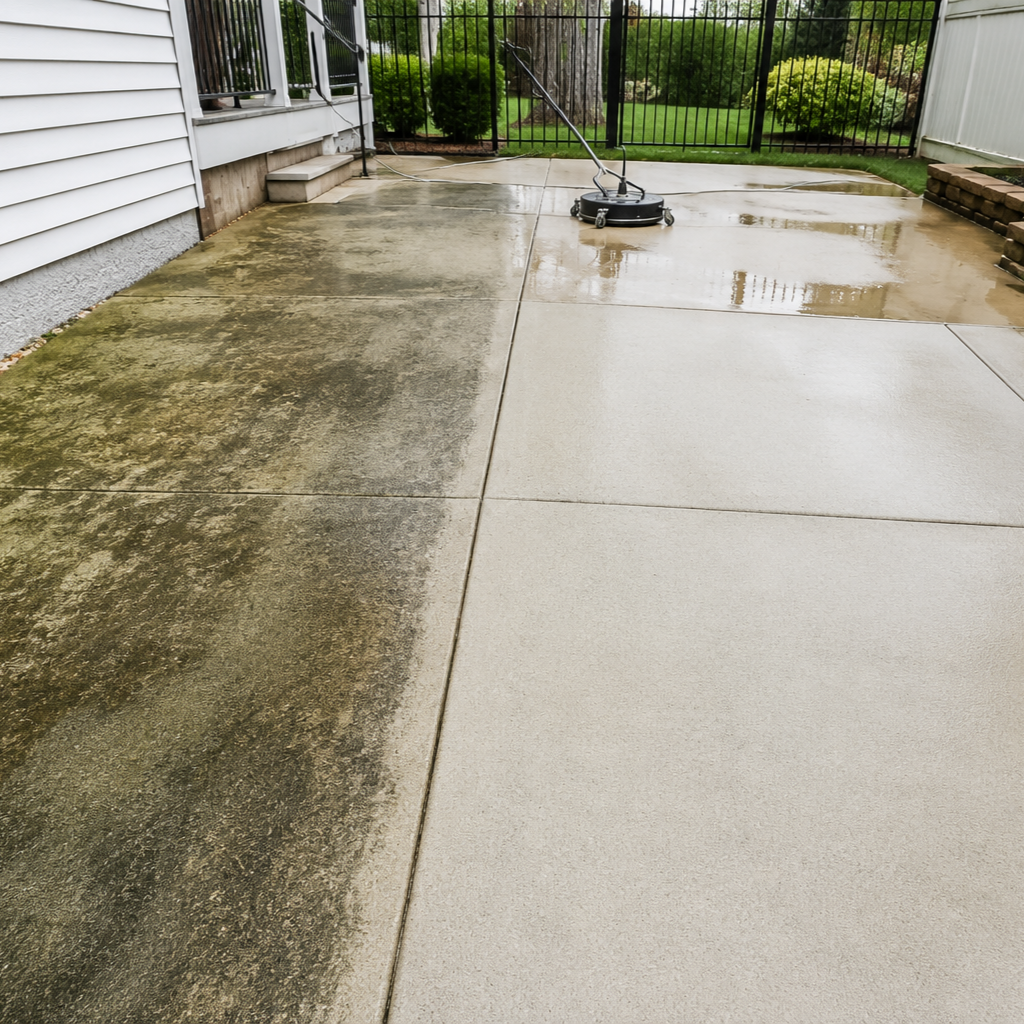
You are standing on the porch with two quotes in your hand. One company wants to pressure wash the house, the roof, the patio, and the deck for one price. The other company wants to soft wash the house and the roof, pressure wash the patio, and won't touch the deck without a separate plan. Same property. Different numbers. Different methods.
The second company isn't being difficult. They are matching the method to the surface — and that's the part most quotes get wrong.
Here is how to tell which method your surface actually needs.
The mechanical difference: force versus chemistry
A pressure washer cleans by hitting a surface with water at high speed. Two thousand to four thousand PSI, sometimes higher, narrow stream, close range. It strips loose material off the surface — dirt, mud, oil film, loose paint, surface grime. The water does the work. The cleaning happens in seconds.
A soft wash cleans by sitting a chemical solution on a surface long enough to kill what's growing there. The water pressure is under 500 PSI — barely more than a garden hose. By comparison, a pressure washer puts out 1,500 to 4,400 PSI, and commercial units run higher. The cleaning agent — usually sodium hypochlorite with a surfactant — does the work. The solution dwells for ten to fifteen minutes, kills the organism at the cellular level, then rinses off at low pressure.
That's the entire difference. Pressure washing is mechanical removal. Soft washing is chemical kill. A pressure washer at four thousand PSI cannot kill algae. A soft wash at twelve percent sodium hypochlorite cannot remove a tire mark. Two completely different tools for two completely different problems.
The mistake almost every homeowner makes is treating them as if one is a stronger version of the other. They're not. They solve different problems on different surfaces.
Match the surface to the method, not the method to the company
Most national pressure-washing franchises own pressure washers because that's what the name says. They use them on everything. Roof. Siding. Deck. Patio. Driveway. One rig for the whole job. The result is fast on the day of, and then half the surfaces look worse six weeks later because the method was wrong for the material.
The table below is the short version of how we approach exterior cleaning quotes by surface.
| Surface | Right method | Why |
|---|---|---|
| Asphalt shingle roof | Soft wash only | High pressure blasts off the granules that protect the asphalt and voids most shingle warranties |
| Vinyl siding | Soft wash | Pressure can crack panels at the seams and force water behind the siding into the wall cavity |
| Brick (unpainted) | Soft wash, sometimes followed by low-pressure rinse | Mortar joints erode under direct pressure; algae lives in the porous brick face |
| Painted brick or stucco | Soft wash only | Pressure peels paint and gouges stucco |
| Wood deck (fence or rail) | Low-pressure wash with deck-safe cleaner | Pressure raises wood grain and gouges soft growth rings |
| Composite decking | Soft wash with mild cleaner | Pressure damages the cap layer that gives composite its weather resistance |
| Concrete driveway or walkway | Pressure wash with a surface cleaner attachment | Mineral surfaces handle pressure; the contamination is mechanical (tire, oil, dirt) |
| Paver patio | Pressure wash at lower PSI with surface cleaner | Same as concrete, but polymeric joint sand washes out at high pressure |
| Garage floor (sealed concrete) | Pressure wash with degreaser pre-treatment | Oil sheen needs chemistry first, then mechanical removal |
| Pool deck (textured concrete) | Soft wash for algae, pressure rinse for mineral film | Algae lives in the texture; pressure alone leaves the surface slick again in weeks |
| Gutters (exterior face) | Soft wash for tiger stripes, hand-cleaning inside | The black stripes are an oxidized chemical film; pressure can't reach the bond |
| Dumpster pad / loading area | Hot-water pressure wash with degreaser | Heavy grease only releases under heat plus chemistry plus pressure |
If a quote treats the patio and the roof as the same line item, the company isn't reading the surfaces.
When pressure is the right tool
Pressure washing is the right answer when the problem on the surface is mechanical — dirt, oil, loose material, mineral residue, tire tracks, mud, debris. Hard mineral surfaces that can take the force. The classic candidates:
A concrete driveway with months of tire marks, oil drips, and ground-in dirt. The surface is dense, the contamination is physical, and a surface cleaner attachment plus three thousand PSI removes what years of foot and tire traffic put down. Soft washing a driveway does almost nothing — there's no living organism to kill, just grime to push off.
A paver patio with embedded dirt in the joint sand and a film of foot traffic across the stones. Lower PSI with a surface cleaner gets the result. The crew has to be careful with the polymeric sand in the joints — that's where pressure washing goes wrong on pavers — but the method itself is correct.
A dumpster pad or loading dock caked in grease. This is one of the few jobs where hot-water pressure washing is the right method. The grease has to soften with heat and a degreaser before pressure can lift it. A cold-water rinse and a biocide spray do nothing here.
A freshly post-construction driveway or patio covered in mortar splatter, paint overspray, or drywall mud. Mechanical removal with pressure plus a surface cleaner is faster, cheaper, and more thorough than any chemical approach.
The common thread is that the contamination is sitting on top of a hard surface that doesn't mind the force. The water does the work because the work is mechanical.
When chemistry is the only thing that works
Soft washing is the right answer when the problem on the surface is biological — algae, mold, mildew, lichen, moss — or when the surface itself can't take pressure. Most residential exterior cleaning falls in this category. The two big drivers:
Anything living. Algae isn't a stain. It's a colony of single-celled organisms rooted into the substrate. The visible green or black is the surface population; the cells in the pores of the shingle, the texture of the vinyl, or the concrete matrix are the part that has to die for the cleaning to last. Pressure removes the visible layer and leaves the substrate population alive. Within six to twelve weeks the colony rebuilds. A soft wash kills it at the cellular level — substrate cells included — and the surface stays clean for two to four years on a roof and one to two years on siding.
Anything that can't take force. Asphalt shingles lose granules under direct pressure. Vinyl siding cracks at the seams. Painted surfaces peel. Stucco gouges. EIFS punches through. Wood deck boards raise the grain and gouge the softer summer rings. On these materials, the question isn't whether soft wash is better — it's whether you want to clean the surface or replace it. Pressure on the wrong surface is destructive in ways that often don't show up for a few weeks. Then the seam splits, the paint blisters, or the deck board grays out in patches.
The cost of using pressure on a soft wash surface is rarely paid on the day of the cleaning. It's paid later, when the siding has to be replaced or the shingles start losing more granules in every storm.
Hybrid jobs that need both
Most full-property quotes are actually hybrid jobs. The house gets soft washed. The roof gets soft washed. The patio gets pressure washed at moderate PSI. The driveway gets pressure washed at higher PSI with a surface cleaner. The deck gets a separate plan based on what wood and what condition. One crew, two rigs, two chemistry kits, and a sequence that puts the right method on the right surface.
The sequence matters too. Soft washing the house first means the runoff doesn't land on a freshly pressure-washed patio. Pressure washing the driveway last means the surface cleaner doesn't push debris back onto a clean wall.
A company that owns one pressure washer and rolls it across every surface on the property isn't doing a hybrid job. They're doing one job four times. The result is mixed by definition: the surfaces that needed pressure look great, the surfaces that needed chemistry look great for six weeks, and a couple of surfaces are quietly damaged in ways that show up next season.
What goes wrong when the wrong method hits the wrong surface
The damage from method-mismatch falls into a few predictable categories.
Granule loss on shingles. A pressure-washed roof loses thousands of granules per pass. The granules are what protect the asphalt from UV exposure. Lose enough and the shingles age in fast-forward. The damage isn't visible the day of — it shows up two summers later when the roof looks bald and the shingles start cracking. Most shingle manufacturers explicitly void warranties on pressure-washed roofs.
Water intrusion behind siding. A pressure stream hitting a vinyl seam at the wrong angle forces water behind the panel. The water sits in the wall cavity, doesn't evaporate the way exterior moisture does, and rots the sheathing from the inside. The owner finds out six months later wjen the drywall gets soft.
Mortar erosion on brick. Direct pressure on brick wears down the lime in the mortar joints. The joints recede, water starts getting in, and over a few seasons the wall needs repointing — a far more expensive fix than a soft wash would have been.
Paint and stain failure on wood. A pressure-washed deck looks great for two weeks. Then the surface starts cupping where the grain raised. Then the stain peels in patches because the surface texture changed. The next refinish is a strip-and-restain instead of a clean-and-recoat.
Spread instead of removal. A pressure stream hitting an algae streak doesn't just knock the visible layer loose — it scatters spores across previously clean surface. The streak goes away, then reappears six feet wider. This is the version of "looks worse than before" that surprises homeowners most.
A soft wash, by contrast, is a slow method that does the right thing. The day-of result is less dramatic. The result that matters — the one six months out — is the right one.
How to tell which one the contractor is actually doing
The equipment tells you. A pressure washing rig is a high-PSI pump on a trailer with a single hose and a wand. A soft wash rig has a separate chemical tank, a downstream injector or a dedicated soft wash pump, and a different nozzle setup. A crew that arrives with only the first one isn't equipped to soft wash, no matter what the quote says.
The questions the contractor asks tell you too. A contractor scoping a real soft wash will ask about plant exposure, dwell time concerns, downwind windows, paint condition, and the age of the roof. A contractor planning to pressure wash everything won't ask any of that — there's nothing to plan around. The water hits the surface and runs off.
The pricing tells you, sometimes. A soft wash uses chemical at a real cost per gallon, plus dwell time on the property, plus crew time during the rinse. A pressure wash is mostly equipment time and fuel. Identical pricing across both methods is a clue that the company is treating them as the same service, which means at least one of the surfaces is going to get the wrong treatment.
Frequently Asked Questions
The right wash is the one that matches the surface.
A pressure washing-only company will pressure wash everything. A soft washing-only company will soft wash everything. A contractor who knows the work uses both, picks the right one for each surface on your property, and explains why before the rig comes off the trailer.
Most of the time the question isn't soft wash or pressure wash. It's which surfaces get which, and in what order. The answer changes based on the materials, the contamination, and the age of the surface.
If the company quoting your property can't tell you which surfaces need chemistry and which need force — and explain why — they're going to use the same tool on everything. That's the result you're trying to avoid.
Superior Power Washing handles soft wash and pressure wash cleaning across Waldorf, MD, and all of Charles County and Southern Maryland — including La Plata, Hughesville, Bryans Road, Indian Head, and Charlotte Hall. Owner-operated, fully insured, and equipped for both methods so the right one ends up on the right surface. Call (240) 901-4252 for a free on-site assessment.
