
How to Clean a Concrete Driveway the Right Way
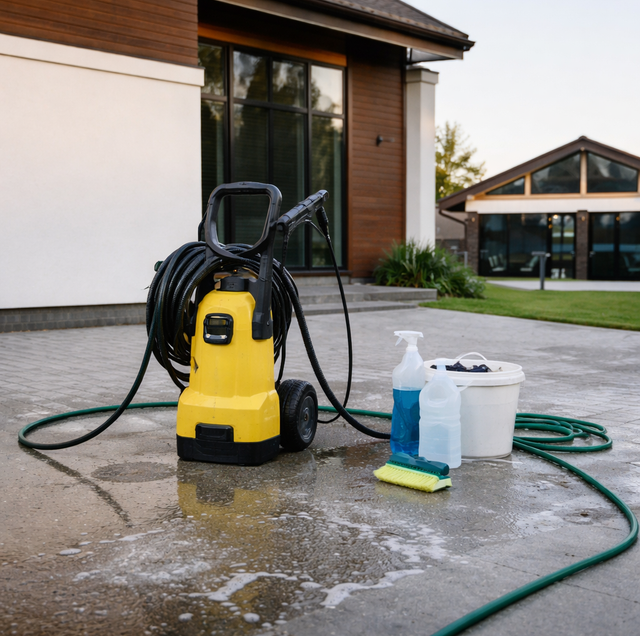
Quick Answer: Clean a concrete driveway by matching the tool to the stain: a flat surface cleaner with detergent for general grime, a degreaser or poultice for oil, an oxalic-acid remover for rust, and a mildewcide soft-wash mix for algae and mold. Pre-treat and sweep first, keep pressure moderate so you don't etch the concrete, rinse thoroughly, then seal to make future cleaning easier.
A driveway rarely gets dirty in one uniform way. What looks like a single gray mess is usually four or five different problems layered on top of each other: ground-in dirt and traffic film across the whole slab, green or black organic growth in the shaded areas, black scuff marks where tires bite the surface, orange rust bleeding from a bike stand or a fertilizer spill, and a dark oil or grease patch under wherever the car parks. Each of those has its own chemistry, and each responds to a different fix. Reaching for one tool and blasting the whole thing at full pressure treats them all the same, and it usually leaves the worst stains behind while quietly chewing up the concrete.
So the first move is not to pick a nozzle. It is to read the slab and sort what you are looking at. Once you know which stains are surface grime, which are organic, which are petroleum, and which are metal oxide, the method almost writes itself.
Read the Stains Before You Pick a Method
Concrete is porous, so stains sit in two places at once: on the surface and soaked into the top layer. That is why a quick rinse makes a driveway look better for a day, and then the stain's shadow comes back. To actually remove it, you have to lift what soaked in, and that depends entirely on what the stain is made of.
General grime and traffic film is the easy part. It is dust, pollen, exhaust residue, and the gray film that builds up from daily driving. A detergent formulated for concrete plus moderate pressure clears most of it.
Organic growth is the green, black, or gray fuzz that shows up in the corners and along the shaded edge of the slab. This is living algae, mold, and mildew, and pressure alone does not kill it. Blast it off, and the root structure stays in the pores, so it grows back within weeks. It needs a mildewcide or a diluted sodium-hypochlorite soft-wash mix to actually kill the organism.
Tire marks are hot rubber and plasticizer smeared into the surface. A degreaser loosens them because they are closer to a petroleum stain than to dirt.
Oil and grease is petroleum that has wicked deep into the pores. Water pushes it around but will not dissolve it. It needs a degreaser to break the bond, and an old, set-in stain often needs a poultice to draw it back out.
Rust is iron oxide, a metal stain. No detergent touches it. It takes a mild acid, usually oxalic acid, to convert and lift the iron.
Naming the stain is the whole game, because the tool you would use for one actively fails on another.
Why Max Pressure Is the Wrong Default
There is a strong temptation to solve everything with more pressure. It feels productive, and it does strip the top layer of dirt fast. The problem is that the top layer of dirt sits on the top layer of concrete, and a pressure washer does not know where one ends and the other begins.
A tight, high-pressure stream held too close etches and pits the surface, leaving visible wand lines and a rougher, more porous slab that then holds dirt worse than before. Push it into the joints, and it blows out the sand and cracks the flexible filler in the control joints, the intentional grooves cut into the slab so it cracks in a straight line instead of a random one. Once that joint filler is gone, water gets underneath, and freeze-thaw cycling does the rest over the following seasons.
Older concrete, decorative finishes, and any slab with surface spalling are especially easy to damage. A washing machine analogy fits here: you do not run delicates on the heavy-duty cycle just because it cleans harder. The right approach is enough pressure to lift grime, no more, with the chemistry doing the work the pressure cannot.
There is a safety reason to respect the machine too.
At full pressure, the stream can lacerate skin, and a surface cleaner or wand can kick back hard enough to throw you off balance. Keep the trigger controlled and the tip pointed away from your feet and anyone nearby.
The Method, Step by Step
Sweep and pre-treat first: Clear the slab of leaves, dirt, and loose debris with a stiff broom or blower. Anything left on the surface turns to mud and redeposits. Then pre-treat the trouble spots while the concrete is dry or barely damp: degreaser on the oil and tire marks, mildewcide on the green and black growth, rust remover on the orange. Let each product dwell for the time on its label, usually several minutes, so it has time to break the bond before any water hits it. Pre-treating is what separates a real clean from a cosmetic one.
Use a flat surface cleaner, not a wand: For the open field of the driveway, a flat surface cleaner attachment is the single biggest upgrade over a bare wand. It houses two spinning jets under a shroud that keeps them a fixed distance from the concrete and sweeps them in an even arc. That gives you one consistent clean across the whole slab instead of the zebra-stripe pattern a hand-held wand leaves when your passes overlap unevenly. It also keeps the high-pressure stream contained, which is both safer and less likely to gouge. Move it slowly and in overlapping rows so no strip gets missed.
Keep the pressure moderate and the tip back: Match the pressure to the concrete, not to your patience. Enough to lift the loosened grime is plenty. Keep a wider-angle tip on the wand for edges and detail work, hold it back from the surface, and never park the stream in one spot. Let the pre-treatment chemistry carry the load so the water is just rinsing, not blasting.
Treat oil with a degreaser or a poultice: For a fresh oil spot, an alkaline concrete degreaser scrubbed in with a stiff brush and then rinsed usually lifts it. For an old stain that has soaked deep, a poultice works better: a paste of an absorbent material and a solvent that you spread over the spot, cover, and leave for a day so it pulls the oil back up out of the pores as it dries. It may take two rounds on a stubborn one.
Lift rust with an oxalic-acid remover: Rust needs a dedicated oxalic-acid or specialty rust remover, applied to the spot and rinsed per the label. Do not reach for a stronger acid thinking it works faster, and never mix products. Acids demand eye and skin protection, and careful, thorough rinsing so nothing acidic is left sitting on the slab.
Kill organic growth; do not just rinse it: For algae and mold, a mildewcide or a properly diluted soft-wash mix does the killing that pressure cannot. Let it dwell, then rinse. Because it kills the organism rather than just knocking off the visible top, the regrowth is far slower. Never combine a bleach-based mix with an acid rust remover or an ammonia cleaner; that reaction releases toxic gas.
Rinse thoroughly, top to bottom: Rinse the entire slab from the high side down so nothing dries with cleaner residue, which can leave streaks or a dull film. A treated surface stays slippery until it is fully rinsed and dry, so keep people and pets off it until then.
Seal It So the Clean Actually Lasts
Bare concrete is a sponge. The reason a driveway restains so fast is that every spill soaks straight into open pores. A penetrating concrete sealer fills those pores so oil, rust, and dirt sit on top where they wipe or rinse away instead of soaking in. It also slows the organic growth by giving algae less damp, porous surface to root into.
Seal only after the slab is clean and fully dry, and reapply on the schedule the product calls for, often every couple of years depending on traffic and exposure. A sealed driveway is dramatically easier to keep clean, which is the whole point: you are trading one careful cleaning now for years of easy rinse-downs later.
Keep It Clean With a Little Prevention
The habits that keep a driveway clean are small and cheap compared to a full restore.
Address oil drips the day they happen, while the oil is still on the surface and a degreaser can lift it before it wicks deep. Keep the slab swept so grit and leaves do not grind in or feed organic growth. And fix drainage that keeps part of the slab wet, because standing water and constant damp are what algae and mold live on.
That last point is the evergreen one. Shade and moisture feed growth in every season, not just the warm months. A north-facing or tree-shaded section stays damp and green year-round, and a downspout that dumps onto the slab keeps a wet stripe going through winter as readily as summer. Cleaning removes what is there today; correcting the shade-and-moisture conditions is what stops it from coming back.
Frequently Asked Questions
Straight household bleach can knock back surface algae, but it is hard on adjacent plants and metal, and it does not include the surfactants a purpose-made soft-wash mix uses to cling and penetrate. If you do use a diluted sodium-hypochlorite mix, pre-wet nearby grass and shrubs and rinse them after, and never let it touch an acid or ammonia product.
Contain and direct the runoff away from planting beds, and neutralize acidic rust-remover rinse before it spreads, since acids can scorch roots. Many areas restrict what can enter storm drains, and rules vary by location, so berm the runoff toward a lawn or planting bed that can absorb it rather than letting cleaning chemicals run straight to the street inlet.
The number on the machine matters less than tip distance and nozzle angle, but concrete tolerates more than wood or siding. The bigger variable is the nozzle: a 25-degree tip is a safe general choice, while a zero-degree needle tip concentrated on one spot is what gouges and leaves lines. A surface cleaner sidesteps the guesswork by fixing the distance for you.
Yes, and it is often the better tool for one. The raised ridges of a broom finish trap dirt that a flat wand skips over, and the surface cleaner's even sweep reaches into that texture consistently. Move it more slowly on a heavily textured slab and expect to run a second pass on the deepest grooves.
That usually means the stain soaked into the pores rather than sitting on top, so water temporarily darkens and hides it. It is the signature of an organic or oil stain that was rinsed but never treated. Go back with the matching product, a mildewcide or a degreaser, let it dwell, and the dry result will finally match the wet one.
Wait until the slab is completely dry all the way through the top layer, which commonly means a couple of dry days after washing, longer in cool or damp conditions. Sealing over trapped moisture clouds the finish and can cause the sealer to peel, so a moisture check with plastic sheeting taped down overnight is worth the delay if you are unsure.
Book a professional driveway cleaning and seal — get an even, streak-free result that stays clean far longer. Superior Power Washing serves Waldorf, La Plata, and Clinton. Call (240) 901-4252.
