
What Causes White Salt Lines on Boat Dock Pilings
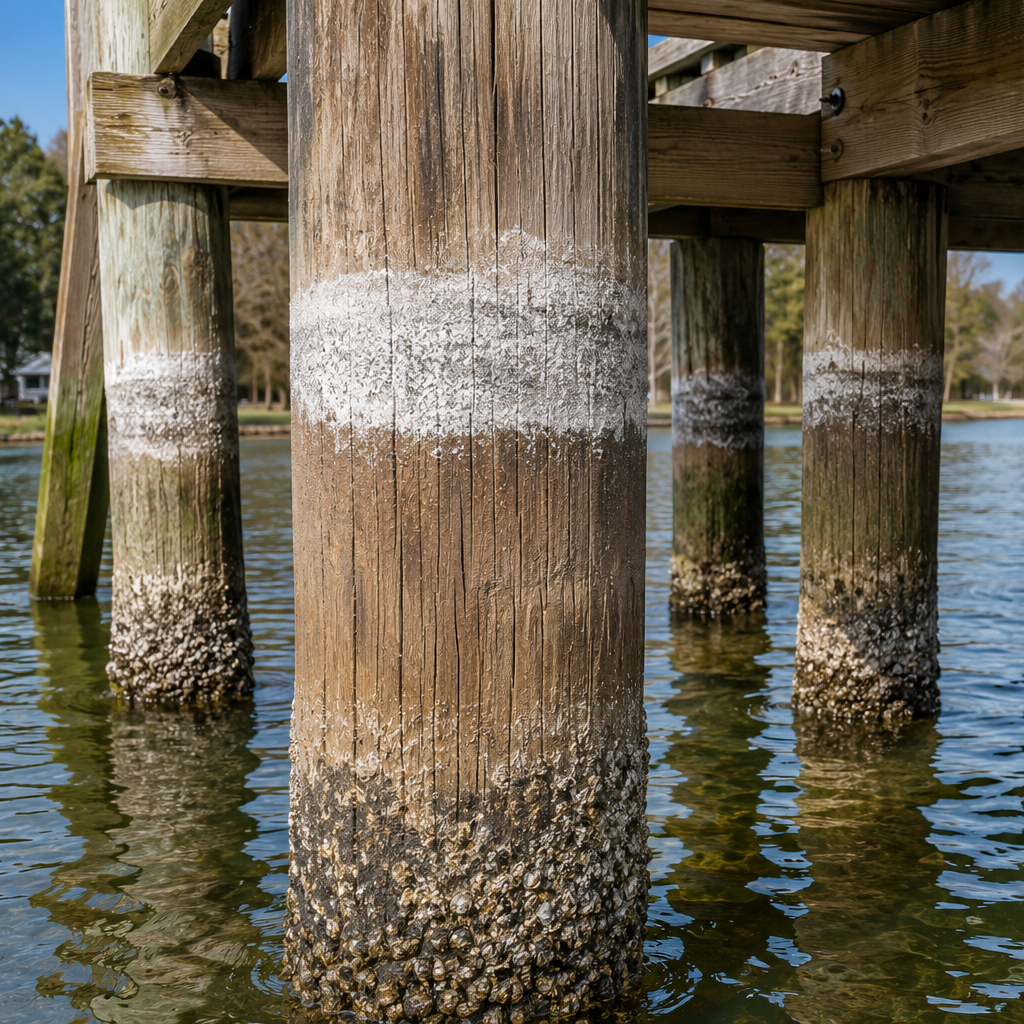
You walk out to the end of your dock at low tide and there it is — a hazy white band running across the pilings at about chest height, then another fainter one a foot below it, and a chalky crust right at the splash zone where the wood meets the waterline. Run a finger across it. The residue comes off gritty, like fine sand mixed with chalk. Rinse it with the freshwater hose and most of it dissolves, then twenty minutes later, when the wood dries again, the white comes back.
Same band. Same height. Same crust.
This is what's actually happening.
The white isn't dirt. It's crystallized salt left behind by evaporating water.
Brackish water in tidal rivers — the Potomac, the Wicomico, the Patuxent — carries dissolved salt, sediment, and minerals. When tide drops or wind splashes that water against a piling, the wood soaks some of it in. The water evaporates. The salt and minerals don't.
What's left behind is a crystalline residue: sodium chloride mostly, along with calcium, magnesium, sulfates, and whatever else was dissolved in that particular stretch of water. The crystals collect at the height where wet wood meets dry wood — the splash zone, the high-tide line, and any spot where water repeatedly soaks in and dries out.
The band you see at chest height isn't a coincidence. That's where the tide reached on the highest swing of the cycle, then receded. Every cycle adds another microscopic layer.
How capillary action pulls the salt deeper than the surface
Wood isn't a solid block. It's bundled tubes — xylem fibers that ran vertically up the tree when it was alive. Those fibers behave like a stack of drinking straws. Water touches the bottom and wicks upward through capillary action, sometimes a foot or two above the actual waterline.
When that wicked water evaporates inside the fibers, the salt crystallizes in there too. Not on the surface. Inside the grain.
That's why scrubbing the outside doesn't fix it. The visible white is the top layer of a much bigger deposit pushed deep into the wood. Rinse the surface and you knock off the top fraction. The salt buried in the fibers stays put. Sun dries the wood, water inside the grain evaporates outward, and the surface gets re-coated within hours.
A piling with two seasons of unaddressed salt loading can hold pounds of crystallized mineral inside the wood — invisible from the outside, but always ready to migrate back to the surface the next time the wood dries.
Walk the pattern down: a decision tree for what's actually on your piling
The pattern matters more than the color. Start at the first question and follow the branch that matches what your piling looks like — two or three steps will usually land you on a diagnosis.
Is the white spread evenly across the high-tide band, or is it concentrated in one spot?
If it's an even haze across the band → you're looking at standard salt evaporation, first season. Low urgency, cosmetic. Wash annually and you'll never see it get worse than this.
If it's concentrated, keep going.
Does the concentrated patch look like a thick chalky crust, or is it streaky and directional?
If it's a thick chalky crust an inch or two deep at the splash zone → multi-season salt loading mixed with mineral scale. Medium urgency. Wash before it pulls moisture out of the wood permanently. The wood under that crust is being dried out from the inside.
If it's a fluffy white fuzz with visible wood fiber lifting off the surface → the salt crystals are forcing the grain apart from inside. High urgency. The wood is being damaged structurally, not just stained. Clean and reseal.
If it's streaky and directional, keep going.
Where is the streak coming from — a piece of hardware, or above the piling?
If the streak runs down from a bolt, bracket, or cleat → galvanic salt deposit from corroded metal hardware leaching minerals into the wood. High urgency. The hardware itself is failing. Replace the bolt or bracket, then clean.
If the streak runs down from a rope, line, or anything stretched above the piling → salt drip from the rope absorbing spray and then dripping. Low urgency on the wood, but check the rope itself for rot — that's where the bigger problem usually is.
Last branch: is there a hard white ring at a single height that won't rinse off?
If yes → calcium carbonate scale from hard-water spray (often from a freshwater dock hose hitting the same spot every wash). Medium urgency. Needs an acid-based cleaner. A freshwater rinse won't move it.
A uniform haze across the high-tide band is normal first-year accumulation. A thick crust with the wood fibers visibly separating is a wood-preservation problem, not a cleaning problem. Get the diagnosis right and the right fix follows.
Why the freshwater hose only solves half of it
Standing on the dock with a garden hose feels like the obvious fix. Spray the piling, the white disappears, job done.
It comes back. Usually within a day, sometimes within hours.
Freshwater rinses only dissolve the salt that's already migrated to the surface. The deposits inside the wood grain stay put. Sun dries the piling, capillary action wicks fresh water back out of the fibers, and the dissolved salt re-crystallizes on the surface as that water evaporates. You've moved the salt around, not removed it.
A real cleaning has to do two things the garden hose can't. First, soak the wood long enough that the embedded salt actually dissolves and starts moving outward. Second, rinse before that salty water evaporates back into the wood. That's a soaking application, not a quick spray.
For a heavily loaded piling, that often means two or three soak-and-rinse cycles spaced fifteen to twenty minutes apart. The first cycle pulls the easy stuff. The second and third get the deeper deposits as the wood releases what it soaked in.
What pressure washing does to a salt-loaded piling — and why it backfires
Hitting a salt-encrusted piling with 3,000 PSI is a tempting shortcut. The crust blows off in seconds. Looks great that afternoon.
A week later the piling looks worse than before.
Two reasons. High pressure tears the soft outer wood fibers — the ones already weakened by salt expansion inside the grain. Splinters lift, the surface roughens, and now every wave hits exposed end-grain that soaks water faster than the original surface did. The next round of salt deposits sink deeper and dry harder.
The other reason: pressure drives surface salt into the wood instead of removing it. The water force pushes dissolved crystals into the cracks the pressure just created. You've concentrated the salt where you can't reach it.
Cleaning a wood piling right uses pressure barely above a strong garden hose — usually under 500 PSI for the rinse — paired with a wood-safe cleaner that lifts the salt at the cellular level. The chemistry does the work. The water moves it away.
What works on salt-loaded pilings without trashing the wood
The right approach depends on the wood, the species, and how much salt is locked in. A few constants apply across most dock pilings.
Mild detergent cleaner first. A wood-safe surfactant drops the surface tension of the rinse water so it actually penetrates the grain instead of beading off. Diluted oxalic acid or a commercial dock cleaner formulated for marine wood works for heavier mineral deposits — it dissolves calcium scale that fresh water alone won't touch. Skip household bleach. It strips the wood's natural lignin and speeds up the gray-out you're probably already fighting.
Long soak times beat high pressure every time. Ten to fifteen minutes of dwell with a brush-agitated cleaner pulls more salt out of the grain than thirty seconds of blasting. The wood needs time to release what it's holding.
Rinse from top down at low pressure, then walk the piling and re-rinse the splash zone twice. Salt water trickling down a piling re-deposits on the lower sections as it dries — top-down rinsing pushes the dissolved salt off the wood entirely instead of letting it migrate downward.
A sealer or wood preservative applied after a thorough clean keeps next season's deposits closer to the surface where they wash off easily. Without a sealer, untreated wood pulls salt back into the grain faster than a treated piling does.
For most homeowners with three to six pilings on a residential dock, this is a half-day job done once a year. For a larger dock or a commercial pier, the wash makes more sense at the start of boating season and again in late fall before the wood sits wet through winter.
Cedar and untreated softwoods need the gentlest possible approach — anything above 800 PSI on cedar will fuzz the surface even before the salt loading is factored in. Pressure-treated southern yellow pine can take slightly more force but still benefits from the chemistry-first method. Marine-grade composite pilings are the most forgiving, but even those etch under aggressive pressure.
A trained crew brings the chemistry, the right rinse equipment, and the experience to read the deposit pattern before deciding which approach to use. For dock owners who don't want to spend a Saturday on a ladder with a pump sprayer, industrial and specialty cleaning covers boat docks and marine structures at the same precision a residential house wash would get.
The other things worth checking while the pilings are being washed
A clean piling is also a piling you can finally see. Salt deposits hide what's happening underneath — and what's happening is usually some combination of hardware corrosion, fastener movement, and slip-readiness problems on the boards above.
Look at every bolt, bracket, and cleat after the wash. White drip lines running down from a fastener are salt being pulled out of the metal as it corrodes. A bolt head that turns by hand. A cleat plate that's lifted at one corner. Rust spreading in a halo around a washer. These are the kinds of small failures that look harmless on a salt-encrusted piling and become obvious on a clean one — and they're cheaper to address with a wrench than with a dock-builder's invoice.
The walking surface immediately above the splash zone matters just as much. Salt residue mixes with algae and dock-board tannins to create a film that's slick when wet, even on textured composite. Most dock injuries happen on this strip — the first two or three feet of decking nearest the water, where someone steps off a boat with wet shoes. A piling wash that doesn't include the adjacent decking leaves the slip hazard in place. Most cleaning visits cover both together for that reason.
Frequently Asked Questions
The white lines aren't going anywhere on their own, but they're also not as urgent as they look.
A salt band at the high-tide line is doing what it's been doing for as long as boats have tied up to wood: tide rises, water soaks in, water evaporates, salt stays behind. Repeat that cycle a few thousand times and you've got a crystalline band where the wood meets the air.
The fix isn't a one-time scrub. It's a yearly maintenance habit timed for the start and end of the boating season, with chemistry calibrated for marine wood and the rinse runoff captured rather than flushed back into the water.
A piling that gets the right wash twice a year looks gray-brown for twenty years. A piling that doesn't gets blanket white and starts losing fiber at year eight.
Superior Power Washing handles dock piling, boat lift, and waterfront wood cleaning across Waldorf, MD, and all of Charles County and Southern Maryland — including La Plata, Brandywine, White Plains, Hughesville, and Charlotte Hall. Marine-safe chemistry, runoff captured before it hits the water, owner-operated, fully insured. Call (240) 901-4252 for a free on-site assessment.
