
What Are the Tiny Black Dots Stuck to Your Vinyl Siding (Artillery Fungus)
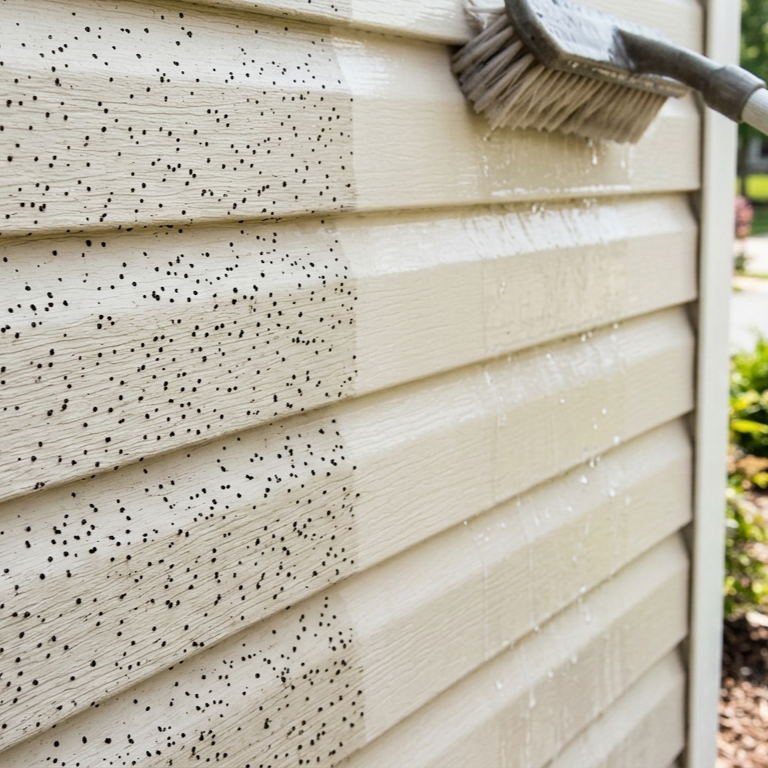
You are walking around the side of the house with a microfiber cloth, ready to wipe off what looks like a patch of dirt or mold on the lower siding. The dots are everywhere — hundreds of them, maybe a thousand, scattered across the bottom four feet of one wall like somebody flicked a wet paintbrush. You press the cloth against one. Nothing. You scrape with a fingernail. The dot is still there, with a smear of glossy black residue around it.
Not dirt. Not mold. Not coming off the way anything else does.
What you're looking at is artillery fungus.
Artillery fungus isn't a stain — it's a tiny spore glued to your siding
Sphaerobolus stellatus — the name on a mycology textbook — is a small wood-decay fungus that lives in hardwood mulch. When the fruiting body matures, it builds up internal pressure and then physically fires a single spore packet into the air. The launch speed is high enough to throw the packet 20 feet horizontally and 8 to 10 feet up the side of a building. The fungus aims for light. Reflective surfaces — vinyl siding, white-painted trim, car windows, glass storm doors — pull the spore packets like flypaper.
Each spore packet is about the size of a poppy seed. Sticky on the outside. Brown when it lands. Within a day or two, it cures into a hard, near-black bead that's bonded to whatever it hits.
The bond isn't surface deposition. The spore packet carries a resinous, adhesive material that essentially welds itself to the substrate as it dries. On vinyl siding, the resin chemically fuses with the plasticizer in the panel. On glass, it micro-etches the surface. By the time you notice the dots and try to wipe them off, the bond is already permanent.
How to tell artillery fungus from the other dark dots on the the siding
Half the calls we take on this topic start with "I think it's mold." A few start with "wasps." A handful start with "the neighbor's grill." Here's the comparison sheet we walk through:
| Suspect | What it looks like | What it does when you try to wipe it | Where you'll see it on the house | Where it came from |
|---|---|---|---|---|
| Artillery fungus | Tiny dark dots, 1–2 mm, slightly glossy, raised | Won't budge; scraping leaves a black smear, and can pull vinyl pigment | Lower 6–8 feet of siding, concentrated on walls facing fresh mulch beds | Hardwood mulch breeding fungus |
| Mold or mildew | Black streaks, green tint, or patchy haze | Wipes lighter with water; a soft wash biocide clears it | Shaded north walls, under drip edges, behind shrubs | Algae or fungal colony living on the surface |
| Spider or insect specks | Small dark dots, dusty, often grouped near corners and eaves | Brush or rinse takes them right off | Eaves, soffits, behind shutters | Spider droppings, mud-dauber debris |
| Tree sap from magnolia, gum, or oak | Brown drips, sticky if fresh, dark and tarry once dry | Comes off with a citrus degreaser or specialty solvent | Directly beneath overhanging branches | Botanical exudate |
| Wind-blown dirt | Brown or gray haze, uniform pattern | Rinses off with a standard wash | Whole walls facing the prevailing wind | Soil, road dust, construction debris |
Artillery fungus is the only suspect on that list that won't come off with a wipe and a rinse. If a dot resists a wet cloth and leaves a dark smear when you scrape it, that's the diagnosis.
Why these dots stick like superglue
A normal stain — mold, dirt, sap, soot — sits on top of the siding. Strip the deposit and the surface comes back clean. A pressure wash works because all you're doing is mechanically removing something resting on the surface.
Artillery fungus doesn't sit on top. The spore packet arrives wet and resinous. As it dries, the resin penetrates the upper micrometer of the vinyl, then hardens like a tiny dot of two-part epoxy. To remove the spore mechanically, you have to remove a few microns of the vinyl with it. That's what makes the dots so hard to clean: any solvent strong enough to dissolve the resin will also damage the pigment layer of the siding.
Dish soap and warm water is the first thing people try. Then a magic eraser. Then a stiff brush. Then a pressure washer. Each step moves the dots a little — sometimes just smears them — and leaves more siding damage than fungus removal.
Where the spores come from: the mulch nobody suspects
Artillery fungus lives in decomposing hardwood mulch. Specifically, the cheap dyed double- or triple-ground hardwood mulch sold in 2-cubic-foot bags at every big-box garden center between March and June. The fungus colonizes the mulch within a few weeks of installation. Once colonized, it fruits in cool, damp weather — early spring and fall in Maryland — and starts launching spores.
A few details that explain the pattern you see on the house. The fungus aims for bright, light-reflective targets. White and light-colored vinyl siding gets hit hardest; brick and dark-painted trim show fewer dots. The spores travel up to 20 feet, so the mulch bed along the foundation is usually the source — but a neighbor's bed across the property line can also be the culprit if the line of sight is clear. The launch height tops out around 8 to 10 feet, which is why the dots concentrate on the lower siding and stop abruptly above the first-story windows.
The temperature window matters more than the calendar. Spore launch happens when air temperatures sit between roughly 50 and 68 °F. Above 78 °F, the fruiting bodies stop forming, which is why the launches drop off in mid-summer. The fungus picks back up when fall cools things off again. The spores already on the siding stay forever.
Wood-chip mulches around playgrounds and commercial landscaping installations carry the same risk. Pine-bark mulch is far less hospitable to the fungus and rarely produces a problem. Pine straw and stone mulches don't host artillery fungus at all.
What actually removes the dots (and what makes them worse)
There's no truly clean removal once the resin cures, but there's a short early window where it's a different conversation. In the first two or three weeks after a spore packet lands, the resin is still tacky enough that a plastic scraper or a stiff brush will lift the dot without taking the siding pigment with it. Catch them that early, and the wall comes back close to the original. Past the three-week mark, the resin is locked in, and the rest of this section applies.
Anything strong enough to dissolve the spore coat will alter the siding. The realistic options run on a spectrum.
A soft wash biocide treatment dissolves the protein coat around the spore packet and softens the resin underneath. A trained crew applies the biocide, lets it dwell, then agitates the dots with a soft brush before rinsing. Some dots come off cleanly. Others leave a faint shadow on the vinyl where the resin penetrated the surface layer. On siding under five years old, the result is usually 70–90 percent removal, with the remaining dots visible only on close inspection.
A magic eraser with patience and steady pressure removes individual dots, but takes the gloss off the siding panel everywhere the sponge touched. Twenty square feet of siding takes a weekend, and the cleaned area looks duller than the surrounding panels.
A pressure washer at 3,000 PSI doesn't remove the dots. It dimples the siding around each dot, leaves the dot in place, and creates a permanent texture you can feel with your hand.
Solvents — acetone, mineral spirits, citrus degreasers — soften the resin a little but also dissolve the vinyl's surface pigment. The dot lifts. A bleached spot stays behind.
Painting over the dots is a tempting shortcut that doesn't work. The paint seals the existing spots, but the surface ends up gravelly to the touch, and any new spores fired the following spring just stick to the paint and start the count over.
Panel replacement is the only path to a fully clean wall. Single panels can be swapped on most vinyl-siding systems, but matching the color of a sun-faded existing wall to a new panel is hit or miss. The realistic move is living with the partial-removal result and focusing on preventing the next round.
Repeat washing never catches up to the source
Even after a successful soft wash, the dot count starts climbing again the next spring. We've washed houses with 600 spots one year and 400 the next — partial progress, never a clean slate. The reason is timing. The spore launch and the resin cure happen in days, while a soft wash happens once a year. Every storm window between two cleanings adds a new generation of dots, and the existing ones are still locked into the substrate.
That's why prevention does more for the long-term look of the siding than aggressive removal. Cutting off the source matters more than chasing the deposits.
Stopping the next generation: replace the mulch, not the siding
The reliable way to stop new dots from appearing is to remove the breeding ground. A few things help, roughly in order of effectiveness.
The mulch swap. Replace any hardwood mulch within 20 feet of the affected wall with pine-bark mulch, pine straw, or river rock. Pine bark resists the fungus. Stone hosts none of it.
The annual refresh. If you're attached to hardwood mulch, replace the top layer every spring before fruiting season starts. Fresh mulch hasn't colonized yet. Old mulch — anything in the bed longer than 18 months — is the high-risk material.
The mushroom check. After a wet week in April or October, walk the mulch beds and look for tiny cup-shaped fruiting bodies, about 2 mm across, often cream or orange with a dark center. If you find them, the bed is actively launching spores. Remove the top 2 inches of mulch and replace it.
The vinyl coating. Some manufacturers sell a wax-like coating that goes on clean siding and creates a sacrificial surface — the next spore packet sticks to the wax, not the vinyl. Wash and recoat annually. The coating doesn't undo damage to existing dots, but it does protect a freshly cleaned wall.
The buffer. Mulch installed three feet or more away from the foundation, with a stone or paver border between mulch and siding, sharply reduces hits. Spores can still travel, but the angle of impact drops off, and fewer reach the wall at sticking velocity.
Once the source is removed, no new dots appear. The existing dots stay where they are until the next soft wash or until the siding gets replaced.
Frequently Asked Questions
What homeowners actually do with a wall full of fungus dots
The realistic answer isn't "remove every spot." It's soft wash the wall to clear the loose deposits, replacing the mulch to cut off the source, and living with the partial-coverage result until the next siding refresh. Spending a weekend or a paycheck chasing 100 percent removal on cured spots isn't worth the cost or the damage to the panels.
Catch the problem in year one, and the math is better. Spot the dots in the first month — before the resin fully cures — and a soft wash can pull off 90 percent of them with no visible residue. Wait three seasons, and you're looking at permanent shadow marks on every panel that got hit.
The shortest path is the boring one: identify the mulch, swap the mulch, wash the wall.
Superior Power Washing handles artillery fungus identification and soft wash treatment on vinyl siding across Waldorf, MD, and all of Charles County and Southern Maryland — including La Plata, Clinton, Fort Washington, White Plains, and Brandywine. Owner-operated, fully insured, honest about what removal will and won't accomplish on cured spore deposits. Call (240) 901-4252 for a free on-site assessment.
