
Why Pool Decks Stay Slippery Even After You Hose Them Down
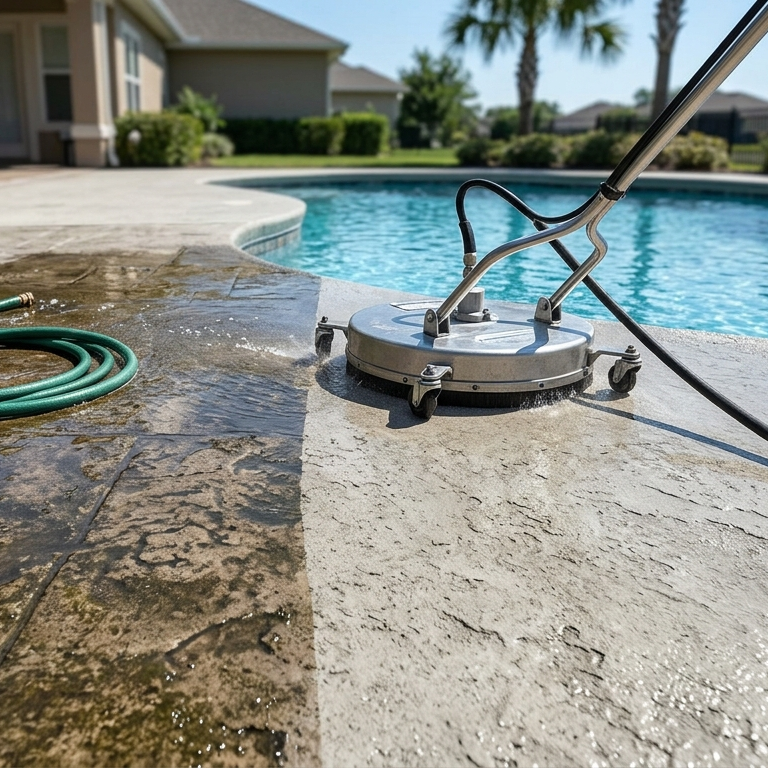
You stepped out of the house barefoot, walked across the pool deck on your way to the cover, and almost went down. Same spot, same time of year, same hose-down two days ago. The deck looks clean. Your soles say otherwise.
That's not water. That's biofilm.
The slick on a hosed-down pool deck isn't the layer of water sitting on top. It's the microscopic film that water is resting on — a living layer of algae, mold spores, and bacterial slime that's been growing into the surface for weeks. Hose water flows over that film without disturbing it. So the deck looks rinsed. The slip is still there.
The slick isn't the water. It's what the water is sitting on.
A garden hose moves leaves, pollen, loose grit, and visible film off the surface of a pool deck. What it doesn't move is the layer underneath — the part that's actually anchored to the concrete or the pavers.
That anchored layer is a biofilm: a colony of microorganisms living inside a self-produced slime. The slime is a polysaccharide gel that the algae and bacteria secrete to hold themselves in place against rain, foot traffic, and yes, garden hoses. It's how they survive on a sloped or textured surface in the first place.
That gel is slippery the way wet seaweed on a beach rock is slippery — not because it's wet, but because the gel itself has almost no friction. Pour a bucket of water over it, and the bucket runs off. The gel stays. Step on it barefoot and there's nothing to grip.
So a hose-down doesn't fix the slip. The slip lives inside the gel.
Symptom, cause, and urgency in one glance
Here's how the most common pool-deck slip patterns line up:
| What you notice | What's actually there | How urgent |
|---|---|---|
| Slippery only when wet, looks clean and dry | Thin biofilm or pollen film | Cosmetic — easy clean |
| Slick feeling even when bone-dry | Mature biofilm with polysaccharide gel | High — fall risk every use |
| Green or brown tint near the pool edge | Algae bloom feeding on splash-out moisture | High — gets worse weekly |
| Black dots or dark patches | Cyanobacteria or mold colonies | High — health and slip |
| Chalky white film around the deck rim | Calcium scale crust over biofilm | Medium — needs acid wash |
| Slick only on the shaded side | Shade-loving algae anchored in pores | Medium — recurs without biocide |
The two patterns to take seriously are the dry-slick and the dark-patch combinations. Both mean a colony has reached maturity in the pores of the deck. A garden hose isn't going to reach those pores.
Three things hosing doesn't touch
A hose handles surface dirt. It doesn't handle anything that's grown into the surface, soaked into the surface, or chemically bonded to the surface. For a pool deck specifically, that's three layers it leaves behind.
The first is biofilm. Already covered above. It lives in the pores of concrete, in the joints between pavers, and in the textured grain of travertine or stamped surfaces. Hose pressure is roughly fifty PSI at the nozzle, and the water spreads on impact, so by the time it reaches the deck, it's exerting maybe a few PSI. That's enough to push leaves around. Not enough to break a biofilm bond.
The second is mineral scale from pool splash-out. Pool water carries calcium, chlorine compounds, and stabilizer chemistry. When that water lands on the deck and evaporates, the minerals stay. Over a season, they form a microscopic crust that traps biofilm against the surface. Plain water doesn't dissolve it.
The third is sunscreen, body oil, and tanning lotion residue. These oils transfer from skin to the deck every time someone walks across it. They bind to the concrete and form a thin oil film that water beads across instead of cleaning. You'll notice it as a strange sheen on the deck the morning after a busy pool day. The hose won't lift it.
Three layers. None of them cares about a garden hose.
Each deck surface holds the slip differently
The material the deck is built from changes how the biofilm anchors and how hard it is to remove. Worth knowing, because the right cleaning approach differs for each.
Broom-finished concrete is the most common pool deck in Charles County. The brushed texture grips bare feet when it's clean — and traps biofilm in every brush line when it's not. The slip pattern tends to be even across the whole surface. Cleaning needs a low-pressure biocide application that can soak into those brush lines, not a high-pressure rinse.
Stamped or textured concrete has deeper recesses and a sealer on top. The sealer wears thin in foot-traffic zones first, which is also where biofilm gets the best anchor. You'll often see a slip pattern that follows the route from house to pool, with the edges of the deck looking fine. A wash that doesn't account for the sealer condition can strip what's left of it.
Painted or epoxy-coated concrete shows up on older patio extensions and DIY refresh jobs. The coating itself isn't porous, but the bond at the coating's edge — where it meets coping or the pool deck rim — is where biofilm wedges in and lifts the paint from below. These surfaces tolerate almost no pressure. Anything over 500 PSI strips the coating and turns a slipperiness problem into a recoating problem.
Travertine and natural stone have pores you can see with the naked eye. Biofilm gets into those pores fast and never fully leaves without a biocide. Acid-based cleaners can etch the stone, which makes the next round of biofilm grow even faster. This surface, in particular, punishes the wrong cleaning approach.
Paver decks hide most of the biofilm in the joint sand between stones. Hose water washes the tops of the pavers but doesn't reach the joints. The slip ends up living in the seams. A correct clean addresses the joints, not just the stone faces.
What actually kills the slick
The fix isn't more pressure. It's the right chemistry sitting on the deck long enough to reach what's anchored in the pores.
A complete pool deck cleaning usually runs in three stages. The first is a low-pressure rinse to clear loose debris and wet the surface. The second is a biocide application — a sodium hypochlorite solution with surfactant, mixed at a concentration the surface can handle, allowed to dwell for ten to fifteen minutes. That dwell is the part that kills the colony down in the pores. The third is a controlled rinse at low pressure to lift the dead biofilm without etching the substrate.
Low pressure here means actually low — usually under 500 PSI on coated, painted, or natural-stone surfaces, and 1,500 to 2,500 PSI on standard broom-finish concrete. The pressure isn't doing the cleaning. The chemistry is. The rinse is there to carry the dead biofilm off the surface.
Edges around coping stones, expansion joints, and channel drains take extra attention on a finished wash. That's where fine grit settles, where the biofilm holds longest, and where the slip pattern usually starts. Skip those zones on the rinse, and the deck will feel uneven underfoot a week later.
For mineral scale or calcium crust, a separate pass with a deck-safe acid solution dissolves the bond between the scale and the surface. For oil and sunscreen residue, a degreaser pass goes in before the biocide so the oils don't shield the colony from the kill. All three chemistries need to be pool-safe and plant-safe when the deck wraps a pool. A solution that's right for a driveway can throw off pool pH, burn the grass three feet from the deck edge, or both — so the dilution ratios get calibrated for proximity to plants and water.
The result feels different under bare feet within a day or two of the work. The deck has actual friction again. Not because it's drier — because the gel layer is gone.
A finished pool-deck wash should leave the surface clean enough that a wet deck is no more slippery than a wet sidewalk. If it still slides under a bare foot two days later, the kill didn't reach the substrate.
When the slick is urgent and when it can wait
Not every slick deck is an emergency. The rough cutoffs:
A deck that's only slippery while actively wet, and grippy again as soon as it dries, is in cosmetic territory. A spring clean with the right chemistry catches it before the colony matures. Most homes can run that pattern once a year.
A deck that's slick when dry — the test is taking off your shoe and pressing the ball of your foot against the surface — has a mature biofilm. That's a fall risk every time the deck gets used, and the kids stop paying attention. It needs the biocide treatment now, not next season.
A deck with visible green or black patches, especially around the pool edge or in shaded corners, is past the tipping point where the colony will spread on its own. The longer it sits, the deeper the anchor goes and the harder the kill is.
A deck that's developed a white calcium crust, along with slipperines,s is overdue for a combined acid wash and biocide treatment. The crust traps biofilm and protects it from any treatment that doesn't first dissolve the crust.
Frequently Asked Questions
The slip lives on the surface, so that's where the fix has to land.
A garden hose was never going to win this fight. The slip is a living layer that pushes back against pressure, against water, against most casual cleaning methods homeowners try. It only loses to chemistry that reaches the pores and kills what's anchored there.
Most pool decks that get hosed every weekend and still feel dangerous are one good soft wash treatment away from being safe again. The work isn't dramatic. The result is.
The deck that's actually clean is the one your bare foot can trust.
Superior Power Washing handles pool deck and patio cleaning across Waldorf, MD, and all of Charles County and Southern Maryland — including La Plata, Clinton, Fort Washington, White Plains, and Brandywine. Owner-operated, fully insured, with biocide chemistry calibrated for concrete, pavers, travertine, and stamped surfaces. Call (240) 901-4252 for a free on-site assessment.
