
Why Pressure Washing Can Void Asphalt Shingle Warranties
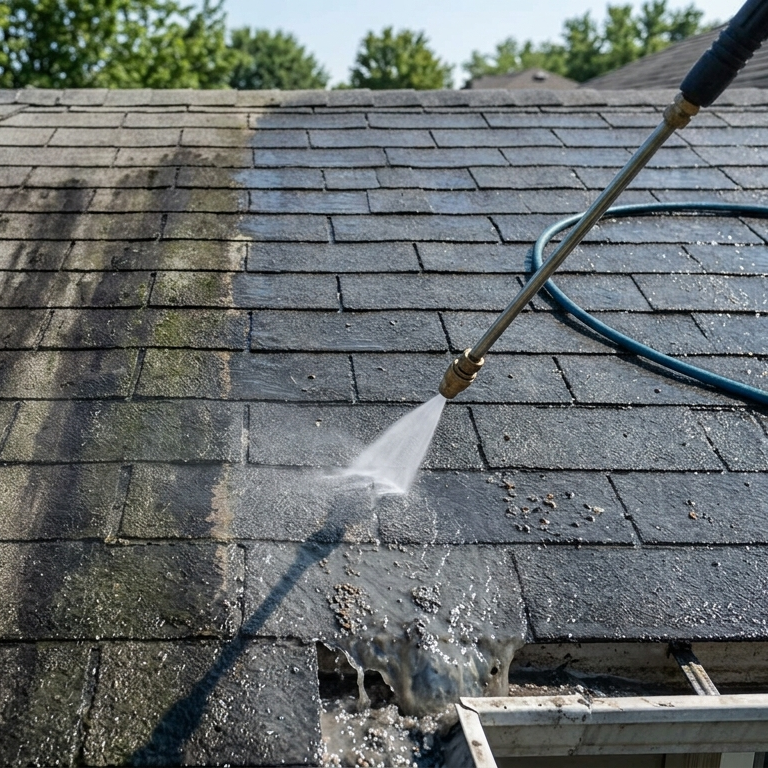
A truck rolls up, a guy drags a pressure washer hose up an extension ladder, and ten minutes later, he's on the ridge of your roof blasting down the dark streaks like he's washing a sidewalk. Water runs off the eaves in dirty sheets. The black is gone. He hands you a bill and drives off.
Two years later, you call the manufacturer about a warranty claim on premature granule loss. They ask one question.
"Has anyone pressure washed the roof?"
That's where this stops being a cleaning story and starts being a warranty story.
The roof looks clean for a season, then it looks worse than before
The trap with pressure washing a shingle roof is that the result looks good the day the work is done. The streaks are gone. The shingles look darker, almost newer. You'd swear from the driveway that the roof just gained five years.
It didn't. It lost five years.
A pressure washer running at the typical contractor setting — 2,500 to 4,000 PSI through a narrow fan tip — doesn't push water at the surface. It hammers it. The water moves faster than the bond between granule and asphalt can withstand. Granules come off in sheets and wash into the gutter trough with the algae. The shingle looks fine from twenty feet away, but the layer that shields the asphalt from UV is thinner than it was an hour earlier.
Then comes summer. UV hits the exposed asphalt where the granules used to sit. The asphalt cooks, dries out, and cracks. By the second or third year after the wash, the roof looks aged — bald patches at the eaves, fishmouthed shingles at the ridges, granules piling at the downspout splash blocks. The streaks come back, too, because the algae cells under the granules survived the rinse.
The homeowner thinks the roof failed early. The manufacturer has a different word for it.
What a pressure washer actually does to an asphalt shingle
Three mechanical effects occur when high-pressure water hits a shingle, and all three act against the roof at once.
The first is granule displacement. The ceramic-coated granules in the shingle's asphalt layer are held by an adhesive bond cured at the factory. That bond is designed to survive rain, hail, and decades of weather. It is not designed to survive a 3,000-PSI jet at six inches. Water at that pressure breaks the bond, and the granules wash off. Every shingle manufacturer's installation manual warns against this.
The second is sealant tab failure. Asphalt shingles seal to each other through a heat-activated adhesive along the bottom of each course. That seal keeps wind from lifting the shingles and rain from blowing under them. When a wand is aimed up the slope — which happens any time someone washes from eave toward ridge — water gets driven under the course. The hot-melt sealant softens in summer heat anyway. Soak it with high-velocity water, and the bond breaks. The next wind storm finds the loose shingles.
The third is water intrusion. The roof deck under the shingles is plywood or OSB protected by a layer of underlayment. The shingles are the primary barrier. When water is driven sideways or upward at hundreds of pounds per square inch, some gets under. Not enough to leak immediately. Enough to wet the underlayment and rot the deck edge from the inside. The leak shows up two or three years later in a bedroom ceiling, and nobody connects it back to the wash.
These aren't theoretical risks. They're spelled out in the manufacturer literature and in the cleaning bulletin the trade group put out to warn against high-pressure roof cleaning.
What the major shingle manufacturers' warranties really say
Pull up the warranty PDFs for the biggest names in asphalt shingles and the story is the same in slightly different words. None allow pressure washing as maintenance. Most call it out as grounds for warranty denial.
| Manufacturer | Position on pressure washing | What's covered if you pressure wash anyway |
|---|---|---|
| GAF | "Do not pressure wash" — referenced in their care and maintenance guidance | Granule loss claims denied; algae-related claims may be denied if cleaning method can't be verified as soft wash |
| Owens Corning | Recommends low-pressure cleaning with appropriate solution; high-pressure washing not approved | Premature granule loss, sealant strip failure, and resulting water damage not covered |
| CertainTeed | Approves only low-pressure soft wash methods for algae removal | Damage caused by improper cleaning method excluded from material warranty |
| Atlas | Specifies low-pressure rinse after biocide treatment; no high-pressure cleaning | Mechanical damage from pressure washing excluded |
| TAMKO | Cleaning instructions limit pressure to garden-hose level and prohibit pressure washers | Damage from pressure washing voids the material warranty on affected sections |
| IKO | Excludes coverage for damage caused by improper maintenance or cleaning; low-pressure methods recommended | Granule loss and shingle aging from high-pressure cleaning excluded |
The pattern is the same across every major brand. Cleaning is allowed. Pressure washing is not. The manufacturers all reach the same conclusion because they've run lab tests on how high-pressure water affects their products and watched the granules wash off.
The Asphalt Roofing Manufacturers Association — the industry trade group that includes basically every shingle maker selling in the U.S. — published Technical Bulletin TR-101 specifically on cleaning algae-stained shingles. The bulletin's recommended method is a low-pressure application of sodium hypochlorite, followed by a gentle rinse. It warns explicitly against high-pressure cleaning. That bulletin is what your warranty department will reference when they deny a claim.
Soft washing is the method the industry already recommends
What the manufacturers and the trade group both point to is a soft wash — and the difference between soft washing and pressure washing isn't a matter of degree. They're two different processes that happen to share some equipment.
A pressure wash uses water velocity to scrub a surface clean. A soft wash uses a chemical treatment to kill the organism, then a low-pressure rinse — usually under 100 PSI, sometimes closer to garden-hose strength — to clear the dead material away. The treatment does the cleaning. The water just carries the residue off the roof.
The chemistry is sodium hypochlorite mixed with water and a surfactant that helps the solution cling to vertical surfaces. This isn't straight laundry bleach — undiluted bleach is a strong oxidizer that reacts with asphalt, causing premature aging and a brittle surface that fails years early. A proper soft wash mix is diluted to a concentration that kills the algae without damaging the asphalt. Dwell time is what kills the organism. After it sits, a gentle rinse takes the dead algae off the shingle. Granules stay put. Sealant tabs stay sealed. The deck stays dry.
A soft wash also reaches the cells under the granules. High-pressure water knocks the visible colony off the surface, but the algae that's worked its way into the asphalt survives. The biocide kills it where it lives. That's why a soft washed roof stays clean for two to four years, while a pressure-washed roof grows the streaks back inside a season.
Here's what the comparison looks like on a single roof, side by side:
| Factor | Pressure Wash | Soft Wash |
|---|---|---|
| Water pressure at the shingle | 2,500–4,000 PSI | Under 100 PSI |
| What does the cleaning | Mechanical force | Sodium hypochlorite solution |
| Granule loss | Significant — visible in the gutter trough | None |
| Sealant tab risk | High — water driven under courses | None — gentle rinse, downward flow |
| Reaches algae cells under granules | No — only surface | Yes — biocide penetrates the colony |
| Manufacturer warranty status | Voided for cleaning damage | Allowed under all major manufacturer warranties |
| How long the roof stay clean | One season at most | Two to four years, sometimes longer |
| Cost difference | Often cheaper upfront | Slightly higher, but vastly cheaper over roof life |
A homeowner who saves $150 on a pressure wash usually pays it back several times over in shortened roof life, denied warranty claims, and repair bills.
The warranty fine print that gets missed before hiring a cleaner
The trap isn't that homeowners are reckless. It's that the warranty language is buried in a document nobody reads, and the cleaning industry isn't required to follow it.
Asphalt shingle warranties run 25, 30, or 50 years. The fine print includes an "owner maintenance" section that limits what kinds of cleaning are allowed. That section is what the warranty department references when a claim comes in. If the cleaner pressure washed the roof — even if the homeowner didn't know better — the manufacturer can deny coverage for any damage pressure washing is known to cause. Granule loss. Premature aging. Water infiltration. Sealant tab failure.
The other part of the trap is that the damage doesn't show up for two or three years. By the time the homeowner notices the bald patches, the wash is a distant memory. They file a claim. The inspector finds the signs of high-pressure damage — uniform granule loss in vertical streaks where the wand passed, sealant failure at the lower courses — and the claim is denied.
The same trap snaps shut on storm and hail claims. An adjuster looking at hail damage on a previously pressure-washed roof may downgrade or deny the claim because the existing granule loss complicates the assessment. A $20,000 replacement under the storm policy becomes a partial claim or no claim at all.
A homeowner's checklist before any contractor climbs onto the roof
There's no way to undo a bad wash, so prevention has to happen before the contractor parks the truck. A few minutes of questions up front catches most of the problems.
Ask what method they use to clean shingle roofs. The right answer mentions soft washing, biocide treatment, low-pressure rinse, or sodium hypochlorite. The wrong answer is "pressure washing" or "we just blast it off." Walk away from the wrong answer.
Ask what pressure they use on the shingle. The right answer is under 100 PSI, often closer to 60. If the answer is in the thousands, they're describing a pressure wash, regardless of what they call it on the website.
Ask whether the method follows ARMA TR-101. A cleaner who knows roofs will recognize the bulletin. One who doesn't will change the subject.
Ask for proof of insurance. A cleaner without liability and workers' comp coverage becomes the homeowner's problem the moment something goes wrong.
Get a written quote with the cleaning method spelled out. "Roof cleaning" is too vague. The quote should say "soft wash" or "low-pressure cleaning with sodium hypochlorite solution." That paperwork is what protects the warranty later.
What to do if a previous wash has already damaged the roof
If the wash already happened and the roof shows damage, the options narrow, but they're not gone. A roof inspector — not the cleaner who did the work — can document the condition. If the damage is recent enough to fall within the cleaner's insurance coverage window, a claim under their liability policy may cover repairs or a partial replacement.
A soft wash now won't undo the granule loss, but it stops the algae from accelerating the damage further. It gives the roof the best chance of finishing its useful life on the timeline the homeowner planned for.
The longer-term answer for a compromised roof is to plan replacement on a shorter horizon than the warranty suggests. A 30-year shingle that's been pressure washed may not make it to 18. Knowing that is worth more than pretending the warranty still has teeth — because in most cases, it doesn't.
Frequently Asked Questions
The warranty is the part of the roof that pays for itself only if you don't void it
A shingle warranty is one of the quieter assets a homeowner owns. It sits in a folder, doesn't get thought about, and matters most when something goes wrong with the roof. The whole point of paying extra for a 30-year shingle is the protection on the back end.
Pressure washing trades that protection for an hour of cosmetic improvement that won't last the season.
The right method costs slightly more and lasts years longer, with the warranty still in place. The wrong method saves a few dollars on the front and erases tens of thousands in warranty value on the back.
Most homeowners only learn the difference when a claim gets denied.
Superior Power Washing soft washes asphalt shingle roofs across Waldorf, MD, and all of Charles County and Southern Maryland — including La Plata, Clinton, Fort Washington, White Plains, and Brandywine. Owner-operated, fully insured, low-pressure method that protects your shingle warranty. Call (240) 901-4252 for a free on-site assessment.
