
What Causes Black Mold Lines on Apartment Building Siding
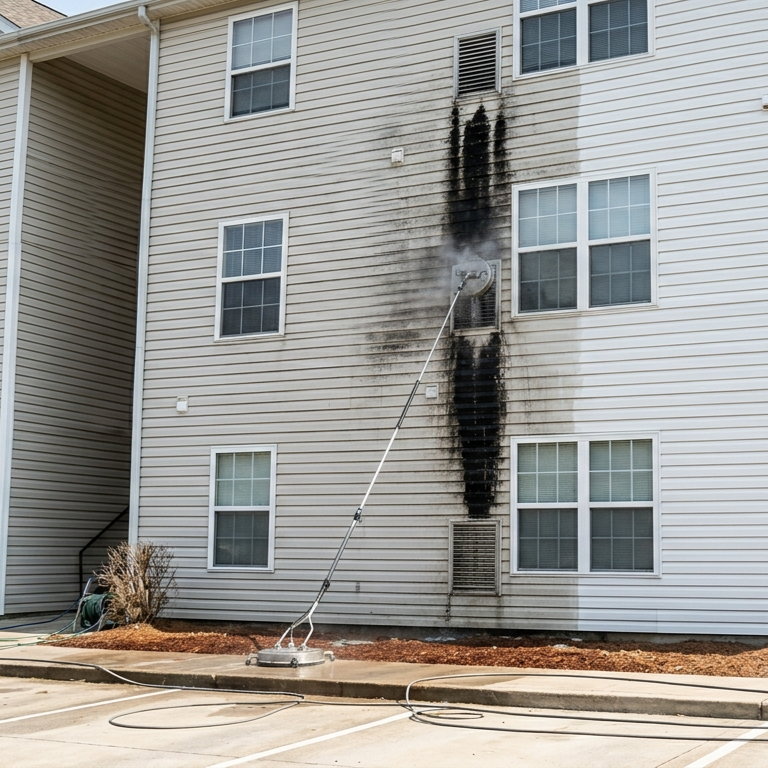
"Tenant in 2B just called. There's mold growing down the side of the building outside her kitchen window." That's the call a property manager makes on a Tuesday morning, and by the time anyone walks out to the parking lot to look, the streak is three units tall — a black line running from a bathroom vent on the top floor down past the kitchen window of 2B, all the way to the trim above the ground-floor windows.
It's a colony. And it's been growing for months.
Apartment siding develops these lines faster than almost any residential surface — and the lines almost never form in random places. They trace exactly where the water goes.
The lines aren't random. They follow water.
Black mold lines are mostly Gloeocapsa magma, Cladosporium, and Aureobasidium — algae and mold species that need three things to grow: a porous-enough surface to anchor to, moisture, and organic dust to feed on. Vinyl and painted siding give them the surface. Apartment buildings give them the moisture sources, over and over, in concentrated locations.
A single-family home has one or two dryer vents and a couple of AC condensate lines. An apartment building has one of each per unit, stacked vertically, often venting onto the same wall. Every vent is a continuous water source. Every roofline transition is a place where rainwater can spill instead of draining. Every balcony drain dumps splash water onto the siding below.
The lines just connect the dots between those sources and gravity.
For property managers, the lines aren't only a curb-appeal issue. Active mold colonies release spores into the air every time someone opens a window beneath them, and respiratory complaints from tenants are usually the first thing a management company hears once a wall gets bad enough to notice. A stained wall is a leasing problem. A spore-shedding wall above an open kitchen window is a different kind of problem.
Read the line by where it lives on the building
Where the line sits on the wall is the single biggest clue to what's feeding it. Walk the perimeter once with this list in hand and most lines identify themselves before you ever get up close.
Directly below a vent or louver. A straight black streak running down from a dryer or bath exhaust louver. Warm moist air with lint is dumping into the siding seam every cycle. High urgency — moisture is also wicking behind the panel, not just sitting on the surface.
Under an AC condensate line. A black line that fades from dark at the top to light heading down. The condensate drip runs in heat, partially evaporates on the wall, and leaves a trail that gets darker the closer it stays wet. Medium urgency — clean the line and redirect the drip.
At every horizontal panel seam, especially under j-channel. A repeating black line at each course of siding. Trapped condensation behind the panel face is the usual cause. Medium urgency — surface clean, then check for backside moisture.
Across two or three panel courses near the ground. A wide black band, not a vertical streak. Gutter overflow or splash from a downspout extension is hitting the wall. Medium-high urgency — fix the gutter or downspout before any cleaning, or it'll be back by fall.
Bleeding from below a balcony deck or stair tread. Black streaks that start under a horizontal walking surface. Splash water plus organic matter from above is the feed source. High urgency in stairwells specifically — the same colony on the walking surface is a slip risk, not just a stain.
No clear pattern, just hazy across the whole wall. Gray-to-black film with no source above it. General algae colony from shade plus humidity. Low urgency — cosmetic, but it spreads outward each season if left.
This is the read-the-line-first principle. Clean before you read the line and you'll be cleaning the same wall again in six months.
The four moisture sources behind almost every line
Dryer vents. A residential dryer pumps out warm air carrying around a gallon of water per load. On apartment buildings, those vents are often spaced one per unit on the same wall, and the louver flaps don't always close cleanly between loads. The wall above and below each louver gets a daily dose of warm, lint-laden moisture. Algae lives there year-round.
AC condensate lines. A residential air handler can dump three to five gallons of condensate a day in summer. Most apartment AC condensate flows through a small line that exits the siding and drips onto the wall below — sometimes onto a panel without a drip kicker or splash block to catch it. The wet streak under each line darkens within a season.
Soffit corners and roofline transitions. Wherever a soffit meets a wall at an odd angle — at gable ends, at dormers, at parapet-to-wall transitions — water that should drain to a gutter instead runs across a few feet of siding. The discoloration is usually darkest at the corner and tapers downward in a teardrop shape.
Balconies, stair treads, and exterior walkways. Anywhere foot traffic drips water and tracked-in dirt onto the railing-to-wall connection, the mold colony has a constant supply of organic food. These lines appear in stairwells and beneath the corner of each balcony deck.
The same four sources cover almost every line on any given apartment building.
What the color and shape of a line tells you about how long it's been there
Color and edge sharpness give a rough age estimate.
A new line — six weeks to three months old — looks gray to medium-brown, has a fuzzy edge, and comes off the surface relatively easily with a soft wash biocide. The cells haven't deeply embedded in the substrate yet.
A six-month-old line is darker, has a sharper edge, and shows visible streaking where the colony has produced enough pigment to permanently tint the siding. It comes off, but the cleaning takes longer and the result is less bright-white.
A year-plus line on vinyl can leave a ghost mark even after the live colony is killed. The pigment has worked its way into the surface texture and the panel underneath has slight oxidation. The siding still looks dramatically better post-clean, but it won't return to the original color of the panels that never had a line.
This is the reason property managers who wait two budget cycles before cleaning end up with permanent staining. The wash still works. The result just isn't as bright.
When the mold is behind the panel, not just on it
Sometimes the line on the outside is the smaller half of the problem.
If water has been wicking behind the siding for months or years — from a flashing failure, a bad seam, or a vent that's never had a working louver — there's usually mold growing on the back face of the panel and on the sheathing behind it. The signs on the outside are subtle: panels that bow slightly when the sun warms them, a soft sound when you tap a panel that should sound hollow, or a faint musty smell at the seam joints on a warm day.
A wash doesn't fix that. The crew can clean the front of the panel and kill any surface colony, but the back-side and sheathing issue is a siding repair — pull the panel, dry the cavity, address the source, replace any rotted sheathing, then reinstall. That's a different trade.
We flag it during the on-site walk-through whenever we see it. Catching it before the wash means a property manager can sequence the repair first and pay for the wash once, instead of paying for the wash, finding the rot anyway, and paying for a second wash after the repair.
A multi-unit building gives mold five places to hide that a house doesn't
Stand next to a single-family home, and you can count the moisture sources on one hand — a couple of vents, one AC line, and a gutter. A twelve-unit apartment building has the same sources multiplied by twelve, often stacked on the same wall, plus a few that don't exist on a house at all.
HVAC condensate from each unit drips onto the same vertical run of siding, one line per floor. Dryer vents at every unit punch through the wall in a grid, each with a louver that doesn't fully close between cycles. Balcony drains dump rinse water onto whatever panel sits below them, every floor. J-channel runs between buildings, collects debris, and hold standing water against the trim. And the breezeway or stairwell column behind the front face of the building creates a permanently shaded corridor where the wall never sees direct sun and never fully dries. Five hiding spots that don't exist on a single-family home — and the colony uses every one of them.
A pressure wash strips the visible layer off the front face of the panel and leaves all five sources untouched. Within a couple of months, the colony rebuilds, fed by the same drip lines, vent lint, and trapped balcony splash that fed the last one.
Worse, on apartment siding, high pressure can drive water behind the panel face through the j-channel and seam joints. That's the opposite of what siding wants. Trapped moisture behind a vinyl panel feeds the next generation of mold on the back of the panel, where you can't see it until the panel starts to bow or warp.
And none of that addresses the root cause. The dryer vent is still dumping wet air. The AC line is still dripping. The gutter is still spilling. Without addressing the source, even a clean wall is two months from showing the same line again.
A pressure wash on apartment siding without source remediation is a rental time, not a fix.
What it takes to break the cycle: kill the colony, then fix the source
The work is in two parts.
The cleaning part is a soft wash treatment for the multi-unit exterior — a biocide solution applied at low pressure that kills algae and mold at the cellular level, allowed to dwell ten to fifteen minutes, then rinsed at low pressure. The dead organism releases over the next several rains. The lines fade. Within three to four weeks the wall reads as clean from across the parking lot.
The source-fix part is less glamorous and more important. Dryer vents that won't close need new louvers or vent covers. AC condensate lines need drip extensions or rerouting to a downspout. Gutters need to be cleared and any spillover diagnosed. Balcony drains need to be cleaned of leaves and debris. None of that is power-washing work, but the wash result doesn't hold without it.
The buildings that go years between cleanings are the ones where the property manager fixes the source the first time. The buildings that get cleaned every spring are the ones where the source keeps feeding the next line.
Frequently Asked Questions
Mold lines on a multi-unit are a system problem, not a panel problem
A line that runs across a balcony slab points to a drain. A line that runs under a window points to an HVAC unit. A line down the J-channel between two units points to a moisture path the original builder never sealed. Cleaning the wall is the easy part. Finding the source, fixing it, and getting on a schedule so the next colony doesn't have time to root — that's the work.
The building that looks clean six months after the wash is the one that got the diagnosis right.
Superior Power Washing handles apartment and condo exterior cleaning across Waldorf, MD, and all of Charles County and Southern Maryland — including La Plata, Hughesville, Bryans Road, Indian Head, and Charlotte Hall. soft wash chemistry calibrated for vinyl and painted siding, balcony and breezeway scope, certificates of insurance for property managers, off-hours scheduling. Call (240) 901-4252 for a free on-site assessment.
