
Why Gas Station Forecourts Stain Faster Than Almost Any Commercial Surface
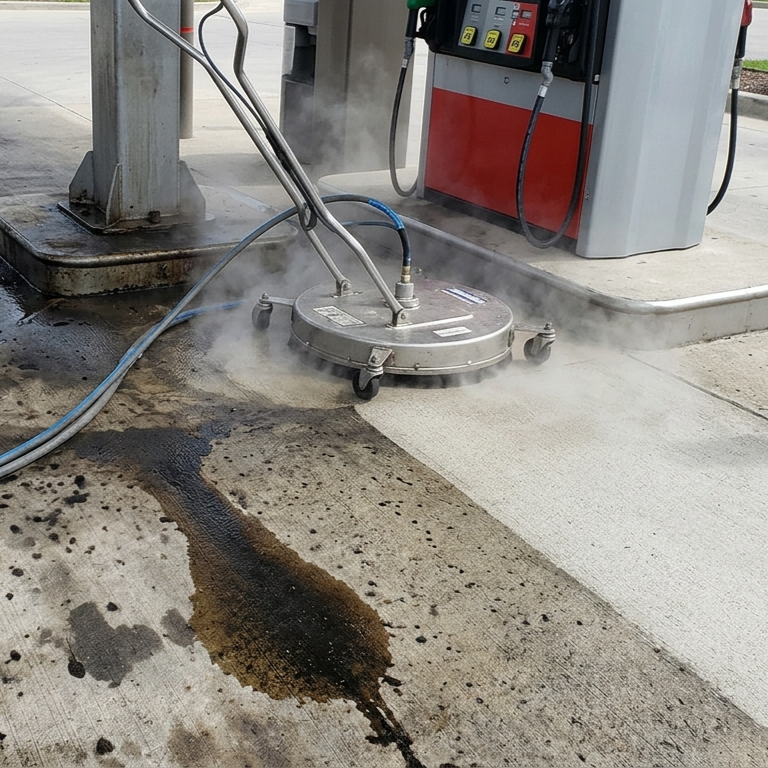
Walk out to the pump island at six in the morning, before the first customer pulls in. The concrete under the dispensers is darker than the concrete twenty feet away. There are halos around each pump base. There are black scuff arcs where tires pivoted. A long dark teardrop runs from one pump out to the drive lane, like somebody dragged a wet rag in a straight line.
You hosed it last week. You hosed it again two days ago.
It's still there.
A gas station forecourt is the worst-case surface for staining in the entire commercial property category. It collects more aggressive contaminants per square foot, per hour, than almost any other slab in the country. Office parking lots, restaurant pads, warehouse loading aprons — none of them take this much abuse. Below is what's actually happening at the concrete level, and why the stains lock in faster than anywhere else.
Concrete is a sponge. The forecourt sits under a faucet of solvents.
Cured concrete looks solid. Under a microscope it's a network of capillaries — tiny pores running through the cement matrix that pull liquid in by surface tension. Pour clean water on a clean slab and it soaks an eighth of an inch deep in a few minutes. Pour gasoline or diesel on that same slab, and the fuel goes deeper and stays longer, because hydrocarbons cling to the calcium silicate in the cement.
A forecourt sits under a faucet of those hydrocarbons. Every fill-up drips a few drops at the nozzle. Every overfill sends a tablespoon down the side of a vehicle. Every fuel delivery loses some product around the drop hatch. Multiply by five hundred customers a day, three hundred sixty-five days a year, and the slab has been soaked thousands of times before the sealer is even noticeably worn.
That's the substrate problem. The slab isn't a barrier — it's a wick.
The four stain zones, and what makes each one
A forecourt looks like one surface, but it has four distinct staining environments. Each one builds a different residue from a different source, on a different timeline.
| Stain zone | What's actually hitting it | Visible result | How fast it locks in |
|---|---|---|---|
| Pump island halo (within 3 ft of dispenser) | Fuel drips, overfill spill, windshield-washer-fluid splash, hand-sanitizer drips | Dark gray-to-black ring under the nozzle, rainbow sheen after rain | Days. Fuel reaches deep pore network within hours of a spill. |
| Drive lane tire path | Tire rubber compounds, melted asphalt from hot tires, road tar tracked in from the highway | Twin parallel dark bands following the path cars actually take | Weeks. Each car deposits a microscopic film of rubber. |
| Tight-turn scrub marks | Tire scrub at low speed, especially under braking and starting | Black arcs and J-shapes near the pump island and corner of the lot | Days for cosmetic marks; months for permanently embedded rubber. |
| Fuel drop pad (around the manhole covers where the tanker fills) | Diesel and gasoline overflow during tanker delivery, fuel-additive concentrates | Wide, dark, irregular blot 8–15 ft across; smell stays after the stain looks faded | A single bad delivery can stain for months. |
Treat the forecourt like one stain and you'll over-clean the easy zones and under-treat the hard ones. Each zone needs its own chemistry and its own dwell time.
Why a power washer alone doesn't pull fuel and oil out of concrete
A standard pressure washer at four thousand PSI looks aggressive enough to flatten anything. On a fuel stain, it isn't. Water can't dissolve hydrocarbon. You can blast a fuel halo at any pressure you want — the visible surface might lighten for a few hours, then the stain rebounds back through the slab as the fuel deeper in the pores wicks back up.
The job needs a degreaser that breaks the chemical bond between the hydrocarbon and the cement matrix. Two main families do that work. Alkaline degreasers (high-pH detergents) lift surface oil and recent fuel. Solvent-based emulsifiers reach the older, deeper contamination — the stains that have been sitting for weeks or months. A trained crew picks the chemistry based on the stain age and the zone, lets it dwell ten to fifteen minutes so it can penetrate, then rinses with hot water at moderate pressure.
Hot water matters here. Cold water at high pressure rolls the contaminant around. Hot water at lower pressure dissolves it. The temperature gradient is doing the work, not the PSI.
Tire scrub and brake dust are a different problem
Fuel and oil stain by soaking in. Rubber and brake dust stain by abrading and bonding. Every tire that pivots at low speed leaves a microscopic layer of compound — the same way an eraser leaves shavings on paper. Brake dust from cars rolling up to the pump scatters fine iron particles across the slab; those particles flash-rust within hours of the first humid morning and the rust permanently colors the concrete.
This is why a forecourt that looks "clean" still has a gray-brown cast in the daylight. The fuel is gone. The embedded rubber and oxidized iron are still in the pores.
Removing that layer takes a different process from removing fuel. An acidic cleaner cuts the iron oxide. A hot-water surface cleaner — the round disk that walks across the slab at controlled pressure — agitates the embedded rubber out of the pores. Skip either step and the slab keeps its dull cast, which is exactly what passing drivers see from the highway when they decide whether to pull in.
The longer it sits, the more it costs to remove
Fresh stains on a forecourt are a maintenance job. Old stains are a restoration job. The math gets ugly fast once you understand what happens at the substrate level.
A fresh fuel drip on day one sits mostly in the top quarter inch of concrete. A degreaser with a short dwell and a hot rinse pulls almost all of it. The slab returns to base color.
The same drip at six months has migrated through the pore network. The visible surface might be only ten percent of the total contamination. To return the slab to base color the cleaner has to be pulled all the way through that depth — multiple applications, longer dwell, sometimes a poultice that draws the contaminant back to the surface over hours. The labor is two to four times higher.
Past about a year, parts of the stain are unrecoverable. The hydrocarbons have reacted with the cement and discolored it at the chemical level. No degreaser can undo that. Restoration in that zone means a concrete dye, a sealer-and-color treatment, or partial slab replacement.
The cost curve isn't linear. Waiting six months doesn't double the cost. It quadruples it, and after a year the option of full removal is off the table.
Sealers extend the runway but don't replace cleaning
A penetrating concrete sealer fills the surface pore network so fuel can't wick down. On a sealed forecourt, fresh fuel drips onto the surface for the first few minutes — long enough that a quick hose-down actually removes it rather than just spreading it. That's a real advantage and worth doing.
But sealers wear from foot and tire traffic at the highest-use spots. The pump islands are exactly where the sealer fails first, because that's where the cars stop and turn. Sealed forecourts still need recurring cleaning — every month or two for the pump island zone, every quarter or two for the drive lanes. The sealer extends the runway between cleanings; it doesn't eliminate them.
The other thing a sealer does is make the next commercial cleaning faster and cheaper. Stains that haven't penetrated come off in one pass. Slabs that aren't sealed need two or three passes for the same result. Over a year of monthly service, that difference adds up.
A dirty forecourt is also a slip-and-fall lawsuit waiting
Fuel and oil residue isn't just visual. Once a slab has absorbed weeks of contamination, the surface friction drops. The pores that gave the concrete its grip are now lined with a thin film of hydrocarbon. Rain doesn't bead and run — it sheets across the slab and pools on the slick film. Customers walking from their car to the pump, or from the pump to the convenience store, hit that film with the same kind of grip a kitchen floor has when somebody drops a chicken thigh on it.
Slip injuries at fuel islands are one of the most-litigated categories in commercial premises liability. The settlement amounts dwarf the annual cost of cleaning the slab. Insurance carriers know this and increasingly ask about cleaning frequency at policy renewal. Regular forecourt cleaning is partly an aesthetic decision and partly a risk-management one.
What "code-compliant" cleaning looks like on a fuel-handling site
A gas station can't be cleaned the same way as a parking lot. Wash water from a forecourt contains fuel, oil, additives, and detergent. Letting it run into the storm drain is a violation in most jurisdictions, including across Maryland, and the property owner is the one who gets cited.
A trained forecourt crew shows up with vacuum-recovery equipment — a surface cleaner that contains and pulls the wash water off the slab as it cleans, plus a filtration setup that captures the contaminants before the water is staged for disposal. The crew either takes the water off-site for treatment or runs it through an oil-water separator on the property.
If a power-washing company quotes a forecourt job and doesn't bring up reclaim or runoff containment, walk away from the quote. The cleaning will work for a day. The fine, if a passing inspector sees the rainbow sheen running into the storm drain, will not be worth it.
Frequently Asked Questions
Get on a service cadence before the stains lock in.
The forecourt is the first thing a passing driver sees and the first thing that decides whether they pull in. A clean slab and clean canopy reads as a well-run station. A dark, rainbowed slab reads as a station the owner doesn't care about — and customers extend that judgment to the food inside, the bathrooms, and the safety of the fuel.
The fix isn't a one-time deep clean. It's a service cadence. Hit it monthly on the pump zone, quarterly on the full slab, and the stains never get past the surface to begin with. Hit it once a year and the slab is half-restoration work, half-cleaning, every time.
The math is simple. The longer you wait, the less you can recover.
Superior Power Washing handles gas station forecourts, pump islands, and full-canopy commercial cleanings across Waldorf, MD, and Charles County and Southern Maryland — including La Plata, Clinton, Fort Washington, White Plains, and Brandywine. Code-aware reclaim setup, hot-water surface cleaning, fuel-specific degreasers, owner-operated by Cedric, fully insured. Call (240) 901-4252 for a free on-site assessment.
