
Why Warehouse Dumpster Pads Develop Permanent Grease Halos
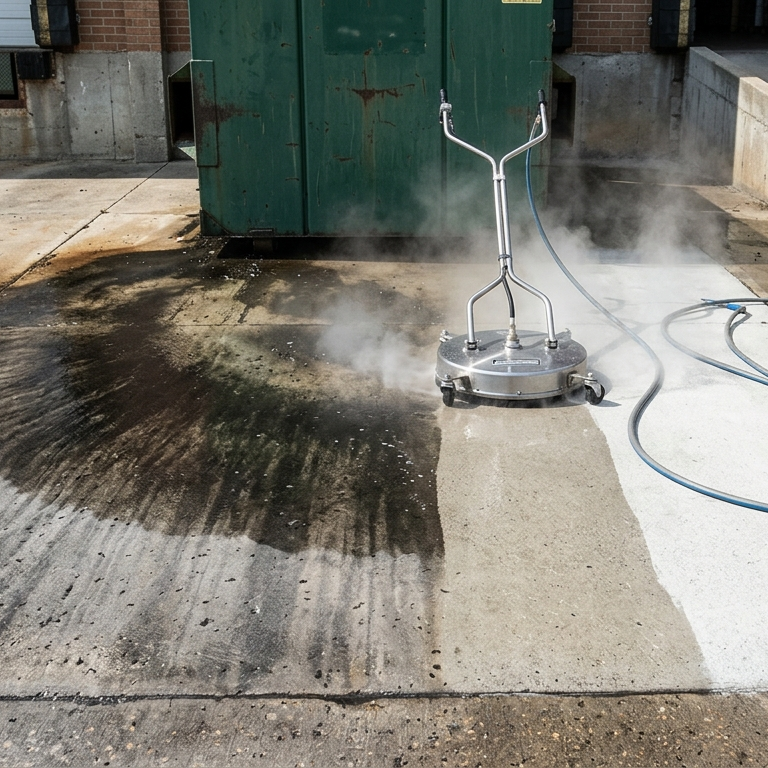
You walk out the back of the warehouse on a Tuesday morning. The forklift driver wheels a pallet of cardboard past you, dumps it into the compactor, and rolls back inside. You glance down at the concrete pad. There's a dark ring radiating maybe four feet out from the base of the dumpster. The middle is almost black. The edge fades into a gray tide-mark on the pad. You had this concrete pressure-washed three months ago. The halo is back, bigger than before.
It's not your imagination. Warehouse dumpster pads stain in a way other concrete surfaces don't. And once the halo gets going, you can wash it monthly and still watch it darken every quarter. The reason isn't the cleaning crew. It's what's actually soaking into the slab.
Here's what's happening below the surface.
What the halo actually is
The dark ring isn't dirt sitting on the concrete. It's a stain that lives several millimeters down inside the slab.
A dumpster pad gets hit with three kinds of liquid every day. Leachate — the brown soup that drains from food waste, soiled cardboard, and any organic load — drips from the bottom corners of the container. Hydraulic fluid sometimes seeps from the lift cylinders on the compactor or the truck arms. And greywater from rinsing the inside of the dumpster ends up on the pad too. All three carry oils, fats, and surfactants in solution.
Concrete is porous. The cement matrix has a network of capillaries that pull liquid in by suction the same way a paper towel does. When greasy water sits on the slab for a few hours, the water evaporates and the oils stay behind — but not on top. The oils move into the pores and bond to the cement. That's the halo. You're seeing the stain through the concrete, not on it.
This is why the ring keeps coming back. Standard pressure washing strips the surface and pushes loose grease off the slab. The stain three millimeters down doesn't care about surface water.
The halo isn't just an eyesore either. The same organic matter that's staining the concrete is feeding a bacterial colony in the pores of the slab — which is what creates the smell that hits you in summer, and what draws rats, roaches, and flies to the back of the building. A pad that fails a visual inspection usually fails a health inspection at the same time.
Symptoms, causes, and how urgent each one is
Different halo patterns point to different problems. Most warehouse pads have more than one going on at once.
| What you see | What's causing it | How urgent |
|---|---|---|
| Even dark ring around the whole dumpster | Daily leachate seepage from the container | Cosmetic at first, structural after 12–18 months |
| One darker corner | Compactor hydraulic fluid leak or a bad container hinge | Address the leak now — the stain will keep loading |
| Black fan-shape away from the dumpster door | Operator rinse water draining downhill | Reroute or contain — washing alone won't help |
| Greasy sheen after rain | Oil sitting on top of grease already in the slab | Surface treatable, but the underlying stain remains |
| Slippery film around the dumpster | Emulsified fats coating the slab surface | Address now — slip-fall liability risk |
| Pitting or scaling inside the ring | Alkaline leachate eating the cement paste | Urgent — concrete is degrading |
| White crystalline edge around the dark area | Salts pushed to the surface by the cleaning water | Strip and seal before the next wash cycle |
The pitting line in that table is the one that turns a dumpster pad from a cosmetic problem into a capital expense. Cement paste is alkaline-stable but acid-sensitive. Decomposing food waste produces organic acids — lactic, acetic, butyric — that dissolve the paste and leave the aggregate exposed. Once aggregate is visible, the slab is past the point a wash can fix.
Why daily pickups don't keep the halo from forming
It's tempting to assume the answer is more frequent pickups. If the truck comes Monday, Wednesday, and Friday, surely the pad doesn't have time to get bad?
It doesn't work that way. The halo isn't a function of how long the dumpster sits there. It's a function of the seal between the container floor and the pad surface, and that seal is bad on almost every commercial dumpster in service. The bottom edges of the container rust, the rubber gasket on a compactor wears, the drain plug at the back gets bent. Leachate drips out around the clock, regardless of how often the truck swings through.
Even a clean pickup leaves behind whatever drained out before the truck arrived. And every truck swap pulls the container across the slab, smearing the wet edge into a fresh arc. The pad doesn't get a chance to dry.
Where the grease really comes from on a warehouse pad
Not all warehouses generate the same load. The halo's chemistry depends on what the dumpster collects.
E-commerce and dry goods warehouses generate the least — mostly cardboard and packing foam. The halo on these pads is usually thin, more of a gray shadow than a black stain. The problem is what slips in: lunchroom food waste from break-room bags, an occasional liquid spill from a damaged product return, hydraulic fluid from the forklift battery exchange dock if it's nearby.
Food and beverage warehouses generate the worst. Soiled produce cardboard, expired refrigerated returns, meat-product packaging — all of it leaks. The leachate from a single bin of spoiled cardboard can carry several grams of animal fat per liter of water. That fat is what creates the deep black stain inside the slab. It's not soluble in water, doesn't rinse out, and doesn't break down for months.
Industrial and manufacturing warehouses sit somewhere between. The dumpster might collect cardboard one day and oily shop rags the next. Cutting fluid, machine coolant, and lubricant trace amounts all migrate into the pad through the same mechanism.
The mix matters because the cleaning approach changes. Animal fats respond to alkaline degreasers and hot water. Petroleum hydrocarbons respond to solvent-based emulsifiers. Get the chemistry wrong and you push the stain deeper without lifting any of it.
How standard pressure washing drives the stain deeper
This is the part most warehouse managers find counterintuitive.
Cold water at 3,000 PSI hitting a greasy concrete pad does two things at once. It blasts the loose surface contamination off — which is what you can see, so you assume the job is working. And it drives the rest of the grease deeper into the capillaries of the concrete, because high-pressure water is a hydraulic ram that forces whatever it's mixed with into any pore that's open.
A month after the wash, the halo looks lighter. Three months later, it looks worse than it did before the wash. The grease you pushed down is wicking back up to the surface as the slab dries, the same way a stain in a paper towel migrates outward as the water evaporates.
Hot water changes the math. At 180°F to 210°F, animal fats melt and become soluble in the surfactant solution rather than getting driven into the slab. The grease lifts out of the pores instead of getting forced further in.
Surfactant-based degreasers add the second half of the solution. A proper alkaline degreaser breaks the grease into smaller molecules — emulsification — that water can carry away. Without that chemistry, you're just rearranging the stain.
The combination of hot water, proper degreaser dwell time, and controlled-pressure extraction is what actually removes a halo. Cold water alone, no matter the pressure, makes it more permanent.
Hot water does one more thing cold water doesn't. At 180°F and above, the bacterial colony living in the pores of the slab dies. The slab dries cleaner and stays clean longer because the source of the smell — and the pheromone trail that's been guiding pests to the dumpster — gets neutralized along with the stain. Cold-water washing leaves the colony intact, and the smell comes back within a week.
Why sealing matters more on a dumpster pad than almost anywhere else
A bare concrete pad acts like a sponge. A sealed concrete pad acts more like a countertop.
After a halo gets stripped down to the lowest stain it can reach, the next question is whether the slab gets sealed before the dumpster goes back. A penetrating siloxane sealer fills the capillaries the grease was using. New leachate sits on top of the sealed surface long enough to be rinsed off before it migrates down. The halo can't reform — at least not in the same way.
The catch: most warehouse pads have never been sealed. The contractor poured the slab, the dumpster went on top, and the property has spent eight years watching it darken. By the time anyone calls about cleaning, the pad is so contaminated that sealing has to wait until a proper hot-water emulsification wash strips it back. Two-stage work, but it's the only sequence that holds.
Penetrating sealers also tolerate the alkaline leachate that's eroding unsealed cement paste. The slab lasts longer. The cost of the sealer pays itself back in the delayed replacement of the pad.
A real warehouse pad refresh combines hot-water emulsification, a degreaser dwell, mechanical agitation, and a penetrating sealer. That's the only sequence that holds. A clean-and-go service that skips the sealer will be back next quarter, watching the halo darken again.
When the halo means the slab has to go
Most halos are aesthetic. The pad is ugly, the warehouse looks dirty, the auditor flags it on a walkthrough. Those are fixable.
A few halos signal the slab is past saving. The signs are: exposed aggregate visible across more than 20% of the stained area, soft or crumbling cement when you scratch it with a key, deep cracks radiating from the dumpster perimeter, and pieces of the slab top coming away during a wash. Once acid attack has gotten that deep, no amount of cleaning brings the surface back. The pad needs to be saw-cut out and replaced with new concrete — ideally with a containment trench around the dumpster footprint to keep leachate from doing it again.
Catching the halo at the staining stage costs hundreds. Catching it at the structural stage costs several thousand. The middle option — strip, neutralize, seal — only exists if you act before the cement paste starts dissolving.
A property under a recurring warehouse exterior cleaning schedule gets a pad inspected every visit. A property without one usually finds out about the structural problem from the next tenant's lease inspection — and pays for it in the renewal terms.
Frequently Asked Questions
The same slab, two outcomes
Two warehouses on the same logistics corridor. Same age, same builder, same dumpster manufacturer. One has a pad that still reads gray under the container. The other has a pad that's darker every quarter and now has hairline cracks fanning out from the back corner. The difference isn't luck. It's whether anyone caught the halo before it became chemistry instead of cosmetics.
If your dumpster pad looks worse every spring even though it's been washed, the answer isn't more cold water and more pressure. It's the right chemistry, hot, with enough dwell to reach the grease where it actually lives — and a sealer to keep the next round from getting in.
Superior Power Washing handles warehouse dumpster pad cleaning and sealing across Waldorf, MD, and all of Charles County and Southern Maryland — including La Plata, Hughesville, Bryans Road, Indian Head, and Charlotte Hall. Owner-operated, fully insured, certificates of insurance available on request. Recurring maintenance contracts available for distribution centers, food and beverage warehouses, and manufacturing facilities. Call (240) 901-4252 for a free on-site assessment.
