
What Causes Grease Trails Below Restaurant Kitchen Exhaust Vents
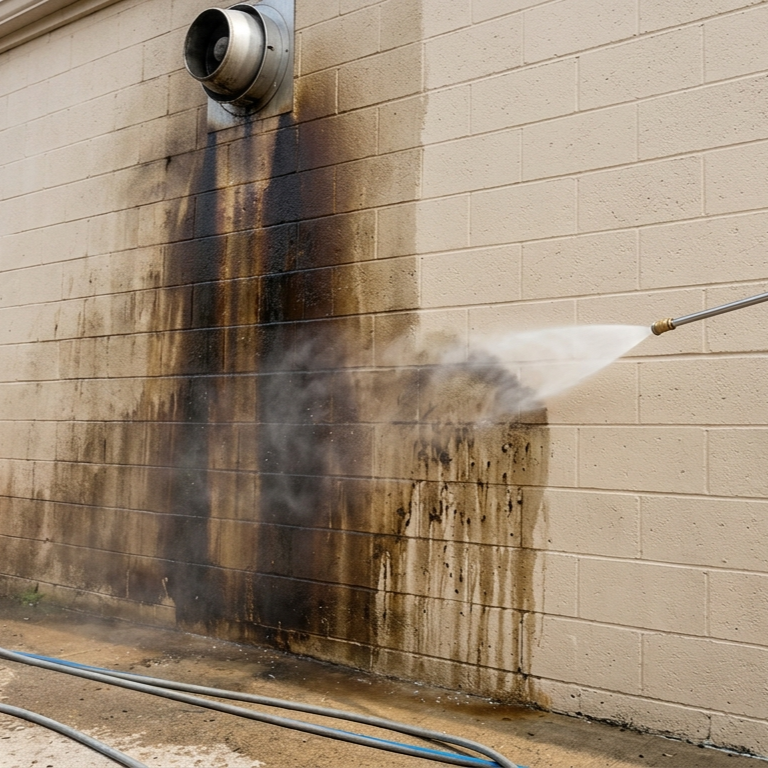
It's 6:15 a.m. and the day cook just opened the back door. The hood fan upstairs has been off for six hours. Out here in the alley, the wall under the exhaust vent has a dark vertical stripe running down it — starting somewhere near the roofline and fanning out toward the dumpster pad. Up close, the streak looks almost waxy. The smell is old fryer oil mixed with something stale, faintly sweet.
That's not dirt. That's not mildew. That's grease the kitchen has been quietly painting onto the back of the building, one shift at a time.
The instinct is to walk back there once a quarter with a pressure washer and let physics handle it. That doesn't work. Here's what's actually going on, and what actually moves it.
Where the grease is coming from
A commercial kitchen hood is doing one job above all the others — pulling heat, smoke, and aerosolized cooking oil up off the line and out of the building. The hood filters catch some of it. The duct catches more. But a steady fraction of the airborne grease makes it all the way through the system and out the exhaust fan on the roof, or out the side-wall vent at the back of the building.
That grease is not vapor by the time it exits. It's an aerosol — microscopic droplets of cooking oil suspended in hot exhaust air. The moment those droplets meet cooler outside air, they condense. They look for the nearest cool surface, and they land on it.
The nearest cool surface is your exterior wall.
Day one of operation, the deposit is invisible. Day thirty, you can see the faintest shadow under the vent. Day ninety, the wall has a distinct streak. Six months in, the streak is dark enough that a customer driving by notices it from the road.
The streak is the path of least resistance for that aerosol — straight down the wall, riding gravity and the heat plume.
What turns the streak from yellow to black
Cooking grease alone wouldn't be that dark. Fresh fryer oil is pale yellow. The streak under the vent is brown, sometimes nearly black. Two things are doing that.
The first is dust. Grease is sticky. Every particle of pollen, road dust, brake-pad dust, and diesel soot floating through the parking lot air gets caught by the grease film the moment it touches the wall. The grease becomes flypaper for airborne grime.
The second is heat and UV. The grease film bakes onto the surface in the sun. Over weeks the oils oxidize and polymerize — they cross-link into something closer to varnish than to oil. That's why a six-month-old grease streak feels like a coat of dark resin and not like a smear of butter.
By the time the streak is dark enough to bother you, you're not looking at grease anymore. You're looking at oxidized, dust-impregnated grease polymer chemically bonded to your siding, brick, or EIFS.
The symptom-cause-urgency table
Here's how to read what you're seeing on the wall:
| What you see | What's actually happening | How urgent |
|---|---|---|
| Faint shadow under the vent | Fresh grease film starting to collect dust | Low — easy to remove now, hard later |
| Defined dark streak, edges still soft | Several weeks of deposit, dust loading, partial oxidation | Medium — clean before the next quarter |
| Hard, varnish-like coat across several feet of wall | Months of deposit, oils have polymerized, dust permanently embedded | High — requires hot water and a degreaser, not a cold pressure wash |
| Streak plus discoloration that bleeds into surrounding siding | Grease has migrated into porous substrate (brick, EIFS, painted stucco) | High — substrate damage; cosmetic loss may be permanent without specialty treatment |
| Streak plus a sour, rancid smell on hot days | Bacterial and fungal colonization feeding on the grease | Urgent — health code exposure, pest attraction |
| Streak plus dripping or pooled grease on the sidewalk below | Hood filters likely overdue; exhaust system itself needs service upstream | Urgent — slip hazard, fire hazard, possible code violation |
The pattern that matters most: how long the grease has been on the wall. Forty-eight hours is a different problem from forty-eight weeks.
Grease bonds to a wall in a way no other stain does
Cooking grease landing on a hot exterior wall doesn't just sit there. It reacts with whatever's underneath.
On brick, painted CMU, or any masonry surface, the fatty acids in the grease react with the alkaline minerals in the substrate — a slow saponification, the same reaction that turns lye and animal fat into soap. The grease becomes chemically tied to the wall, not stuck on top of it. Soft soap, hard soap, depending on how long the reaction has been running, EIFS or painted stucco, the oils penetrate the topcoat and migrate into the binder. On bare metal, the grease oxidizes into a layer that's closer to varnish than to oil — the heat of the sun and the heat of the exhaust crosslink the fatty chains into a polymer.
That's why a six-month-old streak feels like a coat of resin. It isn't a film anymore. It's a compound of the wall and the grease made together. Cold water at 3,000 PSI bounces off it. You can hold the wand on the streak for ten minutes and watch nothing happen. Or worse — you blast the soft edges of the streak, smear them across previously clean siding, and now you have a larger gray haze surrounding a darker core. The streak got wider instead of going away.
A few specific failure modes show up over and over on these jobs:
The crew rents a cold-water washer and walks away thinking it's a "tough stain." It isn't a stain. It's a coating. Different problem, different chemistry.
The crew tries dish soap. Dish soap is a degreaser, but it's formulated for fresh grease on a smooth ceramic plate at sink-water temperatures. It doesn't break the polymer bonds in an oxidized exterior streak.
The crew turns up the pressure to compensate. On vinyl siding, the high-pressure carves shadow lines under the boards. On EIFS or stucco, it bites into the foam or scrubs off the topcoat. On painted metal, it peels paint in strips. The grease stays. The wall is now damaged underneath.
The trick isn't more pressure. It's heat plus the right chemistry.
How a real restaurant exterior wash actually moves grease
A restaurant exterior cleaning done by someone who's worked with grease before looks completely different from a generic power wash.
It starts with hot water — not warm, hot. Most commercial-grade machines built for restaurant work heat the water to 180–200°F at the wand. Heat softens the polymer film and lets the chemistry penetrate it. Cold water cannot do this job and no amount of pressure compensates for the missing heat.
Then comes the degreaser. A commercial alkaline degreaser broken down for exterior wall use — not the same product you use on a hood filter, not dish soap, not a multi-surface cleaner. The crew applies it with low pressure, lets it dwell while the heat keeps it active, and watches for the streak to start lifting visibly before the rinse.
The rinse is hot, low pressure, and worked from the top down. The goal is to flush the loosened grease off the surface and down toward a collection point — not to drive it sideways into the surrounding wall or down into the storm drain on the sidewalk.
Done right, the wall comes back to its original color. A six-month varnish streak that no garden-store washer would touch lifts off in twenty minutes. The neighbors think you painted.
Why the grease keeps coming back even after a perfect cleaning
Cleaning the wall does nothing about the source. The hood is still venting. The aerosol is still landing. The streak starts forming again the next shift.
How fast it comes back depends on volume and equipment. A fry-heavy menu running fourteen hours a day will redeposit a visible film within four to eight weeks. A breakfast-only spot pushing eggs and pancakes might go six months between visible streaks. A wok kitchen vents a different kind of aerosol — more oil, finer droplets — and tends to be the fastest to redeposit.
The upstream fixes that slow it down:
A clean hood filter is the cheapest one. Filters that have gone past their service window stop catching grease and let more through to the exterior. Most kitchens benefit from a tighter filter-change cadence than the schedule the manufacturer prints on the box.
The exhaust hood interior and duct cleaning matters too. Grease inside the system means it can't pull as well, fan motors strain, and more grease finds its way past the filters. Most jurisdictions require this on a regular cycle anyway for fire-code reasons; many kitchens are overdue.
A small canopy or grease-collection shield around the exterior vent catches a portion of the aerosol before it hits the building. Not a cure, but it cuts the deposition rate.
None of these stop the grease entirely. The exterior wall will still need cleaning on a schedule. But the schedule moves from monthly to quarterly, and that changes the math.
What a maintenance schedule looks like for grease-heavy buildings
For a busy restaurant with fryers, a flat-top, or a wok line venting to the rear wall, plan on:
A full exterior wash on the back wall every quarter at minimum. Some kitchens need monthly. The lower the cadence, the cheaper each cleaning is — quarterly grease lifts in twenty minutes, six-month grease takes an hour and harder chemistry.
Pair the exterior wash with the hood and duct service when you can. If the duct is overdue, no amount of exterior cleaning keeps the wall clear for long.
Inspect the wall yourself between cleanings. The moment you can see a defined edge on the streak, that's the point where it's cheapest to remove. Wait until it's fully oxidized and you're paying for chemistry, time, and possibly substrate damage that doesn't fully come out.
Match the cleaning to the surface. Painted CMU block, EIFS, vinyl siding, and brick all want different chemistry. A crew that hits all of them with the same alkaline solution is leaving damage somewhere.
Frequently Asked Questions
The cheapest grease streak is the one you remove early
Two restaurants run the same fryer-heavy menu on the same kind of building wall. One gets a quarterly exterior wash. The other has never had the back wall cleaned since opening day three years ago.
The first one pays for twenty minutes of hot-water work four times a year and the wall always looks new. The second one is going to pay for a multi-hour deep clean with aggressive chemistry, possible substrate touch-up afterward, and a wall that may never come back fully to its original color because the grease has soaked into the brick.
The difference between the two isn't the cooking. It's the schedule.
A real exterior cleaning crew for restaurant work shows up with hot water, the right degreaser for your wall material, runoff containment, and the experience to know when the streak is older than the chemistry can fully recover. A generic pressure washing crew shows up with cold water and a wand and tries to muscle through. The streak comes off the surface, the brick looks lighter for a week, and then the streak comes back through the cleaned masonry darker than before — because the grease that got pushed deeper has been baking in the heat ever since.
The schedule and the chemistry are the whole job. The crew that runs that math is the crew that keeps the wall looking like a wall.
Superior Power Washing handles restaurant exterior grease cleaning across Waldorf, MD, and all of Charles County and Southern Maryland — including La Plata, Hughesville, Bryans Road, Indian Head, and Charlotte Hall. Hot water rigs, food-grade degreasers, off-hours scheduling, owner-operated, fully insured. Call (240) 901-4252 for a free on-site assessment.
