
Why Algae Streaks Above Storefront Awnings Reappear So Quickly
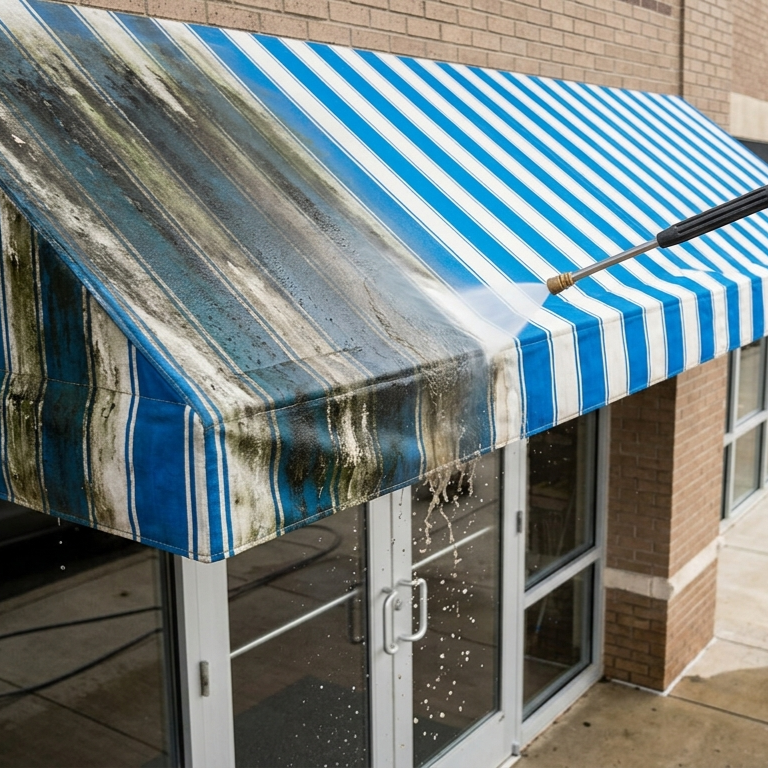
You stand at the curb on a Monday morning, coffee in hand, and look up at the awning over your shop entrance. Six weeks ago, it was clean. The crew came out, sprayed it down, and said it would last the season. Now there's a faint green tint creeping back along the front edge. A dark streak running down from where the awning meets the brick. By the time the lunch crowd shows up, you'll be hoping nobody notices.
Same awning. Same crew. Two months.
The reason it keeps happening isn't the awning.
The short answer first
A storefront awning sits in the worst microclimate on the entire building. It's shaded most of the day. It traps humid air against itself. It collects spores from the sidewalk traffic, the parking lot trees, the HVAC condensate, and the splashback from rain. And on top of all that, most awnings get cleaned with whatever the crew used on the sidewalk that morning — meaning the algae cells embedded in the fabric weave never get killed. They just get rinsed.
The streak doesn't come back because the awning got dirty again. It comes back because the algae was never killed in the first place.
The microclimate above your entrance is a perfect nursery
Walk around your building. The west wall, hit by afternoon sun and dry breeze, stays mostly clean. The east wall, same story by mid-afternoon. Now stand under the awning. Look up. The fabric is in shade. There's moisture trapped against the underside from the morning humidity. The air sitting between the awning and the storefront glass is several degrees cooler than the air on the sidewalk — and several degrees more humid.
That's exactly the climate algae wants.
Three conditions stack on top of each other above a storefront entrance:
The awning blocks UV. Direct sunlight is one of the best algae killers in nature. UV breaks down the cells faster than the colony can rebuild. Under an awning, the surface gets near-zero direct UV exposure, even on a bright day.
The awning traps moisture. Morning dew settles on the top surface and can't evaporate quickly because there's no airflow underneath. Rain hits the fabric, runs partway down, and pools where the awning seam meets the wall. After a humid summer night the fabric is damp from condensation by sunrise.
The awning collects re-seeding material constantly. Foot traffic kicks up dust, spores, and organic debris. HVAC drip lines often run near awnings and shed micro-droplets carrying nutrients. Tree canopy over the sidewalk drops pollen, sap, and algae spores from leaves. Splashback from rain hitting the sidewalk lands on the underside of the awning. The awning sits at the intersection of every spore source on the property.
Put those three together and you have a 24-hour-a-day algae incubator hung above your front door.
What a 3,000-PSI tip actually does to awning fabric
A standard pressure washer pushes water at the fabric somewhere between 2,500 and 3,000 PSI. That's enough to strip paint off a deck board. Aimed at an acrylic awning weave, the jet drives water through the threads, blows the UV-protective topcoat off the surface, and stretches the stitching at the seams. The streak lifts. The awning loses a year of service life in ninety seconds.
Vinyl-coated polyester takes the hit differently. The pressure doesn't tear the surface — it micro-pits the coating. Every pit becomes an anchor point for the next algae colony and a moisture trap that the original sealed surface didn't have. The awning looks bright in the afternoon of the wash and dirtier than ever six weeks later.
There is a second layer to the damage. Awning fabric is anchored to a metal frame by stitching at the perimeter and at any reinforced seams. High-PSI water hitting those seams perpendicular drives water under the stitch line and stretches the thread. After two or three pressure washes the seams start to weep and eventually fail — a repair that costs more than the awning was worth to clean.
The result: a service that costs money, takes the awning down for a day, and accelerates the problem it was supposed to solve.
Symptom → cause → urgency: what each kind of streak means
The streak pattern on an awning usually tells you what's driving it. Here's how to read it:
| What you see on the awning | What's actually happening | How urgent |
|---|---|---|
| Faint green tint across the top surface | Algae colony rebuilding in the textured fabric weave from cells the last wash didn't kill | Routine — clean before it darkens |
| Dark streaks running from awning seams down the wall | Algae trapped at the awning-to-wall seam where rain pools; biofilm migrating with runoff | Moderate — biofilm holds moisture against the building |
| Black mottled patches under the awning (the side facing the storefront) | Mold or mildew from trapped humidity and no UV exposure | High — mold doesn't self-clear and can spread to interior trim |
| Yellow-brown haze on a previously white awning | Pollen, road grime, and HVAC condensate residue layered on top of an algae base | Moderate — cosmetic if caught early, permanent if left to bake in summer sun |
| Pink or red blotches near sidewalk-level signage | Red algae (a different species) thriving in shaded brick-and-fabric junctions | Routine — same treatment as green algae, slightly longer dwell time |
| Slick black drip lines beneath HVAC exhaust above the awning | Mold fed by warm condensate water dripping onto the fabric | High — the source keeps re-seeding the awning until the drip is redirected |
If the streak is faint and across the top surface, you are behind on routine cleaning. If the streak is black, patchy, and on the underside, you've got a moisture problem the cleaning crew needs to address before the awning gets worse.
Fabric awnings and vinyl awnings need different chemistry
A storefront awning is one of two materials in almost every case. Acrylic fabric (Sunbrella and similar) on the higher-end retail buildings. Vinyl-coated polyester on the older or budget installations. They look similar from across the street. They clean nothing alike.
Acrylic fabric is woven. It holds algae cells deep in the weave, well below the visible surface. It also has a UV-resistant finish that can be stripped by aggressive chemistry or high-PSI water. Cleaning acrylic awnings means a low-concentration biocide, a longer dwell time, and a gentle rinse — the exact opposite of what a pressure-only crew does. Bleach at high concentration can lighten the fabric and weaken the fibers. Done wrong, the awning fades.
Vinyl-coated polyester is a sealed surface. Algae anchors on top, not into the substrate. Cleaning vinyl is faster — the biocide doesn't need to penetrate as deep — but the chemistry has to be compatible with the vinyl coating. Petroleum-based degreasers can soften the coating. Aggressive scrubbing leaves micro-scratches that hold dirt and accelerate the next colony.
The PSI matters more than most people realize. Awning fabric and vinyl should be rinsed under 500 PSI — roughly what a strong garden hose puts out. A standard pressure washer set to 2,500 or 3,000 PSI will tear seams and drive water through the weave. Metal awning frames can take a stronger rinse, around 1,500 to 2,000 PSI, but the fabric panels attached to those frames cannot. A crew that doesn't switch settings between the frame and the panel will damage the panel every time.
A crew using the same solution and the same pressure on both materials is doing one of them wrong. Usually both.
What actually keeps the streaks from coming back
There's a real version of awning cleaning that holds for one to two years, not six weeks. It looks like this:
A soft wash on storefront awnings starts with a low-pressure application of a biocide solution dialed to the fabric type. Acrylic gets a milder concentration with a longer dwell. Vinyl gets a stronger surfactant blend with a shorter dwell. The solution sits on the fabric for ten to fifteen minutes, killing the algae at the cellular level — including the cells anchored down in the weave.
After the dwell, a low-pressure rinse removes the dead organism and the cleaning solution. The fabric or vinyl isn't blasted. It isn't scrubbed. The pressure doesn't strip the protective coatings the manufacturer put on the awning.
A good crew also addresses the re-seeding sources. HVAC drips get redirected away from the awning. Splashback from the sidewalk gets evaluated. Tree canopy issues get noted for follow-up trimming. The awning seam at the wall gets sealed if it's pooling water. The goal is to break the feedback loop — kill the colony and reduce the rate at which the next one arrives.
That's the difference between a wash that holds and a wash that doesn't.
Frequently Asked Questions
The streak isn't an awning problem. It's a microclimate problem.
The mistake most building owners make is treating awning algae like a stain. Stains stay gone once they're cleaned. Algae streaks come back because the conditions that grew them — shade, trapped humidity, constant re-seeding from the sidewalk and HVAC — are still there the second the cleaning crew packs up. The only way to stretch the time between cleanings is to kill the colony at the cellular level the first time, and to address the sources that are feeding it.
If the company quoting your awning job can't tell you what kind of fabric it is, what biocide concentration they're using, and what the dwell time is, they're not cleaning the awning. They're hosing it off.
The wash that holds is the one that does the chemistry right and respects the material.
Superior Power Washing soft-cleans storefront and restaurant awnings across Waldorf, MD, and all of Charles County and Southern Maryland — including La Plata, Hughesville, Bryans Road, Indian Head, and Charlotte Hall. Acrylic, vinyl, and canvas awnings each get the right chemistry. Owner-operated, fully insured. Call (240) 901-4252 for a free on-site assessment.
