
What Causes Rust and Oil Stains on Concrete? 5 Culprits
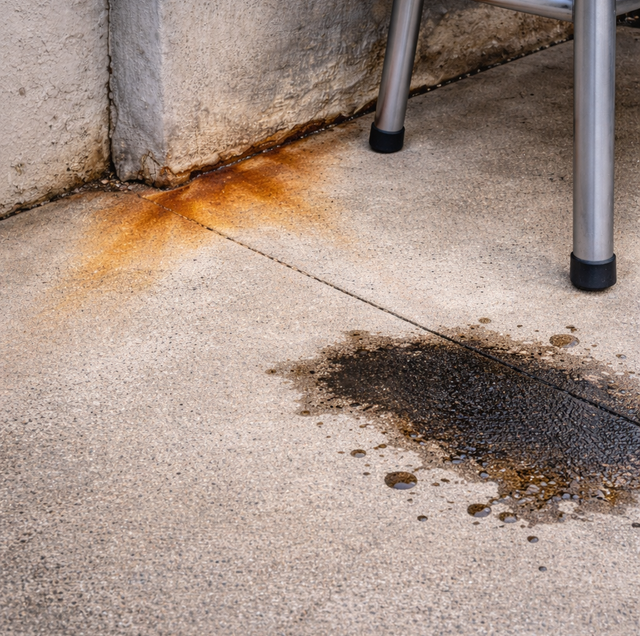
Quick Answer: Rust stains come from iron oxidizing on or in the concrete (metal furniture feet, shallow rebar, iron in fertilizer, or well-water sprinklers), and the dissolved iron soaks into the pores. Oil and grease soak in because concrete is absorbent and oil is not water-soluble, so plain pressure washing spreads them. Rust needs an acidic (oxalic-acid-based) remover; oil needs an alkaline degreaser or a poultice.
Concrete looks like solid stone, so it surprises most people to learn it drinks. A patio slab, driveway, or garage floor is riddled with tiny voids, and any liquid on top works its way down into them. That is why a rust ring or oil shadow shrugs off a good scrubbing: the color you see is no longer on the surface; it is inside the slab. Knowing where these stains come from, and why they behave so differently from ordinary dirt, is the difference between a clean slab and a smeared one.
Why Concrete Stains In The First Place
Cured concrete is not a sealed surface. As the mix hardens, water that helped it set leaves behind a network of interconnected pores, making the material closer to a hard sponge than to glass. Pour water on a fresh, unsealed slab, and you can watch it darken as it wicks in.
That porosity is the root of nearly every stubborn concrete stain. A spill does not sit on the surface waiting to be wiped; it descends. Once a colored compound, iron from rust or the pigments in oil, has migrated below the top layer, no surface agitation reaches it. It is why the same stain that ruins a driveway wipes clean off a countertop: the counter is sealed, the driveway is open.
Two things follow. The longer a spill sits, the deeper it goes and the harder it is to draw back out. And the correct removal method almost always has to pull the stain up out of the pores by chemical action, not scour it off the top. Pressure alone treats the surface while the source stays buried.
Fresh Stains Versus Old Ones: A spill caught within minutes has barely penetrated and often lifts with a quick cleaner. The same spill left for weeks has soaked deep, and by then it needs a chemistry that either dissolves the staining compound or slowly drags it back to the surface. Time is the single biggest factor in how hard a stain fights you.
Where Rust Stains Come From And Why They Keep Returning
Rust is iron oxide. It appears whenever a source of iron sits in contact with moisture and air long enough to corrode, and the dissolved iron then soaks into the pores and stains them a stubborn orange-brown. The iron source is often something you would never suspect.
Metal furniture and fixtures. The feet of patio chairs, tables, planters, and railings are common offenders. A steel chair leg left on a damp slab develops a rust ring beneath it within a season. Even a forgotten nail, a bottle cap, or a bit of steel wool can leave a spot.
Rebar sitting too close to the surface. Concrete is reinforced with steel bars meant to sit well below the surface. Where they were set too shallow, or the slab has worn thin, moisture reaches the steel, and it rusts from the inside out. The stain bleeds up through the slab in a line or patch that tracks the bar underneath. This kind comes from within the concrete, not from something resting on top.
Iron in lawn fertilizer. Many fertilizers and weed-and-feed products contain iron to green up grass. When granules land on a driveway or walk, or when overspray drifts onto concrete, they leave rust freckles the moment they get wet. A single misdirected spreader pass can dot a whole walkway.
Well-water sprinklers. Well water often carries dissolved iron. Every time a sprinkler throws it across a slab, it leaves a faint iron film, and over months the repeated wetting builds into a broad orange stain along the spray arc. Because the source is the irrigation itself, the stain returns after every cleaning until the water or spray pattern is addressed.
That last point explains recurring rust. If the cause is a chair you can move or fertilizer you can sweep up, the fix holds. If the cause is your irrigation water or a shallow rebar, the stain keeps returning until the source itself changes.
Do Not Confuse Rust With Efflorescence: A white, chalky, powdery haze on concrete is not rust and not oil; it is efflorescence, mineral salts carried to the surface by evaporating moisture. It brushes off dry or rinses with water and a mild acidic cleaner. Rust is orange to brown and soaks in; efflorescence is white and sits on top. Treating one as the other wastes effort; an acid meant for rust does little for a salt bloom's underlying moisture problem.
Why Oil And Grease Are A Different Problem
Oil stains behave nothing like rust, and the reason is chemistry. Oil and grease are not water-soluble. Water and oil separate rather than mix, so hitting an oil stain with plain water, even at high pressure, cannot grab the oil and carry it away. Instead, the blast pushes the oil sideways and down, smearing a tight spot into a wide gray halo and driving some deeper into the pores.
Because concrete is absorbent, motor oil, transmission fluid, cooking grease, and hydraulic oil wick straight into the slab the way they would into a paper towel. What sits on the surface is only the top of the stain; the bulk is held in the pores. Removing it means breaking the oil's grip and lifting it out, which water alone cannot do.
This is the job of a degreaser. An alkaline degreaser emulsifies the oil, breaking it into droplets that water can rinse away. For an old, deep stain, a poultice does the reverse of a spill: a paste of absorbent material mixed with a solvent or degreaser, spread over the stain and left to dry. As it dries, it draws the dissolved oil up out of the concrete and into the paste, which you scrape away. A poultice is a sponge working in reverse, pulling the stain back out of the slab the same way the slab pulled it in.
Why Pressure Washing Alone Fails On Oil: A pressure washer removes surface grime beautifully, but on oil it often makes things worse before it makes them better. Without a degreaser to release the oil first, the water spreads the stain and can lighten it just enough to look cleaner while the oil is still there. The right sequence is degreaser first to break the bond, dwell time to let the chemistry work, then a rinse, and only for surface soil does raw pressure do the heavy lifting.
Choosing The Right Cleaner For Each Stain
The two stains need opposite chemistry, which is why a single all-purpose cleaner rarely handles both.
For rust: an oxalic-acid-based remover: Oxalic acid reacts with iron oxide and converts it into a compound that rinses away. Hence, it lifts the color rather than bleaching over it. Sold as a rust remover for concrete and masonry, it is applied to the stain, left to dwell as the label directs, then rinsed thoroughly.
Acidic rust removers and alkaline degreasers are hazardous. Dilute strictly per the label, work in ventilation, wear eye protection and chemical-resistant gloves, and never mix an acid with any other cleaner, since combining chemistries can release dangerous fumes.
For oil and grease: an alkaline degreaser or a poultice: A degreaser handles fresh and moderate stains; a poultice is the tool for old, deep ones. Alkaline degreasers are also hazardous and demand the same care with PPE and ventilation; they must never be mixed with acids or other products.
Matching the chemistry to the stain matters because using the wrong one does nothing useful. An acid will not emulsify oil, and a degreaser will not convert iron oxide. Identify the stain first, then reach for the cleaner built for it.
Why Gentle Methods Beat Blasting
There is a strong temptation to fix a stubborn stain with brute force, cranking the pressure high or standing close with a narrow tip. On concrete, this backfires. High-pressure water can etch and pit the surface, stripping the smooth cement paste and exposing the rougher aggregate beneath. The etched area then looks lighter and rougher than the concrete around it, trading a stain for permanent damage that is far harder to hide. Concentrated high-pressure water is also an injury hazard and can lacerate skin.
Soft washing, low pressure paired with the right cleaning solution, works through chemistry instead of force. The cleaner breaks down or converts the stain, and a gentle rinse carries it off without carving into the slab. For a deep, set-in stain, a poultice does the same in slow motion, drawing it out over hours rather than blasting it out in seconds. The gentler approach reaches the part of the stain that pressure never could.
There is an environmental side to this as well. Oil, degreaser, and acid runoff should never flow into a storm drain, which typically leads straight to local waterways untreated. Contain and capture the wash water when you are lifting oil or using chemical removers, rather than letting it run off the driveway.
How To Keep Rust And Oil From Coming Back
Prevention is far easier than removal, and it comes down to keeping liquids from ever reaching the pores.
Seal the concrete: A penetrating or film-forming sealer fills or caps the pore network so spills bead on top and can be wiped up before they sink in. Sealers wear off with traffic and weather, so reapply on the schedule the product specifies. A sealed slab is not stainproof, but it buys time to catch a spill.
Use drip mats and trays: In a garage or under a parked vehicle, an absorbent drip mat catches oil before it hits the floor. A tray under a motorcycle, mower, or generator does the same.
Put rubber or plastic feet under metal furniture so damp steel never rests directly on the slab, and sweep up stray fertilizer granules before they get rained on. A stain with a live source, such as well-water sprinklers, returns after every cleaning until the source is addressed.
Address recurring sources: If well water is staining along a sprinkler arc, adjusting the spray away from concrete or filtering the iron out of the water stops the stain at its origin. A stain with a live source will always return until that source is dealt with, no matter how well you clean.
Rust and oil are stubborn because they live inside the concrete, not on it, and because they demand opposite chemistry. Read the stain first, match the cleaner to it, favor gentle methods that lift rather than blast, then seal so the next spill never gets the chance to soak in.
Frequently Asked Questions
No, and bleach can make it worse. Chlorine bleach is an oxidizer, and it can react with the iron to darken or set the stain rather than lift it. Dish soap is a surfactant meant for grease, not a reducing acid, so it does not affect iron oxide. Rust needs an oxalic or comparable acid that chemically converts the iron. Reaching for a laundry or kitchen product wastes time and, in bleach's case, can lock the stain in.
Dwell time is where the chemistry actually happens, and most products call for roughly 5 to 15 minutes, but always follow the specific label. The one rule that overrides the clock: never let the product dry on the surface. A cleaner that dries out stops working and can leave its own residue or etch marks, so on a hot or breezy day you may need to re-wet the area to keep it active through the full dwell.
A surface rust ring from a chair foot is cosmetic. But a stain bleeding up from rebar signals something structural: the embedded steel is corroding, and as steel rusts it expands to several times its original volume, which can crack and spall the concrete from the inside. That kind of rust stain is an early warning worth investigating, not just a blemish to scrub.
The bigger variable is curing and sealing, not just years on the calendar. Concrete under about a month old is still curing and runs more alkaline with tighter pores, so acidic rust removers react too hard and can etch a young slab, which is why fresh concrete should be left to finish before any acid treatment. At the other end, a slab that has never been sealed slowly loses the fine cement paste at its surface to weathering, so an old bare driveway both grabs stains faster and holds them deeper than a sealed slab of the same age. Sealing status often matters as much as the number of years.
Often, but it takes a poultice and patience, sometimes more than one application. A years-old stain has migrated deep, so a single poultice may pull out only the upper portion, and the remaining oil then wicks back toward the surface over the following days. Reapplying the poultice after that migration catches the deeper oil. Complete removal of a very old, deep stain is not always possible, and a faint shadow may remain.
It does, meaningfully. Heat lowers oil's viscosity, thinning it so it releases from the pores more readily, which is why many degreasing setups use heated water rather than cold. Warm water also speeds up the emulsifying action of an alkaline degreaser. It is not a substitute for the degreaser, but pairing heat with the right cleaner noticeably improves how much oil lifts on the first pass.
Book a soft-wash treatment before that stain sets any deeper — protect your concrete and get it looking right the first time. Superior Power Washing serves Waldorf, La Plata, and Clinton. Call (240) 901-4252.
