
When to Call a Pro for a Fresh Oil Spill on Your Concrete Driveway
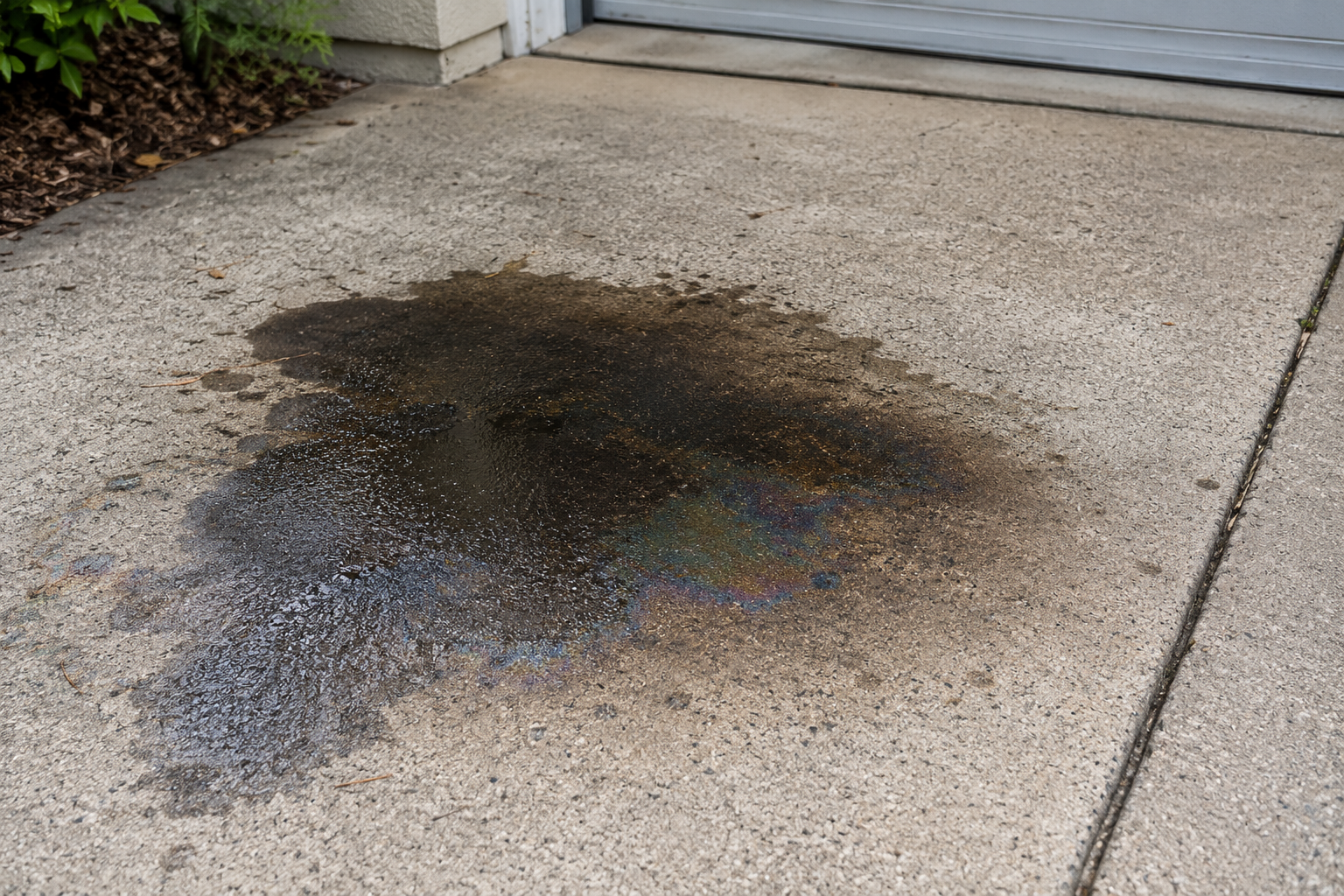
You back the car out of the garage and notice a dark puddle the size of a dinner plate sitting where the front wheel was parked. It's glossy. It's spreading. There is a thin rainbow sheen on the edge where it's already crept into the concrete pores. The next ten minutes are about to decide whether this is a $0 fix or a permanent stain.
That's the part nobody tells you about a fresh oil spill on concrete.
Concrete acts like a sponge made of stone. The surface looks solid, but it's full of microscopic pores, and oil wicks into them faster than you can blink. Once it's down there, you can't pressure-wash it out. You can't soap it out. You can fight the stain for years and lose ground each season.
The fix isn't complicated. The window is short.
The first five minutes are the whole game
Forget the garden hose. Forget the dish soap. The single most important thing you do in the first five minutes is soak up the wet oil before it migrates.
Here's the playbook in the order it actually happens:
1. Stop the leak source. If the car is still dripping, slide a cardboard box, baking sheet, or oil drip pan underneath the engine. Every additional drop is more pores filled.
2. Cover the entire wet area with an absorbent. Plain clay cat litter (the cheap non-clumping kind) is the gold standard. Sawdust, cornstarch, baking soda, or kiln-dried sand also work. A thick layer — half an inch — over and a few inches past the visible edges of the spill.
3. Walk on it. Press the absorbent down with the sole of an old shoe to push it into the wet oil. Not stomping. Just steady pressure.
4. Wait twenty to thirty minutes. Longer is fine. The absorbent is wicking oil up out of the concrete pores by capillary action.
5. Sweep it up. Use a stiff broom and a dustpan. Bag it in a sealed plastic bag — used oil-saturated absorbent goes to a hazardous-waste drop-off, not the curbside trash.
6. Reapply if the concrete still looks wet. Two or three rounds of fresh absorbent is normal for anything bigger than a coffee saucer.
Do NOT hose it off. Do NOT pressure wash. Do NOT spread it with a push broom. Do NOT wipe with a rag — wiping smears the oil sideways across pores it hadn't yet reached, and pushes the rest down. Each of those moves takes a contained spill and turns it into a four-foot-wide stain.
Only after the absorbent stage is done — and the concrete is visibly dry — do you move to a degreaser and water.
The DIY window vs. the call-a-pro window
Most fresh spills under a coffee cup, caught within the first hour, clean up to no visible mark with the steps above, plus a follow-up scrub of degreaser and warm water. The question is which spills land outside that window.
| What you're looking at | DIY this | Call a pro |
|---|---|---|
| Quarter-sized drip, caught within an hour | Yes | No |
| Coffee-saucer puddle, caught within an hour | Yes | No |
| Dinner-plate spill, caught within an hour | Maybe | Yes if it's already setting in |
| Anything bigger than a dinner plate | No | Yes |
| Spill that's been there overnight | No | Yes |
| Spill that's been there more than 48 hours | No | Yes — the stain is bonding |
| Brake fluid, power steering fluid, or unknown fluid | No | Yes — different chemistry |
| Sealed concrete driveway (decorative finish, stained, or coated) | No | Yes — wrong chemistry strips the sealer |
| Sloped driveway running toward a storm drain | No | Yes — runoff containment matters |
| Multiple overlapping old + new stains | No | Yes |
| Spill on a rental, HOA property, or pending home sale | No | Yes — you need it gone, not faded |
The cutoff isn't size or age in isolation. It's whether you finish the cleanup before the oil bonds with the concrete matrix. Once it's bonded — usually 24 to 72 hours, faster in hot weather — you're no longer cleaning a wet spill. You're treating a chemical stain, which is a different job.
Why hosing it off makes everything worse
This is the mistake that turns a $0 fix into a $400 problem.
A garden hose looks like the obvious move. The oil is on the surface, water rinses things off the surface, water and oil don't mix, problem solved. Right?
No. The water hits the puddle and disperses the oil — instead of one wet circle, you have a wet area three times the size with a film of oil across all of it. The water also drives oil down into pores it hadn't reached. A pressure washer is worse — the high-velocity stream atomizes the oil into tiny droplets and forces it deep into the slab where no absorbent can reach.
Think of oil on concrete like a drop of food coloring on a white paper towel. Touch a dry sponge to it and you lift most of it out. Spray it with a water bottle and it spreads across the whole towel.
The garden hose is the water bottle.
What different fluids do to concrete
Not all "oil" is oil. Each fluid in a car behaves a little differently when it lands on concrete, and the difference matters.
Motor oil is the most common spill and the most forgiving. It's viscous, dark, and slow to migrate. You usually have an hour or two before it bonds, longer in cool weather.
Transmission fluid (ATF) is bright red, much thinner, and wicks into concrete pores within minutes. The pink-to-orange stain it leaves behind is harder to lift than motor oil because the dye in ATF bonds with the cement separately from the oil itself.
Brake fluid is clear or pale yellow, eats most concrete sealers on contact, and is mildly corrosive to the cement paste itself. A brake-fluid spill on a coated decorative driveway is a real problem — the coating will lift.
Power steering fluid and hydraulic fluid from a riding mower behave like ATF — same playbook, same urgency, just lighter colors.
Gasoline and diesel evaporate partially, but the residual oils in the fuel stain concrete like motor oil does. The fire-safety angle matters more than staining — never use rags or absorbents near an open flame, and never hose fuel into a storm drain.
If you don't know which fluid you're looking at, don't experiment. The wrong degreaser on a brake-fluid spill strips color from stamped concrete and leaves a bright patch worse than the stain.
The mistakes that turn a small spill into a permanent stain
A few moves we see homeowners try, with predictable results:
Gasoline or paint thinner as a cleaner. Dissolves the oil, yes. Also dissolves any sealer, drives the diluted oil deeper into the pores, evaporates into a fire hazard, and is illegal to wash into a storm drain. Skip this entirely.
WD-40 sprayed on as a "lifter." WD-40 is itself a petroleum-based product. You're adding more oil to a concrete pore that already has too much oil in it. The stain spreads and then sets harder.
Bleach poured over the stain. Bleach has no chemistry to break down oil. It will lighten any algae around the spill, which makes the contrast worse, not better. Bleach on bare concrete near grass also kills the grass.
Coca-Cola, Dawn dish soap alone, or kitty litter with no follow-up. Each is part of a real solution, not a complete one. Dawn cuts fresh oil on contact and works as step two after absorbent removal — alone it leaves a film. Kitty litter without a follow-up degreaser leaves a shadow stain where the oil that didn't get wicked up bonded with the concrete.
Waiting until next weekend. The single most common mistake. Every day that passes drops your odds of a no-trace cleanup. By 48 hours you're treating a bonded stain. After a few months the oil polymerizes — it hardens inside the pores into a wax-like film that no surface cleaner can dissolve.
If you can't get a pro out for a week or two and the stain is setting in, a homeowner poultice is a reasonable holding move. Mix baking soda or Portland cement powder with water to a thick paste, spread it a quarter-inch deep over the stain, cover with plastic, let it dry for a day, then sweep it up. The dried paste pulls oil up out of the pores as it cures. Repeat two or three times. It rarely lifts an old stain fully, but it stops the damage from getting worse and bridges to a real treatment.
What a professional stain treatment actually involves
When the spill is too big, too old, or on the wrong substrate for a DIY round, the work shifts to chemistry that homeowners can't easily buy and equipment that contains runoff.
A typical professional oil-stain removal on concrete starts with assessment. The crew identifies the fluid if it's unknown — motor oil, ATF, brake fluid, hydraulic — because the chemistry choice depends on it. They check whether the concrete is sealed, stained, stamped, or bare gray, because a degreaser strong enough to lift a 6-month-old stain will also strip the wrong sealer.
Then they contain runoff. A sloped driveway with a storm drain at the bottom isn't a place you flood with cleaning solution and walk away — booms, berms, or vacuum recovery keep the dirty water from running off-site. Most municipalities consider degreaser runoff into storm drains a violation, and the homeowner is the one cited if it's their property.
The treatment itself is a hot-water alkaline degreaser at a concentration matched to the age and depth of the stain, dwell time long enough for the chemistry to reach the pores, mechanical agitation, then a captured rinse. Deep, set-in stains take repeat cycles. Stains months or seasons old need a poultice that draws oil back out of the pores over hours rather than minutes.
A good treatment leaves the concrete the same color and texture it was before the spill. The stain comes out. The slab doesn't read as a clean patch surrounded by dirty concrete, and it doesn't read as a bright halo where the cement was etched. It reads as concrete.
Frequently Asked Questions
What to do in the next ten minutes
If you are reading this because you just spilled oil on your driveway and the puddle is still wet — close the browser, grab the cat litter, and cover the entire spill an inch thick. Walk on it. Come back in half an hour. Sweep it up and reapply. Don't touch the hose until the concrete is visibly dry.
If you are reading this because the spill was last weekend and it's set in — you can still get most of it out, but the DIY toolkit isn't going to be enough. A degreaser strong enough to lift a week-old stain is also strong enough to etch unsealed concrete, strip a coated finish, or kill grass downstream. That's a call.
Hold the concrete-sponge image in mind. Once oil's in the pores, getting it out takes longer than putting it in — and time only makes the job harder.
Superior Power Washing handles fresh oil, transmission fluid, and set-in stain removal on residential driveways, garage floors, and commercial parking areas across Waldorf, MD, and all of Charles County and Southern Maryland — including La Plata, Brandywine, White Plains, Hughesville, and Charlotte Hall. Runoff contained, chemistry matched to the fluid and the substrate, no etched halo where the stain used to be. Call (240) 901-4252 for a free on-site assessment.
