
What Causes Rust Stains Around Concrete Patios and Walkways
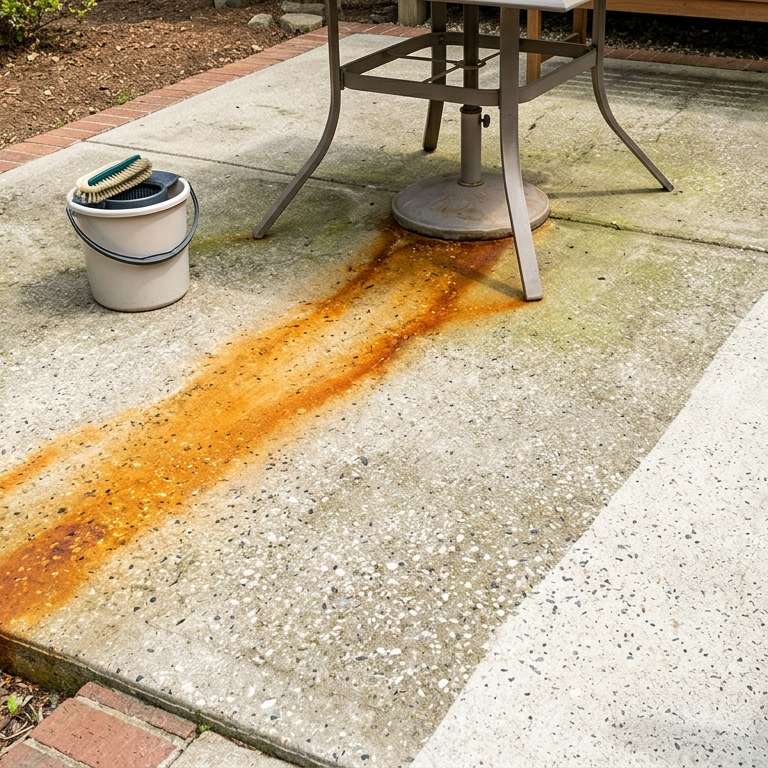
You walk out to the patio with a coffee in hand, and there it is — a streak of orange along the south edge of the concrete that wasn't there last weekend. It doesn't look like dirt. Doesn't wipe off with a wet rag. Closer to a rust-colored tea stain than a smudge, and it's clearly soaked into the concrete rather than sitting on top.
That's a rust stain. And the shape of it tells you exactly where it came from.
Rust stains on a concrete patio or walkway can come from at least six different sources, and they don't all get cleaned the same way. A couple of them are signals that something else is wrong and the stain is just the visible symptom.
The pattern is the diagnosis
Before you reach for a cleaner, look at the stain. Rust on concrete almost always leaves a pattern that points back to the source. A fan-shaped spray of orange dots points one direction. A circle the size of a chair leg points another. A long streak that follows the slope of the patio points to a third.
This table lines up the most common patterns we see across Charles County patios and walkways, the cause behind each one, and how urgently it needs attention.
| Stain pattern | Cause | How urgent |
|---|---|---|
| Fan-shaped orange dots, repeating in arcs | Iron in sprinkler water | Low — cosmetic, but it'll keep coming back until the water source changes |
| Round or square stain matching a furniture leg | Metal patio furniture sitting in standing water | Low — move the furniture, treat the stain |
| Random orange spots tracking from lawn onto concrete | Iron fertilizer (ironite) overspray | Low — wash before it sets; the stain bonds in a week |
| Long orange streak following the slope of the slab | Well water with high iron, or runoff from a metal object uphill | Medium — find the source uphill |
| Orange ring with a hairline crack at center | Rebar inside the concrete is rusting | High — structural; the rust is pushing the concrete apart |
| Orange halo around an embedded bolt or post anchor | Galvanized hardware has failed and the steel underneath is corroding | Medium — replace the hardware before the concrete spalls |
| Small orange-green crusty patch under a toy or piece of equipment | Battery acid leaking from a kid's ride-on, a golf cart, or a cordless mower | Low — neutralize and clean before the etch deepens |
Six of these seven are surface problems. One of them is a structural problem with the slab itself. Knowing which is which is the whole point of figuring out the cause before cleaning.
Sprinkler dots are the most common culprit
If your patio shows a pattern of small orange dots in repeating arcs, and the dots get heavier near the edges of the patio that border the lawn, the cause is almost certainly an irrigation system.
Well water and municipal water in parts of Southern Maryland carries dissolved iron. Not enough to taste or notice on white laundry, but enough that when the water hits concrete, sits in the pores for a few hours, and evaporates in the sun, it leaves a faint orange dot behind. Each pass of the sprinkler adds another layer. After a season the dots merge into a continuous tint.
The fan shape is the giveaway — sprinkler heads throw water in an arc, and the spray pattern shows up on concrete the same way it shows up on the grass. If you can stand at the corner of the patio and see the arc match a sprinkler head ten feet away, that's your answer.
The fix isn't really a cleaning problem. We can pull the iron stain out with an acidic rust remover, but unless the sprinklers get redirected, the dots will be back by midsummer. Adjusting the sprinkler heads to throw away from the concrete is cheaper than cleaning twice a season, and that's where most of these end up.
Furniture-leg rings are easy if you catch them early
The other extremely common rust stain is a circle or square the size of a chair leg, a planter base, or a hose-reel foot. Steel furniture, even powder-coated steel, will eventually rust where the coating cracks or where the foot sits in a puddle after rain. The rusty water bleeds out underneath the foot and stains the concrete in the exact shape of the contact area.
A few weeks old, this stain comes out with a household rust remover and a stiff brush. A few months old, it's a different job — the iron has migrated down into the pores of the concrete and a surface scrub does nothing. At that point it needs an acidic treatment with enough dwell time to draw the iron back to the surface.
The prevention is simple. Plastic feet or rubber pads under any metal furniture, and don't leave wet planters sitting on concrete. Anything that holds water against the slab for more than a day will eventually stain.
Fertilizer overspray is the one that surprises people
You hire a lawn-care company. They show up with a spreader, walk the lawn, and broadcast a granular fertilizer that includes iron sulfate — sometimes called ironite. The iron is what makes the grass turn dark green within a few days. It works.
The problem is that the spreader doesn't stop at the property line. Granules end up on the patio, on the walkway, on the driveway. The first sprinkler cycle or rain after the application dissolves those granules into a concentrated iron solution that soaks straight into the concrete. Within twenty-four hours the spots set. Within a week they're locked in.
If you see random orange spots that don't follow a sprinkler arc, don't sit under furniture, and showed up within a few days of a lawn-care visit, this is almost certainly the source. The lawn company should sweep or blow concrete surfaces after applying granular product — the good ones do this without being asked. If yours doesn't, that's a conversation worth having.
Caught within the first day, a thorough rinse with plain water clears most of the residue before it sets. After that it needs the same acidic treatment as a furniture stain.
The orange ring with a crack at the center is the one you cannot ignore
This is the stain that matters. An orange halo on a concrete patio with a hairline crack running through the middle of it means the rebar inside the slab is rusting.
Concrete is porous. Over years, water works its way through the slab and reaches the steel reinforcement embedded inside. The steel oxidizes. Rust takes up about seven times the volume of the original steel — that's what corrosion does. The expanding rust pushes outward against the surrounding concrete with enough force to crack it from the inside.
The crack lets in more water. More water means more rust. More rust means more cracking. It's a feedback loop that ends with chunks of concrete breaking off (called spalling) and the rebar exposed to open air.
We don't clean these. Or, rather, we clean the surface stain so the homeowner can see what's underneath, but the cleaning isn't the fix. A concrete contractor needs to assess the slab, decide whether the section can be repaired with epoxy injection or whether the affected area needs to be cut out and re-poured. The earlier this gets caught, the smaller the repair. A small spider crack with a faint orange tint costs hundreds to fix. A spalled section with exposed rebar costs thousands.
If you're seeing this on a walkway near a foundation, an attached patio, or a structural element — call a concrete contractor first. Cleaning the stain comes later.
Why rust on concrete is harder to clean than rust on metal
People assume rust is rust. It isn't.
Rust on a metal surface sits on top of the metal. You scrub it, you wire-brush it, you treat it, it comes off. Rust on concrete behaves more like a dye than a coating. The iron particles work their way into the porous matrix of the cement and bond chemically with the calcium compounds in the concrete. By the time the stain is visible on the surface, the iron has already penetrated downward by an eighth of an inch or more.
That's why household cleaners don't touch a set-in rust stain. The cleaner sits on the surface for thirty seconds and goes after the iron right under it. The iron a quarter-inch down is still there. Within a few rain cycles it migrates back to the surface and the stain reappears, sometimes lighter, sometimes not.
The chemistry that actually works on set-in concrete rust is oxalic acid. It's stronger than the citric or phosphoric acid in most household rust removers, and it has the right molecular shape to pull iron out of the concrete pores rather than just dissolving what's on the surface. Applied at the correct concentration, with enough dwell time to penetrate, then neutralized and rinsed — it lifts the iron out of the substrate.
Done wrong, oxalic acid etches the concrete. Done at the wrong concentration, it leaves a lightened patch where the cement paste itself was attacked. This is one of the cases where the "rent a pressure washer from the hardware store" approach almost always makes the problem worse — the homeowner ends up with both the original stain and a halo of etched concrete around it.
What professional stain removal actually looks like
A real rust treatment on concrete starts with figuring out which of the causes above is in play. If it's rebar, we stop and refer to a concrete contractor. If it's a surface stain — sprinkler, furniture, fertilizer, well water, embedded hardware, battery leak — the work itself follows the same general shape.
The crew wets down nearby grass and beds first so any runoff is diluted before it reaches the roots, then rinses the slab to remove loose dirt and surface organic growth. They test the chemistry on a small patch in an inconspicuous corner — broom-finished concrete, exposed aggregate, and stamped pavers all react a little differently, and the test patch tells us whether the concentration is right before we treat the whole area. Then they apply an oxalic-acid-based rust remover at a concentration matched to the age and depth of the stain, and let it dwell. Dwell time matters more than scrubbing — the acid needs minutes to migrate into the pores and bond with the iron. After the dwell, a low-pressure rinse pulls the acid and dissolved iron back out of the concrete. A neutralizing rinse follows, because leftover acid on the surface will keep etching long after the crew leaves.
If the stain is deep, the cycle gets repeated. A patio stained for years sometimes takes two or three cycles to lift fully — better than one heroic single application that etches the cement.
The standard is simple: a good rust treatment leaves the concrete itself unchanged. The stain comes out, the texture stays, the color stays. The patch where the stain used to be doesn't read as a clean patch — it reads as concrete. Anything less and you've traded a rust stain for a bright halo, which is arguably worse.
Frequently Asked Questions
A rust stain isn't always just a rust stain
The orange streak on the patio is one of those things that looks cosmetic and sometimes is, and sometimes isn't. Five times out of six it's a surface problem with a known fix. The sixth time, it's the slab telling you something is happening inside it that's going to get worse if no one looks.
The diagnosis isn't hard. Stand back. Look at the pattern. Trace it to the source. If you find a sprinkler head, a furniture foot, a lawn-care date, or an uphill metal object that explains the shape, you are in surface-stain territory, and oxalic acid will pull it out. If you can't find an external source — if the stain is over a crack — that's a job for a concrete contractor before it's a job for a pressure washer.
The patio tells you what's wrong if you read it the right way.
Superior Power Washing handles rust stain removal on concrete patios, driveways, and walkways across Waldorf, MD, and all of Charles County and Southern Maryland — including La Plata, Clinton, Fort Washington, White Plains, and Brandywine. Oxalic-acid treatments dialed in for the age and depth of the stain, neutralized and rinsed so the concrete looks like concrete. Call (240) 901-4252 for a free on-site assessment.
