
Why Composite Decking Develops a Chalky White Film Over Time
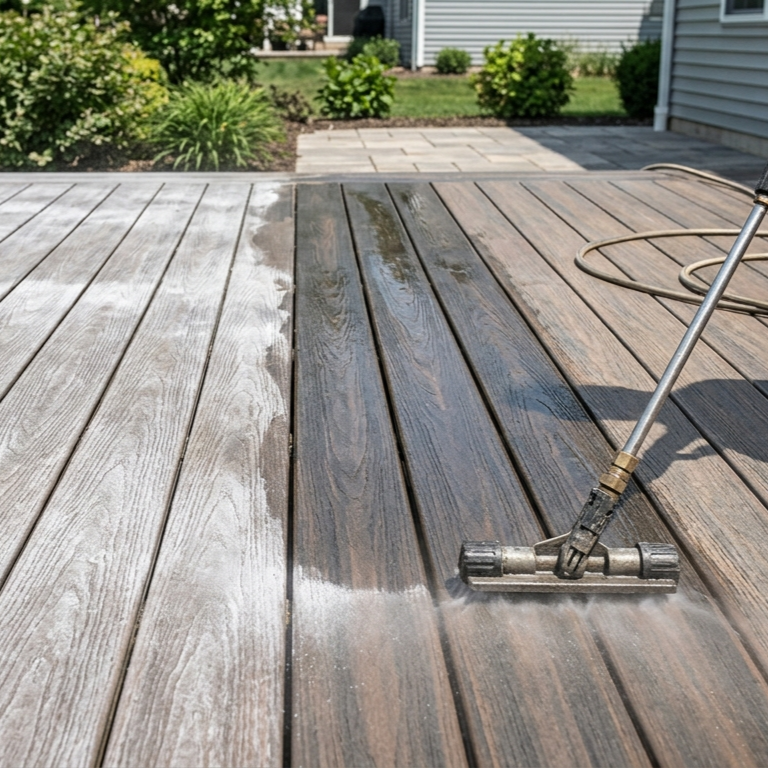
You run a hand along the top rail of the deck, and a fine white powder comes off on your palm. The boards look hazy in the afternoon sun — flat, dusty, slightly faded against the part still shaded by the table. You hose it off, and the boards look right for an hour. By the next morning, the haze is back.
This wasn't supposed to happen. Composite was the deck you bought, so you didn't have to deal with this.
Here's the part the brochure left out.
The white film isn't one thing — it's three different things that look the same
Three separate problems produce that chalky look on composite deck boards. They sit on the same surface, they look almost identical from across the yard, and they need three different cleaning approaches. Treat the wrong one and the haze comes back within a week.
| What you see | Underlying cause | How urgent |
|---|---|---|
| Dull chalky surface, comes off on a finger, worse in sun-exposed sections | Polymer oxidation — UV breakdown of the plastic matrix in uncapped (first-gen) composite | Cosmetic on uncapped boards. Surface won't get worse fast, but the film returns after every rinse. |
| Powdery white patches in shaded sections, near soil contact, around the deck skirt | White mold or white algae growing in the wood-flour component of the board | Moderate. Spreads in damp weather. Makes the surface slick. |
| White crusty rings near sprinkler heads, hose bibs, or under planters | Mineral residue from hard water or fertilizer salts leaching from soil | Cosmetic. Won't spread on its own, but builds up if the source keeps soaking the same boards. |
| Hazy white film overall, mostly on horizontal surfaces, after a recent pressure wash | Surface damage — pressure stripped the cap layer and exposed wood flour | High. The board is now permanently more porous. Future cleanings get harder. |
If you can't tell which one you're looking at, the diagnosis comes from where it shows up and what happens when you wet it. We'll work through each.
Polymer oxidation: the chalky look that means your boards are first-gen composite
Older composite decking — anything made before about 2010 — has a uniform mix of wood flour and recycled plastic all the way through the board. No protective shell. The plastic matrix on the surface takes direct UV exposure every day for years. UV breaks the polymer bonds. The plastic on the very top of the board degrades into a microscopic chalky layer that lifts off when you touch it.
This is why the powder comes off on your hand. It's the surface of the deck itself, slowly breaking down.
The film is heavier on south- and west-facing sections where sun exposure is highest. Boards under the picnic table, under planters, under the grill — anywhere shaded — usually still look closer to the original color. That contrast is the giveaway. If the chalk follows the sun pattern across the deck, you're looking at oxidation.
A garden hose lifts the loose powder. The film comes back because the surface continues to oxidize the next sunny week. There's no cleaning agent that stops it permanently — the polymer is degrading. What helps is a deep clean that removes the loose oxidized layer, then a composite-deck restoration product that re-binds pigment to the surface. Some manufacturers sell rejuvenation kits specifically for this. Sanding is not recommended on composite. It exposes more raw wood flour and accelerates the next round of breakdown.
Newer capped composite — Trex Transcend, TimberTech AZEK, Fiberon Symmetry, anything with "cap" or "shield" in the product name — doesn't oxidize the same way. The cap layer is a separate UV-stable polymer co-extruded over the wood-plastic core. If your deck was installed in the last ten or fifteen years and the boards are showing chalk, it's probably one of the other two causes below, not oxidation.
White mold and algae: the patches in shaded spots that feel slick
Wood-plastic composite contains real wood fiber — usually sawdust or wood flour, between 30 and 60 percent of the board by weight. Mold and algae feed on that wood fiber the same way they feed on a wood deck. The polymer doesn't stop them. It just slows the colony down enough that homeowners don't expect to see it.
White mold (commonly Trichoderma species) shows up as fuzzy or powdery patches in shaded sections, usually:
Along the deck skirt where it meets soil or mulch
Under sections shaded by trees or eaves
In board grooves where leaves sat over winter
Near hose bibs, planters, or anywhere water pools
Wet the patch with a spray bottle. If it darkens to a wet gray-green and looks slimy, it's organic — mold or algae. If it stays chalky-white when wet, it's mineral or polymer.
The fix is a soft wash biocide treatment — usually a diluted sodium hypochlorite solution with a surfactant, the same family of chemistry used on roofs and siding. The biocide kills the organism at the cellular level, soaks into the wood fiber where the colony is rooted, and lets the dead material rinse off. A pressure wash on its own won't kill it. It knocks the visible patch loose and leaves the cells in the wood fiber, which is why the white patches usually come back within a few weeks of a standard pressure wash.
The same dwell-time chemistry we use for deck and fence cleaning is what makes the result last. Pressure alone gets you about a month.
Mineral residue: the crusty white rings near sprinklers and planters
Hard water has dissolved calcium and magnesium in it. Every time a sprinkler hits the deck, a thin film of water sits on the boards and evaporates. The minerals don't evaporate. They stay behind as a fine white crust.
Same thing happens with fertilizer salts leaching from planters that drain onto the boards, with potting soil that gets watered weekly, with the side of the deck where the dog's water bowl tips.
Mineral residue stays white when you wet it — water just runs over the crust without darkening it. Vinegar dissolves it. A 50/50 white vinegar and water solution, brushed on with a soft deck brush, breaks the calcium scale down within a few minutes. Rinse with the hose.
The fix is to redirect the water source. Move the sprinkler head. Switch to drip irrigation in planters that sit on the deck. Pull the dog bowl off the boards onto a tray. Otherwise the same ring shows up again within a few weeks.
Why pressure washing can make composite chalk worse instead of better
This is the part where homeowners spend a weekend making the deck look worse than when they started.
A pressure washer at 3,000 PSI tears the cap layer off capped composite. It doesn't fully strip it — it leaves the cap intact in some spots, gouged in others. The gouged spots expose the wood-flour core. The exposed core absorbs water, swells, releases fine wood fiber to the surface, and chalks faster than the original surface ever did.
On uncapped (first-gen) composite, the same pressure removes the loose oxidized layer along with healthy material underneath. The surface gets visibly rougher. Future dirt and mold embed more easily because there's more texture to hold onto. The next year the deck looks dirtier than the year before.
The combination of pressure too high, fan tip too narrow, and the nozzle held too close to the board is what does the damage. Composite manufacturers will void the board warranty for pressure-washing damage, and the visible signature is hard to argue with — parallel streaks the width of the fan pattern, all running the same direction.
A composite deck wants low pressure (under 1,500 PSI for most uncapped boards, with manufacturer-specific maximums going up to around 3,100 PSI for some capped Trex products), a wide fan tip (40-degree minimum), the nozzle held twelve to eighteen inches from the surface, and a deck-safe cleaner doing most of the work instead of the water force. Sweep with the grain of the embossed wood-pattern, never across it — water driven sideways into the grain edges can lift the cap layer at the seams. That's the same general approach as a soft wash on a roof, scaled to a deck. The water rinses what the cleaner has already loosened.
Bleach and chlorine cleaners get a separate warning. They lighten the surface color of composite, weaken the cap polymer over time, and on most major brands they void the warranty if used at concentration. The diluted soft wash chemistry pros use for mold is a different chemical profile from a homeowner pouring household bleach out of the jug.
How to tell what your deck actually needs
Three diagnostic tests, done in order:
Run a finger across a sun-exposed section. If chalk comes off on the finger and you can see contrast between sunny and shaded boards, oxidation is part of what you're dealing with.
Spray a patch of the white film with water from a bottle. If it darkens to gray-green, you have mold or algae. If it stays white, it's mineral or polymer.
Check the location pattern. Rings near sprinklers, hose bibs, or planters point to minerals. Patches in shaded spots, near soil, or under tree cover point to organic growth. Uniform haze across all sun-exposed sections points to oxidation.
Most decks more than five years old have a mix of two of the three. The cleaning approach gets sequenced — biocide first to kill the organic growth, vinegar or a calcium remover next for the mineral rings, then a deck-restoration product on the oxidized sections if the surface allows it.
Frequently Asked Questions
The chalk has three causes and three different fixes — not one cleaning trick
The reason a single pressure wash never seems to fix this for long is that one cleaning approach can't address three different problems. The mold needs chemistry. The mineral rings need acid. The oxidation needs a restoration product. And the wrong pressure makes all three worse.
A composite deck that's been chalking for a few seasons usually has a layered set of issues — some surface mold in the shade, some mineral rings near a planter, some oxidation on the south side. The deck doesn't need replacement. It needs the right cleaning approach matched to each spot.
Get the diagnosis right, and the deck stays looking like it did three years after the install. Get it wrong, and you're rinsing a haze that comes back every weekend.
Superior Power Washing cleans composite and wood decks across Waldorf, MD, and all of Charles County and Southern Maryland — including La Plata, Hughesville, Bryans Road, Indian Head, and Charlotte Hall. We diagnose the cause before the wash, match the chemistry to the surface, and use pressure low enough to protect the cap layer. Call (240) 901-4252 for a free on-site assessment.
