
What Causes Tiger Stripes on the Outside of Gutters
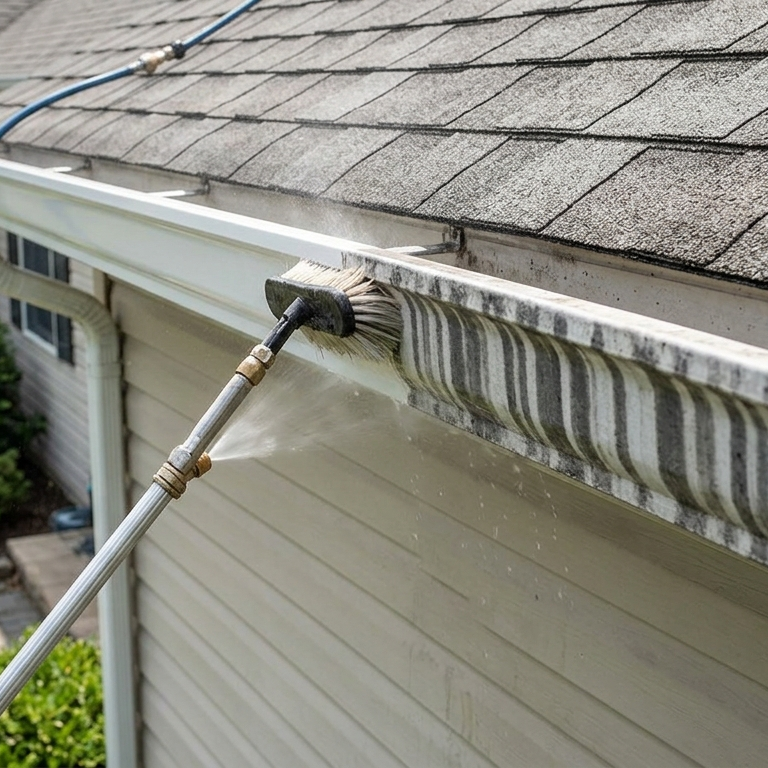
Pull into your driveway, look up at the gutter line, and there they are — dark vertical streaks running down the front face of the gutter, evenly spaced, almost decorative. Like someone took a wide brush and dragged vertical bars across the white aluminum. The siding is clean. The roof is clean. But the gutters look like they have been wearing the dirt for a decade.
You grab the hose. You spray the gutters down. The streaks don't budge.
They're not dirt.
Tiger stripes are a chemical stain, not surface dirt
When it rains hard, water doesn't just fall neatly into the open top of the gutter. Some of it sheets cross the lip and runs down the outside face. Some of it overflows at the corners and over clogged sections. That overflow water has been picking up everything on the way down — oils that wash off asphalt shingles, soot and atmospheric pollution, tannic acids from leaves and tree resin, even a little oxidized aluminum from the inside lip of the gutter itself.
That contaminated water hits the front face of the gutter. It dries there. The contaminants stay behind.
Then the rain stops. The front face of the gutter never gets a real wash from the rain — rain falls into the top, not onto the front. So the stain dries in place. Next storm, the same thing happens. Layer on layer.
After a year or two of that, you've got tiger stripes.
The reason they look like stripes — evenly spaced, vertical, not random — is that the overflow water follows the same paths every storm. Each path is set by a tiny low spot on the gutter’s lip. Water runs over those low spots, leaves a stain in the same place each time, and the stripe darkens with every rain.
Symptom → cause → urgency
The stripes don't all mean the same thing. Some are routine. A few are warning signs.
| What you see | What's actually causing it | How urgent |
|---|---|---|
| Even gray or tan vertical streaks across the whole gutter run | Asphalt shingle oils and atmospheric residue washing down during rain | Routine — clean within 6–12 months before the stain bonds |
| Streaks concentrated under roof valleys, hip joints, or downspout corners | Overflow points carrying more contaminated water than the rest of the run | Address within 6 months — these sections stain fastest |
| Black streaks that have spread sideways into wing shapes | Algae colonies are growing in the residue layer | Soft wash within 3 months |
| Streaks that look etched into the paint, won't lift with detergent | Stain has chemically bonded with the painted finish through oxidation | Specialty gutter brightener service or repaint |
| Streaks with rust-colored undertones near fasteners | Galvanic corrosion from steel screws sitting against aluminum | Inspect brackets, treat the corrosion, then clean and repaint that section |
| Streaks plus chalky white film on the gutter face | Paint is oxidizing alongside the staining | Clean first, then evaluate whether the gutter needs recoating or replacing |
The cause matters because it changes the fix. A six-month-old shingle-oil stripe lifts in twenty minutes. A five-year-old bonded stain needs different chemistry and a brush. A rust-undertone stripe is a hardware problem before it's a stain problem.
Why pressure washing doesn't touch them
A pressure washer removes surface dirt by force. It blasts loose particles off a surface fast enough that they don't stick. That works when the contaminant is sitting on top of the paint.
Tiger stripes aren't sitting on top of the paint. They are sitting inside the paint.
The painted finish on an aluminum gutter has a thin, clear topcoat over the color layer. As the stain dries on that topcoat over months of rain cycles, two things happen at once. UV breaks down the topcoat. Humidity drives the contaminants into the softened surface. Within a year, the stripe is no longer "on top" of the paint — it's chemically bonded to the oxidized layer that used to be your topcoat.
You can crank the PSI up. You'll strip the paint before you strip the stain. The gutter underneath comes out lighter, chalkier, and dull — and the stripe is still visible because the discoloration has reached deep enough that even the layer below is tinted.
Pressure washing the front face of a striped gutter usually makes it look worse, not better. The pressure washes off the topcoat, exposes the oxidized paint underneath, and leaves the gutter both striped and faded.
How a real fix works
A proper gutter cleaning on tiger-striped gutters has nothing to do with pressure. The work involves chemistry.
The crew applies a gutter brightener — usually a mild oxalic-acid solution or a proprietary surfactant blend formulated for painted aluminum. The chemistry breaks the bond between the oxidized residue and the paint. It sits on the surface for several minutes while it does that work.
Then the front face gets agitated with a soft brush on an extension pole. The brush is the part that gets skipped. Chemistry alone lifts about sixty percent of a bonded stain. Chemistry plus mechanical agitation lifts most of the rest. A low-pressure rinse — barely more than a garden hose — carries the released stain off the face and onto the ground, where it gets diluted away by the next rinse.
Done right, the gutters come out looking the way they did when the house was new. Not brighter than that. Tiger-stripe removal is restoration, not bleaching.
What to try yourself first, and what to avoid
For a fresh stripe in its first six months, a homeowner with a sturdy ladder can often handle it without a service call. A mild, non-abrasive household cleaner — dish detergent or a painted-surface degreaser — applied to a soft cloth lifts a stage-one stripe with a few minutes of gentle wiping in the direction of the streak. Rinse low-pressure with the garden hose.
If gentle work doesn't lift the stripe in a couple of minutes, stop. Harder scrubbing won't break a chemical bond. It'll just scratch the gutter.
A few mistakes to skip:
Steel wool, metal brushes, or any abrasive scrubber. Painted aluminum scratches in seconds, and a scratch becomes a new spot that catches a stain in the next storm.
Ammonia-based cleaners. They soften the painted finish and speed up the oxidation that bonds stripes to the surface in the first place.
Full-strength bleach on a localized stripe. It can pull pigment from the surrounding paint and leave you with a bright patch where the stripe used to be — visible from the curb, harder to fix than the stripe was.
Prevention is the other half. Three things slow how fast the next batch forms. Keeping the inside trough clear cuts down on overflow events that send contaminated water onto the front face. Trimming overhanging branches two or three feet back off the roof line reduces the pollen, sap, and leaf litter that feed runoff. Gutter guards on heavily treed lots reduce clog-driven overflow, though they don't stop normal rain runoff from striping the front face. None of these eliminates tiger stripes. They buy you time between cleanings.
How long before the stain becomes permanent
Tiger stripes go through three stages, and the chemistry that removes them only works in the first two.
For the first six months, the stain sits on the topcoat. A degreaser and a soft brush handle it.
Between six months and roughly two years, the stain starts bonding to the paint. The brightener still works, but it needs more dwell time and harder brush work. Some of the deepest stripes lighten significantly but don't fully disappear.
After two years, the bond is mostly permanent. The brightener will lift surface darkness but won't restore the original color. At five years and beyond, you're usually looking at repainting the front face or replacing the gutter section. The brightener still helps — it gives the paint a clean surface to bond to — but it won't bring back what's already gone.
This is why the right cadence for striped gutters is once a year in heavily-shaded or tree-covered yards, every two years on sunnier exposures. After a wash, the stripes start over from stage one. Cleaning catches them in stage one or two every time.
When the inside cleanout is the actual fix
Cleaning the front face is one job. Cleaning the inside trough is another. The two jobs are more connected than they look.
When a gutter clogs — leaves, shingle grit, pollen mats, bird debris — water backs up and runs over the lip. Every overflow event sends contaminated water down the front face. The clog isn't just a drainage problem. It's a stain problem.
We've seen homes where the front face stripes look fine until you get to one fifteen-foot section that's dramatically darker than everything else. Walk around the back of the house and check the corresponding downspout — there's almost always a clog at that corner, backing water up onto that one stretch.
Clearing the gutter interior eliminates the worst overflow events. Less overflow means less contaminated water on the front face. Less contamination means stripes form more slowly. That's why a real gutter service usually flushes the inside and treats the outside on the same visit — they're the same problem from two directions.
What about painting over them
When the stripes are past saving, painting the front face is sometimes the middle-ground option. It's not a quick job, and it's not cheap, but it's cheaper than full gutter replacement.
The front face has to be cleaned and dulled. An aluminum-specific primer goes down first. Then two coats of an exterior-grade enamel matched to the original gutter color. The work has to happen on a dry day at a temperature the paint manufacturer allows.
A repaint buys five to eight years before stripes start forming on the new finish — and only if the gutters get cleaned regularly during that span. Skip the cleaning and the new paint stripes the same as the old paint did, sometimes faster because new paint takes contaminants in more readily.
Painting is a real option. It's just rarely the first option. Cleaning the stripes off before they bond is almost always cheaper and easier than painting over the stripes once they've set.
Frequently Asked Questions
Catch the stripes early or pay to paint over them later.
Tiger stripes are slow until they aren't. In the first six months, they wipe off with chemistry. By year three, their chemistry-and-brush work is partial. By year five, they are a paint problem dressed up as a cleaning problem.
The right time to deal with them is when you first notice them — not when they've spread into wings, not when they've started to look etched, not when the paint underneath is already gone. Cleaning a fresh stripe is twenty minutes of brush work. Cleaning a year-old stripe is forty-five minutes plus a stronger dwell time. Cleaning a five-year-old stripe is a repaint estimate.
The stripe isn't on the gutter. It's in the paint. The longer the stain has, the deeper the bond.
Superior Power Washing brightens tiger-striped gutters across Waldorf, MD, and all of Charles County and Southern Maryland — including La Plata, Clinton, Fort Washington, White Plains, and Brandywine. Owner-operated, fully insured, and equipped with the right brightener chemistry for painted aluminum. Call (240) 901-4252 for a free on-site assessment.
