
What Causes White Chalky Residue on Brick (Efflorescence)
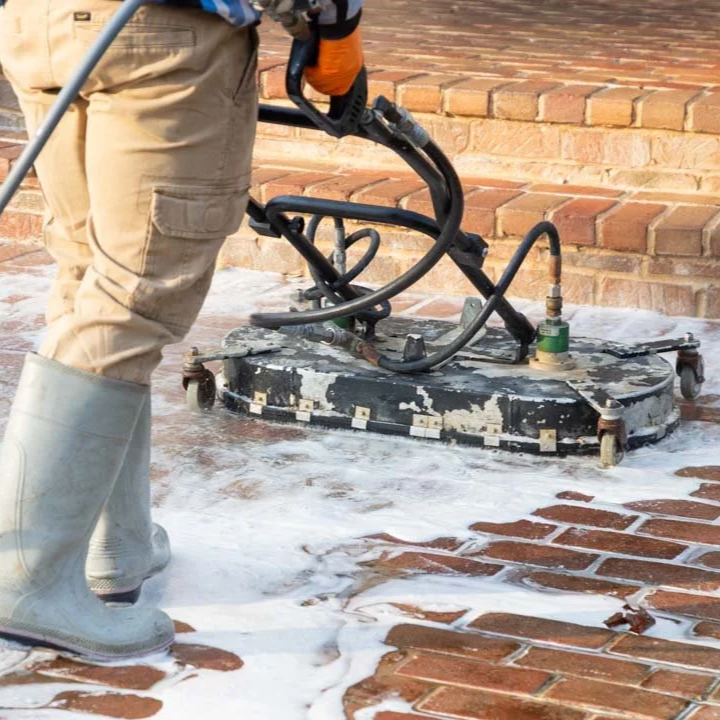
You walk past the side of the building after a wet weekend and notice it for the first time. A pale, almost dusty film smeared across the brick about three feet up from the ground. It wasn't there last month. You run your finger across it and it leaves a chalky white streak on your fingertip — like sidewalk chalk, but finer. Brush at it with your hand, and most of it falls off. A week later, it's back, in roughly the same place, after the next rain dries off.
That's efflorescence. The brick is sweating salt.
It's one of the most common things a Charles County property owner calls us about, and it's also the one most likely to get worse from the standard "just pressure-wash it" response. Here's what's happening, how to tell whether it's a cosmetic problem or a structural warning, and what actually removes it.
First, make sure it's actually efflorescence
Three white-ish films can show up on brick, and they don't get treated the same way. Worth thirty seconds with a spray bottle before you do anything else.
Spritz a small section with plain water. If the white film dissolves and disappears under the wet patch, then comes back as the brick dries — that's efflorescence. The salts go back into solution when wet and recrystallize when the water evaporates.
If the film stays visible under the water, doesn't dissolve, and feels slightly slimy or has a faint musty smell — that's likely mold or mildew. Different problem, different treatment. A soft wash with biocide handles it.
If the film is actually flaking paint, primer chalk from an old painted-brick job, or limewash residue from a coating product, it'll come off in flakes or papery pieces rather than fine dust. You're looking at coating failure, not a masonry issue.
Efflorescence is the only one of the three where pressure washing makes the situation noticeably worse. The other two will at least tolerate it. That's why the diagnosis matters first.
Where the salt is actually coming from
Brick, mortar, and concrete all contain small amounts of water-soluble salts — sodium and potassium sulfates, calcium sulfate, calcium hydroxide, calcium carbonate. They're there from the raw materials, the cement chemistry, and sometimes from groundwater contact at the foundation.
For a white film to actually form, three ingredients have to be present at once: soluble salt inside the masonry, water moving through it to dissolve that salt, and an evaporation path that lets the water escape but leaves the salt behind. Take any one of those away, and efflorescence can't develop. That's why the durable fix is almost always a water-source fix — it removes the only variable you have any real control over.
Salts don't move through dry masonry. They need water to dissolve into and travel through. When moisture enters the wall — rain absorbed by the brick face, condensation, leaking flashing, a downspout dumping water against the foundation, deicing salt splash in winter — that water dissolves whatever salt it touches. The water then moves through the wall by capillary action toward whichever surface is drying fastest. That's almost always the outside face.
When the water reaches the surface and evaporates, the salt has nowhere to go. It crystallizes right where the water left it. The crystals are what you see and feel as that chalky film.
This is why efflorescence almost always appears in a horizontal band rather than randomly. The band marks the height the moisture wicked to before it dried. It's also why it shows up most often in the first year after construction (the masonry is still releasing its initial moisture and built-in salts), after a long wet stretch, and on walls with a known water source nearby — a leaky gutter, a sprinkler hitting the brick, splash-back from a hard surface below.
Brick gets most of the attention, but the same chemistry shows up in stucco, concrete walls, retaining walls, pavers, natural stone, and the mortar joints between them. If a material is porous and cement-based, it can effloresce. The diagnosis and the treatment are largely the same.
Symptom, cause, and how urgent it actually is
| What you're seeing | What's causing it | How urgent |
|---|---|---|
| Light white dusting across a brick face, easily brushed off | Primary efflorescence from initial masonry moisture (often first-year construction or after a long wet season) | Cosmetic. Will diminish on its own over 12–18 months as the wall dries out |
| Horizontal band of white film 1–4 feet above grade, recurring after rain | Capillary moisture rising from foundation contact with wet soil, splash-back from hardscape, or a downspout draining nearby | Moderate. The wall is wet on the inside more than it should be. Find and fix the water source before treating the brick |
| Heavy crystalline crust along a single mortar joint, visible from across the yard | Concentrated leak through that joint — failed flashing above, cracked sealant, or a missing weep hole | Higher. Active water entry. Get the source identified before any cleaning |
| White film plus spalling, flaking, or popped-off brick faces | Subflorescence — salts crystallizing inside the brick, not just on it. The expansion is breaking the brick from within | High. Structural. Stop water entry now and bring in someone to assess the masonry |
| White film plus a green or black tint underneath | Mixed problem — efflorescence on top of algae or mold growth, both fed by the same moisture | Moderate. Diagnose the water source, then treat it in the right order |
A one-time, light white film on a relatively new wall almost always goes away by itself within a year or two as the masonry finishes curing and drying. Recurring efflorescence — same spot, every wet season — is a moisture problem the brick is trying to warn you about. And efflorescence that's been ignored for years doesn't stay powdery. The deposits harden into a calcified crust that's bonded to the surface, which is a much more aggressive job to remove than the same deposit caught early.
Why pressure washing efflorescence makes it worse
This is the trap. The natural response to a white film on brick is to spray it with water under pressure. The film disappears immediately. The wall looks clean. Job done.
It comes back stronger in a few weeks.
Pressure-washing efflorescence floods the wall with water — the exact thing that dissolves and mobilizes more salt inside the masonry. Some of that salt comes to the new surface and crystallizes there next time the wall dries. Some of it gets driven deeper into the brick than it was before. When that deeper salt crystallizes inside the brick rather than on top of it, the crystals expand against the inside of the pore structure. Over enough cycles, that pressure cracks the brick from the inside. The face pops off in a flake the size of a quarter. That's called spalling, and it's not reversible — once the face of a brick is gone, the brick is exposed to weather it wasn't designed for.
Aggressive pressure washing also strips the mortar joints, removing material that's load-bearing in some cases and decorative in all cases. The hairline cracks formed in the joint surface become new water entry points, feeding the next round of efflorescence.
So the chain reaction looks like this: white film appears, gets pressure-washed off; more salt mobilizes; the white film reappears, worse; gets pressure-washed again; mortar starts eroding; brick faces start spalling. By year three, the wall needs tuckpointing instead of cleaning.
The standard rule on a wall with active efflorescence: keep water off it until the salt is cleared by other means.
What actually clears it
The right approach depends on how heavy the deposit is and whether the wall is still actively wicking moisture.
Dry brushing first. A stiff natural-bristle brush, no water, on a dry day. This removes the loose surface crystals without dissolving anything back into the wall. For light primary efflorescence on a relatively new wall, dry brushing plus time is often the whole job. Skip the wire brush. Steel bristles and aggressive scraping tools etch the brick face and tear up the mortar — the same damage pressure washing causes, just delivered by hand instead of by water.
Mild acid wash for what brushing doesn't lift. Heavier deposits — especially the calcium carbonate "lime bloom" that's nearly insoluble in plain water — need a chemical wash. A diluted solution of white vinegar works on light cases. Heavier deposits are treated with a commercial efflorescence remover containing a buffered phosphoric or sulfamic acid base. The wall has to be pre-wet (sounds counterintuitive, but it stops the acid from being pulled deep into the dry brick), washed at low pressure, and thoroughly rinsed. Muriatic acid will dissolve the deposit but also etches and discolors the brick if the concentration or dwell time is wrong, which is why most pros have moved away from it for residential and light commercial work.
Soft wash, not pressure wash. When the wall finally does get rinsed, the rinse is done at near-garden-hose pressure — somewhere between 50 and 500 PSI with a wide fan tip held a foot or more off the wall, never the 3,000-plus PSI a hardware-store rental defaults to. The work is in chemistry, not the water force. This is the standard soft wash approach used for brick and other commercial masonry surfaces. High pressure on brick is almost never the right tool and is the reason most DIY efflorescence cleanups end badly.
The sequence matters too. Cleaner goes on from the bottom up, so any drips that streak land on already-wet brick instead of dry brick that'll lock the streak in. Rinse goes the other direction — top down, so loosened salt and chemical run off the wall instead of pooling on what you've already cleaned.
Fix the water source. None of the above lasts if the moisture path isn't addressed. The wall will pull more salt up along the same path and deposit it in the same spot. Check the gutter directly above the affected area, the downspout discharge point, the grade pulling water toward the foundation, the failed sealant around a window, and the sprinkler head that's been hitting the brick three times a week. The cleaning fixes today. The water source fixes in the next five years.
When efflorescence is a structural warning instead of a stain
Most efflorescence is cosmetic. Some of it isn't.
If spalled or flaking brick faces accompany the white film, popped corners, soft mortar that you can scratch out with a screwdriver, hairline cracks in the brick itself, or visible moisture staining on the interior side of that same wall — you are past the cleaning stage. The wall has been wet long enough that the freeze-thaw cycles and salt crystallization have done physical damage. At that point, a power-washing company is the wrong first call. Either a masonry contractor or a building envelope inspector needs to inspect the wall.
The good news is that this level of damage takes years to develop and gives plenty of warning. The bad news is that every year of pressure-washing the symptom without addressing the cause shortens the timeline.
Frequently Asked Questions
The film is the warning, not the problem
The white chalky dust on the brick is rarely the actual issue. The brick is doing what brick does when there's more water moving through it than there should be — pulling dissolved salt to the surface and leaving a deposit when the water evaporates. The film is the wall telling you where the moisture is.
Cleaning the deposit without finding the moisture source resets the timer, nothing more. Find the water path first, fix or interrupt it, then clear the salt with dry brushing or the right chemistry at low pressure. Done in that order, the wall stays clean for years. Done in the wrong order, it's back next spring, and the spring after that, with a little more spalling each round.
The brick will keep telling you the truth. The question is whether the next round of cleaning listens to it.
Superior Power Washing diagnoses and treats efflorescence on brick and masonry across Waldorf, MD, and all of Charles County and Southern Maryland — including La Plata, Clinton, Fort Washington, White Plains, and Brandywine. Owner-operated, fully insured, soft wash methods that don't drive more salt into your wall. Call (240) 901-4252 for a free on-site assessment.
