
Why Office Buildings Develop Algae Faster Than Nearby Homes
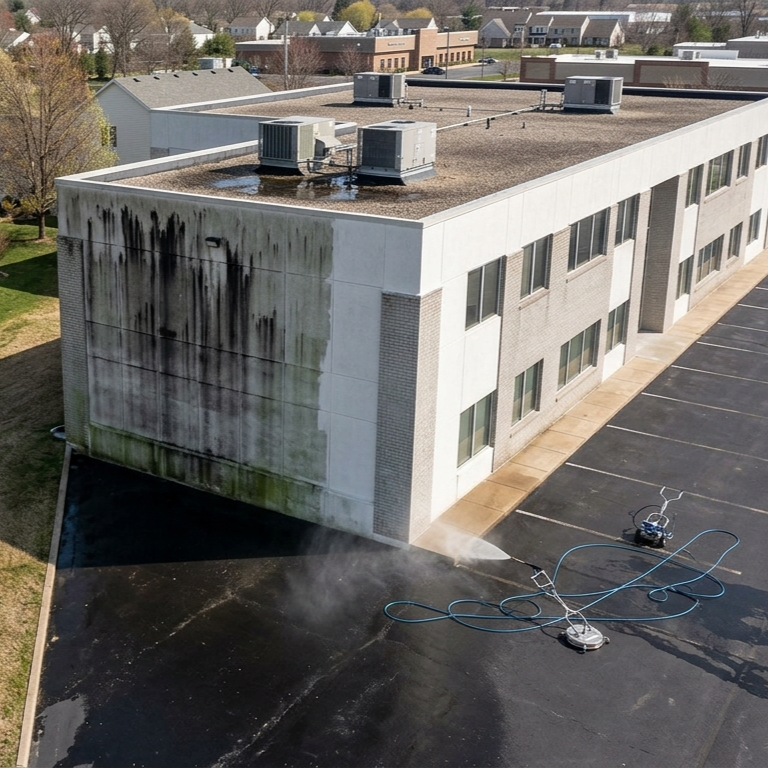
You drive past the office building every morning. Black streaks run halfway down the north wall, dark stains spread under every HVAC penetration, and a green tint creeps up from the foundation. Then you turn the corner into your subdivision. The houses look fine. Same neighborhood, same humidity, same weather. The office building always looks worse.
It's not your imagination. Commercial buildings develop algae visibly faster than the homes around them — sometimes by a factor of two or three. And it's not because they are bigger. A 12,000-square-foot office and a 2,400-square-foot home in the same humidity, same rainfall, same season, age at different speeds for reasons that have nothing to do with footprint.
Here's what's actually different.
The microclimate around a commercial building is its own little weather system
A house sits on a lawn. The lawn breathes, transpires, and stays cooler than asphalt. The temperature and humidity around a house stay roughly in sync with the broader weather outside.
A commercial building sits in the middle of a parking lot. Asphalt heats to 130°F on a sunny day in July and keeps radiating that heat back into the air for hours after sunset. That heat creates a small but persistent microclimate of warm, humid air pooling against the building's walls — exactly the conditions algae prefers. The same building, set on a lawn, would age more slowly. The parking lot is doing real damage.
That microclimate compounds with three other commercial-specific factors. The result is a building that hosts algae year-round, whereas a comparable home would see it only in the rainy season.
What's different about a commercial building, side by side
| Factor | What a home has | What an office building has |
|---|---|---|
| Surroundings | Lawn, trees, soft surfaces | Asphalt parking lot, heat island |
| Roof drainage | Sloped — sheds water in minutes | Flat or low-slope — pools water for hours |
| HVAC | One condenser at ground level | Rooftop units dripping condensate down the walls |
| Cladding | Vinyl, fiber-cement, painted wood | EIFS, painted metal, stucco — all porous |
| Wash schedule | Annual or pre-listing | "When someone complains." |
| Foot traffic and exhaust | Low | Drive-through exhaust, fryer hoods, dumpster pad |
Every row on that table is an algae accelerant. Stack five or six of them on the same building, and you get the streaks-on-the-north-wall problem that bugs every commercial property manager.
HVAC condensate is doing what rain does — but worse
Look at any rooftop unit on a commercial building. Underneath the housing, there is a drip line — usually a piece of PVC, sometimes just a stained track running down the metal panel below. That drip is condensate from the air handler, and it runs all day, every day the air conditioner is on.
Rainwater hits a wall for a few minutes during a storm and stops. Condensate hits the same patch of wall every day from May through September. The wall under an HVAC drip stays wet for weeks at a stretch in the cooling season. Algae sees that and moves in.
If one wall of your building looks ten times worse than the others, look up. There's a unit on the roof above it.
Commercial cladding is a buffet for biofilm
Residential siding — vinyl, fiber-cement, brick veneer — is mostly flat and mostly non-porous. Algae cells can land on it, but the surface doesn't give them much to hold onto.
Commercial cladding is different.
EIFS (synthetic stucco) has a textured surface that traps moisture and organic debris. Algae cells lodge in the texture and stay there through dry spells. Painted metal panels look smooth, but the paint and the seams between panels create micro-channels where water beads, dries, and beads again. Each cycle leaves a mineral residue that gives the next round of algae something to anchor to.
Painted concrete and stucco are porous by nature. Water is drawn to the surface by capillary action and remains there. Algae lives in the pores well below the visible surface — same problem soft washing has to solve on residential brick, but worse because the wall covers thousands of square feet.
A brick with eroded mortar joints is the worst case. The mortar is slightly limy when weathered, and old commercial brick — common on buildings thirty-plus years old — has weathered joints that are essentially calcium carbonate, the same chemistry that makes asphalt shingles a feast for the same organism.
The maintenance gap is the real reason it shows
A homeowner notices algae streaks the day the neighbors mention them. The next weekend, they're online getting quotes.
An office building has no one walking the perimeter looking for streaks. The property manager sees the front elevation maybe once a month, the side and back elevations maybe twice a year. By the time the algae is bad enough to phone home about, it's been growing for two seasons.
The gap doesn't just delay the cleaning — it lets the algae establish deeper. A first-year colony can be cleaned off with a single soft wash visit. A three-year colony has cells rooted into the substrate and may need two visits a few months apart to fully clear. Waiting costs more than acting early.
This is why commercial cleaning contracts make economic sense. A property under a recurring commercial wash contract gets caught at year one every year. A property without one gets caught at year three, paying double.
The fix uses the same chemistry — different equipment
Soft wash chemistry works the same on a four-story office building as it does on a two-story home. The sodium hypochlorite biocide and surfactant blend that kills algae on a roof kills it on commercial EIFS the same way.
What changes is the equipment. Reaching the third or fourth story of a commercial building safely requires extended-reach delivery systems, ground-based downstream injection rigs, or aerial lifts rated for the building height. Most residential power washers don't carry any of that. That's why most companies that quote a commercial building send back a price for the ground level only and skip the upper stories — exactly where the algae is worst.
A real commercial cleaning quote covers the whole envelope, not just what the crew can reach from a ladder.
Frequently Asked Questions
The same wall, the same weather, a different outcome.
Two buildings on the same block — one a home, one an office — built in the same decade and standing in the same humidity. One stays clean for years between washes. The other shows new streaks every spring. The difference isn't the size of the structure. It's the eight or ten environmental factors stacked against the commercial building that the home gets to escape.
If you manage a commercial property and the exterior keeps getting away from you, the answer isn't a bigger pressure washer. It's a wash schedule built around the way your building actually weathers — and chemistry that kills the colony at the substrate, not just on the surface.
Superior Power Washing handles commercial building cleaning across Waldorf, MD, and all of Charles County and Southern Maryland — including La Plata, Clinton, Fort Washington, White Plains, and Brandywine. Owner-operated and fully insured; certificates of insurance available on request. Recurring maintenance contracts are available for properties under HOA, lease, or compliance schedules. Call (240) 901-4252 for a free on-site assessment.
