
What Cladding Type Means for Cleaning Pressure: Brick vs EIFS vs Stucco vs Metal
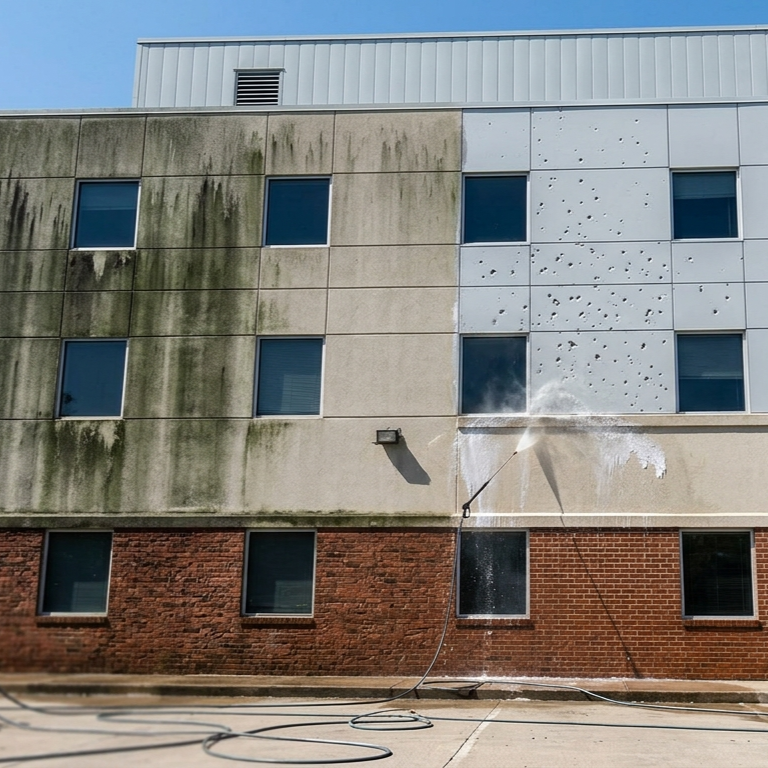
A property manager calls. Her four-story office building had its facade cleaned three months ago, and the contractor used a 4,000-PSI rig. The brick on the lower floors looks fine. The EIFS panels above the parapet line look like someone took an ice cream scoop to them — dimples, pock marks, soft edges along every joint. She wants to know what happened.
What happened is that the crew used one pressure setting for a building made of four different materials.
That's the trap.
A commercial wall is rarely all one thing. The bottom three feet might be brick. The middle two stories painted stucco. The mansard up top synthetic EIFS. The penthouse mechanical room sheathed in painted metal panels. Each one of those surfaces tolerates pressure differently, takes chemistry differently, and shows damage differently when the wrong setting hits it. The wash crew that treats them all the same will leave at least three of those surfaces worse than they found them.
Here's what each cladding type actually tolerates — and where the wash fails when nobody asks the question.
Why one pressure setting doesn't work across a multi-surface wall
Pressure isn't a single number on a dial. It's the force the water exerts on the surface, measured in pounds per square inch — and what matters for a wash isn't the rated pressure of the pump, it's the pressure at the surface after you account for distance, tip angle, and tip size.
A 4,000-PSI rig held two feet from a wall with a 40-degree fan tip delivers maybe 300 PSI to the surface. The same rig with a 0-degree tip held six inches away delivers close to the full 4,000. That's a 13x difference from the same machine, in the same hour, with the wrong nozzle in the same hand.
That's why cladding pressure ratings aren't about machine specs. They're about what the surface can survive at impact — and every type has a ceiling that, once crossed, leaves damage that won't come back. Soft washing solves the problem on most commercial work by dropping surface pressure under 100 PSI and letting biocide chemistry do the lifting. But every job still starts with the question: what's on the wall, and what can it take?
Pressure and chemistry by cladding, side by side
| Cladding | Max safe surface pressure | Cleaning method | Risk if pressure too high | Risk if chemistry too strong |
|---|---|---|---|---|
| Brick (sound mortar) | 800–1,500 PSI | Pressure wash + biocide | Mortar washout, spalling on aged units | Efflorescence bloom, white residue |
| EIFS (synthetic stucco) | Under 100 PSI — soft wash only | Soft wash (biocide + surfactant) | Dimpling, gouging, base-coat exposure | Discoloration, finish coat softening |
| Traditional stucco | 800–1,200 PSI | Low pressure + biocide | Surface erosion, hairline crack widening | Bleach burn on pigmented finishes |
| Painted metal panel | 1,200–1,500 PSI | Low pressure + degreaser/biocide | Paint blistering, seam intrusion, chalking lift | Oxidation streaks, paint adhesion failure |
Five hundred PSI between safe and damaging on stucco. Twelve hundred between safe and damaging on EIFS versus painted metal. Get the wrong end of those windows and the building doesn't come back.
Brick — tougher than the wall, weaker than the mortar
Brick handles pressure better than any other commercial cladding. The fired clay itself can take 1,500 PSI without flinching. That's why so many wash crews bring the same rig to a brick building they'd bring to a parking lot.
The brick isn't the problem. The mortar is.
Mortar joints sit half an inch below the face of the brick, in a recess. A direct pressure hit on the mortar — especially with a tight tip angle and close standoff — can scour out a tenth of an inch of jointing per pass. Once mortar washes out, water gets behind the wall through the gap. Six months later you're looking at efflorescence — white chalky salt deposits leaching back through. A year later you're looking at freeze-thaw spalling along the bottom courses.
The fix is a wider fan tip — 25 or 40 degrees, never 0 or 15 — and a standoff of eighteen inches or more. The water sweeps the face of the brick and rinses the mortar without scouring it. On older commercial brick where the original mortar is already eroded, the call shifts to soft wash entirely. Pressure on aged mortar is a guaranteed callback.
Painted brick is a different conversation. The paint adds a sacrificial layer that holds biofilm and dirt, but it also tells you the brick can't be hit with anything stronger than soft wash — a 1,500-PSI rinse strips paint in patches and leaves the wall looking blotchy. Painted brick gets the EIFS treatment: low pressure, biocide chemistry, dwell time.
One more brick-specific issue: never pressure wash brick under 60 days old. Fresh mortar is still curing for the first two months, and even a low-pressure wash will wreck the chemistry. Post-construction wash crews know this. Wash crews who don't ask when the building was built don't.
EIFS — the cladding that fails first if you guess wrong
EIFS — Exterior Insulation and Finish System, what most people call synthetic stucco — is the surface that punishes more wash crews than any other commercial cladding.
It looks like stucco. It isn't.
Under the finish coat is fiberglass mesh embedded in base coat, then rigid foam insulation, then sheathing. The whole assembly is maybe an inch and a half thick, and the only thing protecting it is a finish coat thinner than a credit card. Hit that finish coat with anything over 100 PSI at close range and the water doesn't just clean it. It punches through.
The damage shows up as soft, dimpled patches where the finish has been eroded down to the base coat. Sometimes you can see the mesh through it. On vertical seams between EIFS boards, pressure forces water behind the foam. EIFS that takes water behind the finish doesn't dry out. The foam holds it. Six months later there's mold growing between the insulation and the sheathing, and the only fix is to cut the panel out and re-finish it.
EIFS gets soft washed. Always. No exceptions. A 0.5 percent sodium hypochlorite blend with a surfactant, applied at garden-hose pressure, dwelt for ten minutes, and rinsed at under 100 PSI. The biocide does all the work. The water just rinses.
If a wash crew shows up at an EIFS building with a 3,500-PSI rig and a 15-degree tip, send them home before they start.
Stucco — old and new behave differently
Traditional cement stucco — the three-coat lath-and-cement assembly common on older commercial buildings and most homes built before the early 1990s — is much tougher than EIFS but still nothing like brick. The finish coat is a Portland cement mix, usually colored with iron-oxide pigments, sitting over a scratch coat over diamond-mesh lath.
That finish coat can take pressure. Up to about 1,200 PSI at an eighteen-inch standoff. But it has two specific failure modes:
The pigment fades under sodium hypochlorite if the biocide concentration runs over 3 percent. Walls that get scrubbed with a stripper-strength bleach mix to chase a stubborn algae colony come out two shades lighter than they went in — and the fade is permanent. The fix is the right chemistry up front, not stronger chemistry on the second pass.
Hairline cracks open up wider under high pressure. Stucco walls develop hairline cracks over time from settling, thermal movement, and minor impact damage. The cracks themselves are cosmetic and don't leak. But a 3,000-PSI jet aimed at a hairline crack will widen it to a quarter-inch gap that does leak. Same wall, same crack, same building. The pressure setting decides whether you have a clean wall or a wall that needs caulking.
Modern stucco systems are a mixed bag — some three-coat cement, some one-coat synthetic, some EIFS in disguise. If nobody on site knows which kind, assume EIFS and soft wash it.
Painted metal panels — the paint is fine, the seams aren't
Painted metal panels — common on warehouses, big-box retail, and the upper stories of mid-rise commercial buildings — handle pressure better than most people expect. Modern factory-applied paint systems are rated for 1,500 PSI direct hit without lifting. The metal under them is even tougher.
The seams are where it falls apart.
Every metal panel system has joints — vertical seams between panels, horizontal seams at the floor lines, and trim seams where the panels meet windows or rooflines. Those seams are sealed with caulk or butyl tape or a folded-metal weather lap, and they're designed to shed water from above, not absorb it from a pressurized jet hitting them sideways. A 3,000-PSI jet aimed at a horizontal seam from below — exactly the angle a wash crew working from the ground will use — drives water behind the panel. From there, it gets behind the insulation, into the wall cavity, and onto whatever is on the inside of the wall.
You don't see that damage on wash day. You see it three months later when a stain bleeds through the interior drywall.
The other risk on painted metal is chalking. South-facing panels oxidize and develop a chalky white film. High-pressure lifts that chalk in patches — and what's underneath is a duller, lighter version that contrasts hard with the patches the wash missed. A uniform soft wash with a mild surfactant lifts all the chalk at once. A pressure wash lifts some of it and leaves the rest.
For most metal panel work the answer is the same as EIFS: soft wash with biocide, low-pressure rinse, no jet angled at any seam.
What goes wrong when the wash crew uses one setting for everything
Walk past a commercial property eight months after a generic pressure wash and you can usually see what the crew did wrong.
The brick is clean but the mortar joints look raked out. White efflorescence haloes are blooming along the bottom courses. The EIFS panels have dimpled patches where the tip lingered too long. The stucco has hairline cracks that have opened up. The painted metal seams have rust streaks running down from joints that took water.
That's not a wash. That's accelerated weathering done in a single afternoon.
The right approach starts with a walk of the building before the rig comes off the truck. Identify every cladding type on the wall, mark the transitions, and either match the equipment to each one — which usually means soft wash for everything except the brick — or hire a crew that does. A commercial building wash on a multi-cladding facade is two or three different cleaning methods executed by the same crew in the same visit, not one method applied to four different surfaces and hoping for the best.
Before any biocide hits the wall, the crew should pre-soak landscaping below it. Sodium hypochlorite at wash strength will burn turf and shrubs if it runs off untreated, so a hose-down of plantings and a tarp at the foundation line is part of the setup, not an afterthought. A crew that doesn't pre-soak is going to leave brown grass along three sides of the building.
If the building is brick all the way up, pressure works. Anywhere else, soft washing earns its keep — and the difference shows up not on wash day but six months out, when the building that got the right treatment still looks new.
Frequently Asked Questions
What the right wash for a multi-cladding building actually looks like
Every commercial building is a stack of decisions made by an architect decades ago that the wash crew has to read in real time. The brick says one thing. The EIFS up top says something else. The painted metal at the parapet says a third. A crew that knows what each one needs runs three setups in the same visit and finishes with a building that looks ten years younger than it did at breakfast.
A crew that doesn't, finishes with a callback.
Superior Power Washing handles commercial building cleaning across Waldorf, MD, and all of Charles County and Southern Maryland — including La Plata, Hughesville, Bryans Road, Indian Head, and Charlotte Hall. Owner-operated, fully insured, certificates of insurance available on request. We assess every cladding type on the building before the rig comes off the truck. Call (240) 901-4252 for a free on-site assessment.
