
Why Gutter Guards Still Need Cleaning Even Though They Look Closed
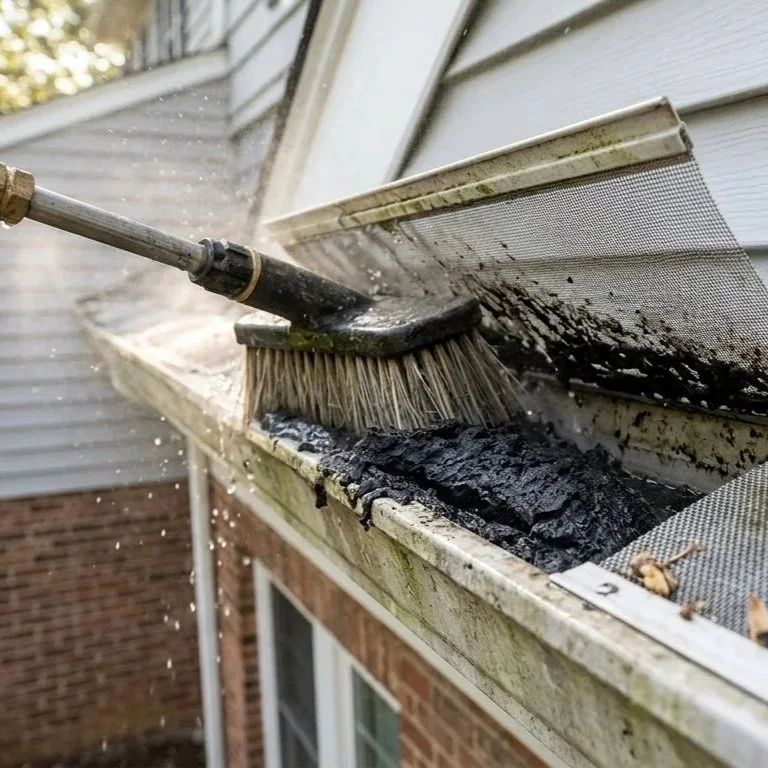
An inch of black silt in the bottom of a guarded gutter. That's what we pull out by the bucketful three years after the installation, on the homes where the salesman said, "never clean your gutters again." The top of the guard looks fine from the ladder — a little leaf debris, easy to brush off. Pop a section loose and the trough underneath is wet, packed, and not going anywhere on its own.
The guard is closed. The gutter isn't clean.
A gutter guard is a leaf filter, not a sealed system
Every gutter guard on the market — mesh, screen, micro-mesh, surface tension, foam insert, brush — does one job. It keeps leaves and large debris out of the trough so they don't dam up the drain. That's it.
Water still has to enter the gutter, and anything fine enough to ride along with the water still gets through. The list is longer than most people expect. Shingle granules from the roof. Pollen from spring and fall. Seed husks from maples and oaks. Wind-blown dust. Bird droppings. Decomposed leaf matter that's been sitting on top long enough to break down into a wet paste. All of it filters through a 1/16-inch mesh just fine.
Think of it like a coffee filter. The grounds stay out. But everything dissolved in the water passes right through, and a few months later the inside of the pot still has a brown ring you have to scrub off. The gutter trough is the pot. The fine stuff has been collecting there the whole time.
What gets past the guard depends on what kind you have
The failure mode is different for each guard type, and, so is the cleaning cadence. Here's what we see when we inspect local homes with guards installed.
| Guard type | What gets past | What goes wrong | How often it needs a real clean |
|---|---|---|---|
| Plastic screen / 1/4-inch mesh | Shingle grit, pollen mats, pine needles slip through sideways | Bottom of the trough fills with silt and pine straw; small clogs at the outlet | Every 12–18 months |
| Aluminum micro-mesh (1/16-inch) | Pollen film, shingle oils, organic dust | Surface tension breaks down when the mesh top develops a film; water sheets over instead of filtering through | Every 18–24 months |
| Surface-tension reverse-curve | Roof grit, sap, organic stickiness on the front lip | Curve fills with sap and grit; in heavy rain water overshoots the gutter entirely | Every 12 months |
| Foam insert | Pollen, seeds, fine grit work into the foam itself | Foam saturates with organic matter; algae grows inside it; trough below never drains | Every 18 months, replace every 5–7 years |
| Brush insert (bottle-brush style) | Almost everything fine; large leaves catch on the bristles | Debris sits on top of the bristles, decomposes into a mat, water flows over the side | Every 6–12 months — these are the worst for "looks closed but isn't" |
The pattern across all of them is the same. The guard keeps the big stuff out. The small stuff still lands in the trough, sits in standing water at every dip in the run, and turns into the black silt we pull out by the bucketful on cleaning visits.
Pine needles deserve their own warning. They're thin enough to slide through screen guards sideways and stubborn enough to lodge between the bristles of brush inserts. A heavily-needled yard will defeat almost any guard short of fine aluminum micro-mesh — and even that mesh holds needles on top until something brushes them off.
The film on top of the guard is its own problem
Walk around the back of the house after a wet spring. Look up at the mesh from below. You'll see a dark cast — not leaves, just a darkening of the metal screen itself. That's the part no one warned you about.
Pollen, road dust, atmospheric pollution, and shingle oils land on the mesh between rains. They don't wash off because the mesh isn't smooth — it has tens of thousands of tiny openings where surface tension holds the residue in place. Each rain adds a thin coat of organic matter that dries between storms.
Within two years that film thickens enough to do something strange: it starts shedding water instead of filtering it. The mesh hasn't clogged in the way you'd expect — you can still see through it from below — but water hitting the top now beads up, runs sideways across the surface, finds the edge, and pours over the lip of the gutter without ever going in.
This is the moment homeowners notice a drip line on the siding or a wet stripe on the foundation and assume the guards have failed. The guards haven't failed. They've gotten dirty on a surface that's nearly invisible until you brush across it with a wet rag.
What it looks like when the guards are overdue
Most overdue installations show the same handful of symptoms. Any one of them is worth attention. Two or more means you're already losing the protection you paid for.
Plants growing on top of the guard, or out of it. Maple seedlings sprouting from the silt caught in the mesh. Moss creeping along the gutter face from the corner where water sits longest.
Overflow during normal rain. Not a thunderstorm — a regular Tuesday afternoon shower that didn't used to cause overflow. If the guards used to handle it and now they don't, the system is loaded somewhere you can't see from the ground.
A wet streak on the siding under one section but not the whole run. Localized overflow points are usually a clog under that part of the guard, or a low spot in the gutter holding water that backs up to the lip.
Dark biofilm visible from the ground, especially on white or light-colored guards. The same algae that streaks roofs streaks guards once enough organic matter has worked into the mesh.
Sagging at one or more sections. Weight from accumulated silt below, or from a wet mat of decomposed leaves on top, drops the guard out of its original plane. The sag creates a low point where water pools instead of running off.
Nests — bird, squirrel, hornet. A guard that's pulling loose at one corner is an open door for nesting, and the silt layer in a neglected trough is exactly the kind of soft, organic bedding pests look for. We've pulled apart guard systems in spring and found wasp paper a foot long under a section the homeowner assumed was sealed.
How a real cleaning works on a guard system
First thing — the guard has to come off the section being cleaned. Some systems pop loose with two hands; others are screwed through the front lip into the gutter and need driver work; others are nailed under the first course of shingles and need a flat bar to lift the shingle edge without damaging it. A crew that knows the system pulls a section in under a minute. A crew that doesn't can break the shingle line trying.
Once the guard is up, the trough gets scooped. Black silt, decomposed leaf paste, sometimes a bird's nest the guard let build sideways. We bag the heavy stuff and flush the rest down the downspout.
Then we look at the underside of the guard itself. If the mesh has a pollen film, a low-pressure rinse with a wand from above clears most of it. If the film is thick or the guard has algae growth, the guard goes through a brief soak in a mild surfactant before it gets reinstalled. The dwell time is short — usually under five minutes — but it's what takes a guard from "looks fine but sheds water" back to filtering the way it did when new.
The downspout gets flushed last, with a hose run down from the top to confirm flow. A clog two stories down won't show during a dry inspection but will become an overflow point the next time it rains hard. Underground drain lines need the same check — silt that washed past the guard for years can settle in the buried pipe and back the whole system up at the outlet, which is the failure nobody thinks to look for.
We do the whole circuit — pull, clean, rinse, reset — on every section where the guard is showing symptoms. A house with one bad corner gets that corner pulled; a house that hasn't been touched in five years gets the full run done.
A gutter cleaning on a guarded house takes longer than a flush on an open gutter. We charge accordingly, and we tell homeowners up front. The trade-off is that this visit happens every eighteen months or two years instead of twice a year — that math still works in the homeowner's favor over a five- or ten-year stretch, but only if the visit actually happens.
When the guard itself needs to come off for good
Sometimes the answer isn't cleaning the guard. It's removing it.
Brush-style inserts past their fifth year hold so much decomposed matter that the bristles are essentially a wick. Cleaning them is possible but the result lasts six months at most before the new mat forms. Replacement of the inserts every five years was supposed to be part of the system, but it almost never gets done because nothing visible from the ground tells you it's time.
Foam inserts in heavily-shaded yards saturate faster than the homeowner can replace them. We've pulled foam pieces out of gutters that were holding water like sponges — algae growing inside the foam itself, smell coming off them like wet basement. The original install was three years old.
Plastic screens that have UV-cracked along the ridges no longer filter and don't reinstall cleanly after a cleaning. The plastic has gone brittle. Bending it to refit it cracks it further. At that point the smarter move is to take the screens off, clean the now-open gutter, and put nothing back until you decide whether to replace the screens with a better system or go back to seasonal cleaning.
How long can you go between cleanings on a guarded house
Honest answer: longer than open gutters, shorter than the manufacturer promised. Cadence depends on guard type and tree exposure — the table above breaks it down by system. A micro-mesh house in a moderately treed yard runs an eighteen-month rotation. Foam or brush in a heavily-treed yard needs a twelve-month visit before the inserts go past cleaning.
What no guard handles is a five-year stretch with no inspection. That's the install where we open the system and find a silted-in trough, a sagging section, and water that's been overflowing onto the foundation long enough to leave a stain on the brick. Five years of overflow doesn't show on the roof. It shows on the basement wall.
Frequently Asked Questions
Treat your guards like a filter, not a lid
A gutter guard is a maintenance tool, not a permanent solution. It filters. Filters get dirty. The honest cleaning cadence on a guarded gutter is every 12–24 months depending on guard type and tree exposure — and the trade-off compared to twice-yearly open-gutter cleaning is still a good one.
What changes is the visit. It's longer, more involved, and worth doing right by someone who's pulled a few hundred guards. A bad visit on a guarded system leaves the guard reseated incorrectly, water sneaking behind, and a slow leak nobody catches until the soffit starts to soften.
The guard looks closed. That doesn't mean the gutter is clean.
Superior Power Washing services gutter-guarded homes across Waldorf, MD, and all of Charles County and Southern Maryland — including La Plata, Hughesville, Bryans Road, Indian Head, and Charlotte Hall. Owner-operated, fully insured, and experienced with every major guard system on the market. Call (240) 901-4252 for a free on-site assessment.
