
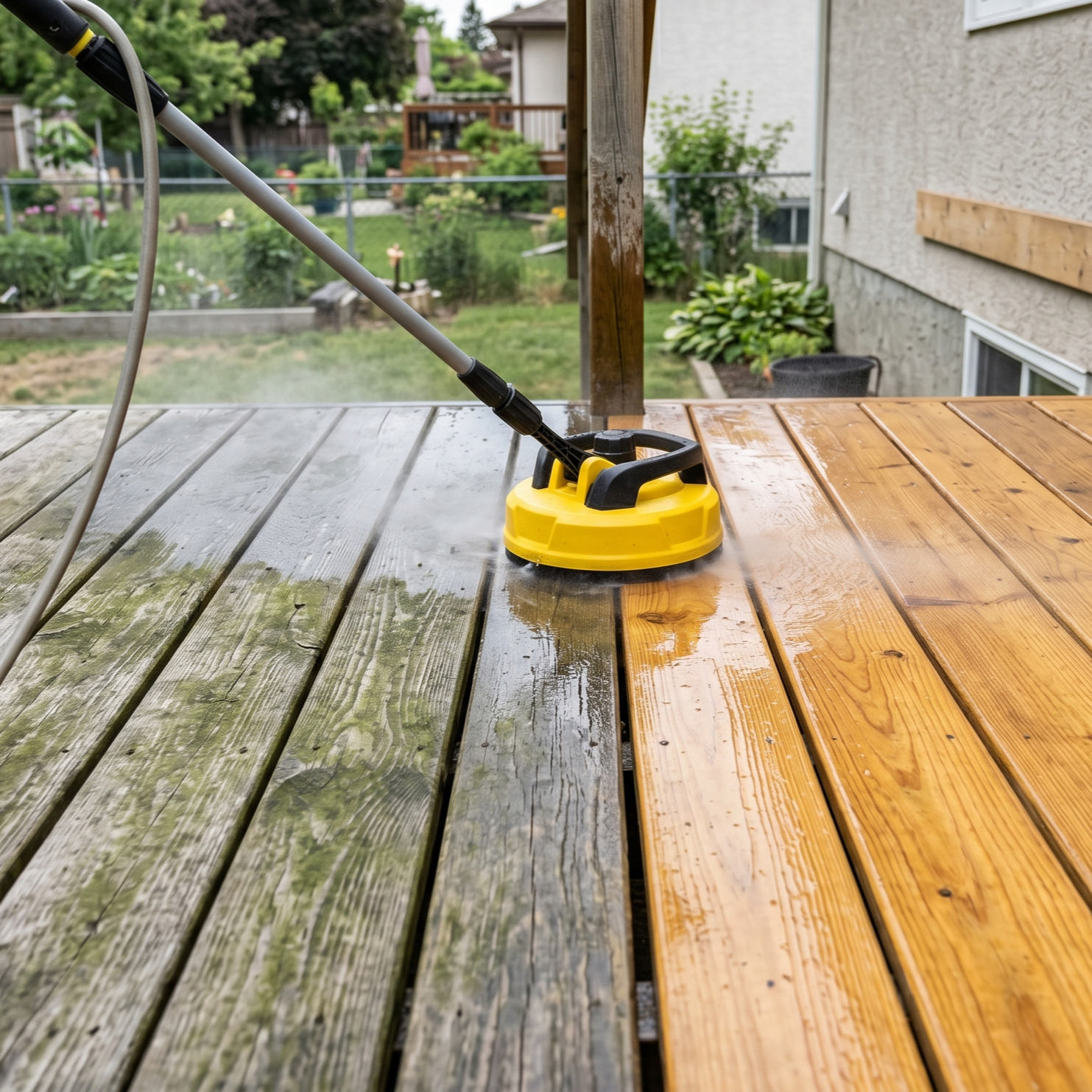
You walk out on the deck the first warm Saturday of the year, coffee in hand. The boards are dull and gray. There's a soft spot near the rail where the screwhead has sunk a quarter inch into the wood. The corner board cups upward like a potato chip. A splinter the size of a toothpick lifts under your bare foot.
You bought the house six years ago. The deck was already gray then.
The question — is this a wash-and-stain job, or do you need to tear the whole thing down and start over — gets answered different ways by different contractors. Some will tell you the deck is fine. Some will tell you it needs to come out. Both are looking at the same boards.
Here's how to tell which one is right.
Start with the framing, not the boards
Almost every homeowner walks out onto a tired-looking deck and starts by looking at the deck boards. Wrong place. The deck boards are the cheapest part of the structure. They're designed to be swapped out without touching anything else.
The structural members underneath — joists, beams, posts, and the ledger board where the deck attaches to the house — determine whether the deck can be saved at all. If the framing is solid, almost any cosmetic problem can be fixed for less than a tear-down. If the framing is gone, replacing the boards on top of it is wasted money.
So, the first move is to get underneath the deck, or to lean over and look between the boards from above, and check the joists. Look for dark water staining, white or green growth on the wood, or the ledger board pulling away from the house. Then push the tip of a screwdriver or an awl into a joist near the ledger and at any spot you see discoloration. If it sinks in like a fork into wet bread, the joist is rotted. That decision was just made for you.
The walk-around inspection that tells you which project you're looking at
Most decks fall into one of three categories: cosmetic, partial rebuild, or full replace. The first walk-around determines which one. Twenty minutes if you know what to look for.
| What you find | What it means | What it costs to fix |
|---|---|---|
| Gray weathered surface, sealer worn off | Surface restoration — wash, sand, stain, seal | $4–$8 per sq ft |
| One or two soft deck boards, sound framing | Board replacement plus surface restoration | $5–$10 per sq ft |
| Multiple soft boards, sound framing | Re-deck (replace top boards), reuse framing | $20–$40 per sq ft |
| Soft joists or rotted ledger board | Full replacement to footings | $35–$70 per sq ft |
| Posts cracking at concrete, footings shifting | Full replacement plus possible footing rework | $40–$90 per sq ft |
| Railing wobbles when pushed, posts loose | Could be hardware (cheap) or framing (expensive) | Inspect first |
The price spread is wide because regional labor, lumber, and deck size all swing the number. The categories themselves are what matter. A 200-square-foot deck and a 600-square-foot deck both fall into the same restore-or-replace bucket based on the same set of clues.
Signs the deck wants restoration, not replacement
A deck that's a candidate for restoration looks worse than it actually is. The gray color, the rough texture under bare feet, the lifted stain — those are symptoms of UV damage to the top millimeter or two of wood fiber. Pressure-treated lumber underneath that surface layer is usually fine if the framing is dry and the boards aren't sunk in.
Specific signs the deck wants restoration:
The gray color washes off when you spray a small section with a wood brightener and rinse it. If the wood underneath comes back warm-colored, the surface is salvageable.
The boards feel firm under a stomp test. Walk to the middle of each board span, hard-step, and listen. A solid board makes a flat sound and doesn't move. A rotted board flexes and gives a softer, mushier sound — sometimes with a creak.
The screws and nails are tight and the heads are flush. Loose fasteners pulling up out of the wood mean the wood around them has lost its grip — but only matters if it's widespread.
The joists pass the awl test. Push the tip of an awl or a sharp screwdriver into the joist at the most exposed points. If it doesn't sink, the framing is sound.
The railing posts don't wobble when you put your shoulder into them. Wobble at the rail usually means the post hardware has loosened, not that the post itself is gone — but a serious wobble warrants a closer look at the post base.
When the deck checks those boxes, a restoration is the right call. The work is real — sand the surface to remove the weathered fibers, replace any individual rotted boards, brighten the wood with an oxalic acid wash, then apply a penetrating stain and sealer. The result holds two to four years before another resealing is needed.
For decks that are structurally sound but too cracked and splintered for a normal refinish, thicker deck-resurfacing coatings are an intermediate option. They fill cracks up to a quarter inch, encapsulate splinters, and lay down a textured non-slip surface. The trade-off is appearance — the wood grain disappears under the coating, and the deck ends up looking closer to a painted composite than stained lumber. On a deck that's otherwise on the edge of replacement, the coating can buy another five to ten years. No coating fixes a rotted joist.
Partial rebuilds: the option that gets skipped past
Sometimes the decking on top is shot but the framing under it isn't. This is a partial rebuild, and it's the most cost-effective option a lot of homeowners overlook. The framing — joists, beams, posts, footings — is the expensive part of a deck. The boards on top of it are commodity lumber.
If the awl test on the joists comes back clean but several deck boards are soft, cupped past sanding repair, or splitting along the grain, the right move is to pull the boards off, inspect the joists carefully now that they're exposed, and re-deck with either pressure-treated lumber or a composite product.
The math on this is friendly. New boards on existing framing usually run a third to half of a full replacement. The crew is in and out in a few days. You get a deck that's structurally as sound as a new build, with a fresh surface that'll last fifteen to twenty-five years. Composite and PVC decking cost roughly twice what pressure-treated pine costs upfront, but they skip the every-two-to-three-years staining work and most come with 25-year manufacturer warranties. On a deck you plan to keep using for a decade or more, the long-run math usually favors composite.
The catch: once the boards come off, the framing sometimes reveals problems that weren't visible from above. Plan for a 10–20% contingency on a partial rebuild for joist sister-ing or hardware replacement that turns up during demo.
Four conditions that mean you're rebuilding from scratch
Any one of these pushes a deck into full-replacement territory.
The ledger board has rotted or pulled away from the house. The ledger is the horizontal board bolted to the house wall that the deck framing hangs off. If water has gotten behind it — usually because it was installed without flashing — the wood rots from the back side outward, and the rim joist behind it on the house can rot too. A failed ledger isn't a repair. It's a structural failure on a deck that holds twenty or thirty people during a barbecue.
Multiple joists are soft when probed. One bad joist can be sister-ed (a new joist bolted alongside the old one). Three or four bad joists, and the rest are heading the same direction. At that point you're spending replacement money to delay a replacement by two or three years.
Posts are rotted at ground contact. Wood posts set in or near concrete footings rot from the bottom up where they hold moisture. A cracked or punky post base can collapse the deck. Replacing posts means jacking the deck up, cutting out the old post, and setting a new one — often more invasive than starting fresh.
The deck no longer meets current code. Decks built before the 2015 IRC update often don't have the ledger flashing, the joist hangers, the lateral load connectors, or the railing height that current code requires. Some homeowners are fine continuing to use a code-non-compliant deck. But once you start replacing significant components — or once a permit is pulled for any reason — the inspector can require the whole structure to be brought up to current code. That can flip a partial rebuild into a full one.
When two or more of those conditions are present, full replacement is the cheaper option once you account for the work you'd spend on the broken pieces.
The 50% rule contractors actually use
Ask three deck contractors when they'd push a customer toward replacement instead of restoration, and at least two of them will give you the same number: 50%.
If the repair work runs more than half of what a new deck would cost, replacement is almost always the better dollar value. A $4,000 patch on a structurally tired deck buys you maybe five more years. A $9,000 replacement buys you twenty to thirty. Per year of usable life, the new deck wins by a wide margin.
The 50% threshold isn't a hard cutoff — it's a sanity check. Below it, restoration is usually the right call. Above it, you're spending half the price of a new deck to keep an old one that already has years of wear under it.
The other number worth knowing: typical wood-deck lifespan runs about 10 to 15 years for a deck built fast and maintained poorly, and 20 to 30 for one built right and stained on schedule. If your deck is past 20 and showing wear from age — not just a tired stain coat — the math starts tilting toward replacement no matter what the surface looks like.
Why a thorough wash usually comes before the decision
A weathered deck hides things. The gray patina makes the wood look uniformly tired, which makes it hard to tell which boards are surface-aged versus which have lost integrity. A thorough deck and fence cleaning — done at low pressure with a wood-safe cleaner, not blasted at 3,000 PSI — strips the gray layer and exposes what's underneath.
After a wash and a day of drying, the cupped boards stand out from the flat ones. Splitting shows up clearly against the brightened wood. Soft spots darken where moisture has soaked in deeper than the surface. Boards that washed back to a warm color can be sanded and resealed. Boards that stayed dark, mottled, or fuzzy need to come out.
For the price of a cleaning, you've usually moved a maybe-replace job into the restore column with confidence. We've watched homeowners save five-figure quotes by paying for a wash first and then deciding.
A few things homeowners regularly miss
The age of the deck doesn't decide it on its own. A well-built pressure-treated pine deck with proper flashing and quality footings can last twenty-five to thirty years. A cheaply-built one can fail in twelve. Look at the structure, not the install date.
Composite boards don't last forever either. They resist rot, but the surface oxidizes and fades, the fasteners can still corrode, and the framing underneath is the same wood that fails on traditional decks. A ten-year-old composite deck with a rotted ledger is still a teardown.
Hidden problems live near water. The corner under a downspout. The section beneath an overflowing gutter. Boards next to the garden-hose spigot. Check those first.
DIY restoration mistakes can push a restore job into a replace job. Aggressive pressure washing strips the softer spring growth out of the wood and leaves it permanently fuzzy. Stains applied over damp wood peel within months.
Frequently Asked Questions
The deck that lasts is the one you inspect before you spend
The most expensive deck mistake is the one made before work starts: restoring a deck that should be torn down, or tearing down a deck that just needed a wash and a coat of stain. Both cost thousands. Both are avoidable with twenty minutes underneath the deck and a sharp screwdriver.
The boards lie. The framing tells the truth.
Superior Power Washing handles deck and fence cleaning across Waldorf, MD, and all of Charles County and Southern Maryland — including Upper Marlboro, Accokeek, Clinton, Fort Washington, and Prince Frederick. We'll wash the deck back to honest condition so you can tell what's salvageable and what isn't, and refer you to a carpenter if the framing is past saving. Call (240) 901-4252 for a free on-site assessment.
