
Why Church Brick Develops Green Streaks Only on the North Side
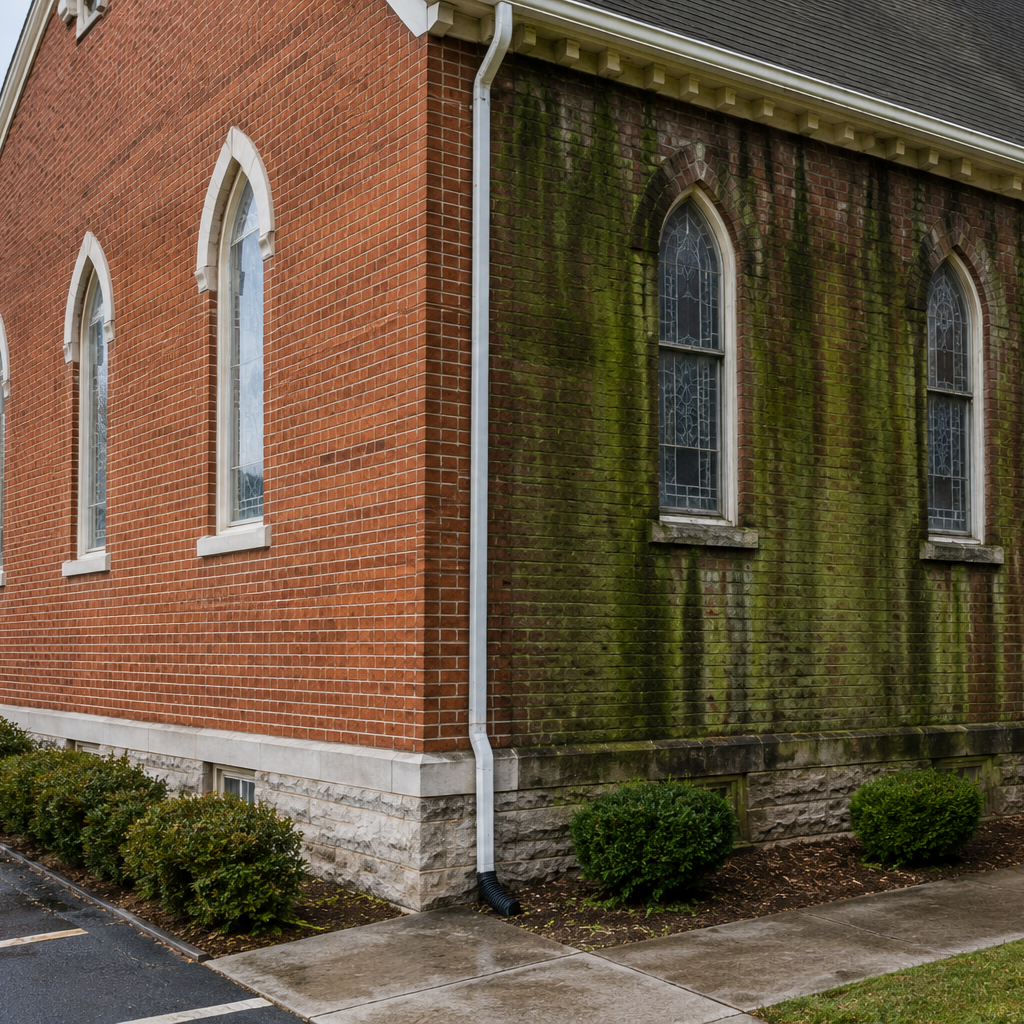
Walk a slow lap around an older brick church on a Tuesday morning. The south wall — the one the parking lot faces — looks the way church brick is supposed to look. Warm red, mellow, picked clean by sun and wind. Turn the corner past the bell tower and the picture changes inside ten steps. The north wall has streaks. Dark green ones running from the eaves down to the foundation, heavier under every window sill, darker still where a downspout pours past the wall. The bricks under those streaks are the same bricks. Same kiln, same century. They just live in a different climate than the bricks on the other side of the building.
That's the whole story in one sentence. The north wall of any older church in the Northern Hemisphere is a separate microclimate from the south wall, and it's the microclimate that grows the green.
The north side has its own weather, and it's the weather algae wants
The sun in Charles County sits in the southern sky from October through March and never gets all that high even in summer. That puts the north face of any building in shade for most of the day every day of the year. South walls dry inside an hour after a rain. North walls stay damp for six to eight. In the cool months they can stay damp for two or three days at a stretch — long enough that whatever rained on the wall is essentially still there when the next rain comes.
That's what algae, moss, and lichen need. Not warmth. Not nutrients in any meaningful sense. Just moisture that lingers. Give a north wall four days a month where the brick is damp at the surface and you've given the colony everything it needs to spread.
The south face gets the same airborne algae spores landing on it. They just dry out and die before they can dig in.
Why old church brick is the wrong substrate for the wrong climate
Newer commercial brick is hard, low-porosity, and laid with Portland cement mortar. Water beads up. Algae lands and gets baked off the next sunny afternoon.
Church brick is rarely that. Most of the older churches across Southern Maryland — anything built before about 1950 — were laid with soft red brick and lime-based mortar. That brick reads water like a sponge reads water. The lime mortar is even hungrier. Hold a wet finger against an old church wall, and you can feel the surface pull moisture out of your skin in a few seconds.
A surface that absorbs water absorbs algae cells with the water. Once the cells are inside the pores of the brick or sitting in the texture of weathered lime mortar, sunlight on the surface doesn't reach them. The colony lives below the surface, sends visible threads up to the daylight, and feeds off the constant moisture the substrate is holding.
This is why a green streak on church brick almost never washes off with a garden hose. The visible green is the tip of a colony that's two or three millimeters deep.
What's actually growing — and why the color tells you which species
The bright, almost emerald green that shows up on a damp north wall in spring is usually a chlorophyte algae — often a Trentepohlia or Trebouxia species. It needs moisture but doesn't need much else, and it's the first organism to colonize a clean wall.
The darker green-black streaks you see under sills, eaves, and downspout outfalls are a different organism. That's typically Gloeocapsa magma, a cyanobacterium — the same one that causes the black streaks on north-facing roofs across Charles County. It's hardier than chlorophyte algae, feeds on calcium in mortar and shingle granules, and shows up after the first colony has prepared the wall for it.
If both are growing on the same wall, the colony has been there for a while. The lighter green is the first wave; the darker streaks are what moves in after the substrate gets seasoned.
Symptom, cause, and how urgent each one is
| What you are seeing on the wall | What's actually causing it | How urgent |
|---|---|---|
| Light green tint, even coverage on the north face | First-year algae colony seeded by airborne spores | Low — clean within 12 months |
| Dark green vertical streaks under sills, downspouts, eaves | Established algae fed by concentrated runoff paths | Medium — clean this season |
| Black streaks mixed with green | Algae plus gloeocapsa or aged biofilm | Medium — clean this season |
| Velvety cushions of moss in mortar joints | Moss in deteriorated lime mortar; root-like rhizoids penetrating | High — clean and inspect joints |
| Round, flat, gray-green, or orange patches | Lichen — symbiotic fungus and algae, very slow to remove | High — soft wash plus follow-up needed |
| Crumbling mortar behind heaviest green | Freeze-thaw damage already happening under the colony | Urgent — repointing decision before next winter |
The first three rows are cosmetic problems that have a cosmetic fix. The last three rows are the ones that turn into masonry repair budgets if they sit untreated through another winter or two.
The church-specific design features that make the north wall worse
A house has soffits, gutters, downspouts, and breaks in the wall every eight or ten feet for windows. The water moving across a residential wall has a hundred small exits.
A church does not have that. The north wall of a typical brick church runs forty to a hundred feet long with maybe two stained-glass windows and no soffits in the older designs. Every drop of rain that hits the roof on the north slope ends up either in one large gutter or, on older buildings, sheeting straight down the wall. Deep eaves trap humid air in a shaded pocket against the masonry. Parapets at the roofline create a shelf where water pools and then drips down the face in concentrated lines — exactly the dark green stripes you can see from the parking lot.
Add the landscaping factor. Churches usually keep mature trees on the property for the same reason cemeteries do — they were planted a century ago and nobody touches them. Those trees shade the building further, drop pollen and tannins onto the brick, and keep the air around the wall noticeably damper than the air twenty feet out from the building.
Stack all of that against the most absorbent masonry on the property and you have a wall that's wet four days a week even when it hasn't rained.
Pressure washing old church brick is how you turn a cosmetic problem into a repair bill
This is where most well-meaning volunteer cleanup days go sideways. Someone shows up with a 3,000 PSI gas pressure washer from the hardware store, points it at the green, and watches a satisfying clean line appear. The brick underneath looks great for a week. Then mortar starts crumbling out of the joints. Then water starts getting into the wall during the next storm and freezing inside the masonry over the winter. Now the church has a repointing bill that wasn't on the agenda.
Old lime mortar holds together at about 350 PSI of resistance. A pressure washer set to 2,400 PSI strips it like sand. Soft red brick, when hit with that pressure at close range, loses its surface fire skin — the kiln-hardened outer layer that's keeping water out of the rest of the brick body. Once that's gone, the brick absorbs five times more water for the rest of its life.
There is no version of pressure washing old church masonry that doesn't shorten its life. The right tool is a soft wash treatment running under 100 PSI — basically a heavy spray bottle, with the work being done by chemistry rather than impact.
What the right cleaning sequence looks like on a church north wall
A soft
wash cleaning on old church brick isn't quick, but it isn't complicated either. The crew protects landscaping and any stained glass with plastic and water. A sodium hypochlorite biocide blended with a polymer surfactant goes onto the wall through a low-pressure pump at the strength the colony needs — a hotter mix for lichen and moss, a milder mix for first-year algae. Pump pressure stays under 100 PSI at the tip, well below the 350 PSI threshold at which lime mortar starts giving up sand. The wall dwells wet for ten to twenty minutes — long enough for the chemistry to reach below the visible surface, short enough that runoff stays in the protected zone. The biocide kills cells in the substrate, not just at the surface. A long-reach rinse at garden-hose pressure carries the dead colony off the wall.
What you see in the next forty-eight hours matters as much as the wash itself. Dead algae lightens from green to gray to invisible across two days as the cells dehydrate and the wind moves them off the surface. If a section is still visibly green after seventy-two hours, the colony was deeper than the first pass reached and a second application is the right call rather than turning up the pressure.
A proper mold and algae treatment on church brick takes a full day for a typical mid-size building, sometimes two days for the larger sanctuaries. There is no shortcut that doesn't shorten the life of the wall.
Why annual cleaning costs less than the four-year wait
Most churches don't notice the green until somebody in the congregation mentions it at coffee hour, and by then the colony is two or three years deep. The cost gap between catching it at year one and catching it at year three is real money:
A first-year colony washes off in a single visit. A three-year colony almost always needs a second visit four to six weeks later to catch the cells the first wash couldn't reach. A five-year colony, where moss has taken hold in the joints and lichen is established on the brick, often needs minor repointing work to repair the damage the colony already did before the cleaning could even start.
On a typical brick church, the math comes out to one inexpensive soft wash a year versus a repointing-plus-cleaning project every four or five years. The annual route is roughly half the lifecycle cost, and the wall doesn't have to spend three years out of every five looking neglected.
Frequently Asked Questions
Same brick, same rain, two different walls. The shade is the whole reason.
A church can stand for a hundred and fifty years, and the south wall will look almost the same on year one as on year hundred. The north wall — same kiln, same masons, same century — will spend the second half of its life fighting a colony the sun on the other side of the building never has to deal with. Knowing that is the difference between an annual cleaning that costs roughly the same as one Sunday's collection and a repointing project that costs ten or twenty times more.
If the green has been creeping across the north face for a few seasons and the property committee finally has it on the agenda, the right move is to catch it before another winter cycle works on the mortar joints. Soft wash, not pressure wash. Once a year, not once a decade.
Superior Power Washing handles church and school exterior cleaning across Waldorf, MD, and all of Charles County and Southern Maryland — including La Plata, Brandywine, White Plains, Hughesville, and Charlotte Hall. Owner-operated, fully insured, certificates of insurance available on request. Soft wash methods only on older masonry, with chemistry that protects landscaping and stained glass. Call (240) 901-4252 for a free on-site assessment.
