
Why Vinyl Fence Panels Turn Chalky and Green Over Time
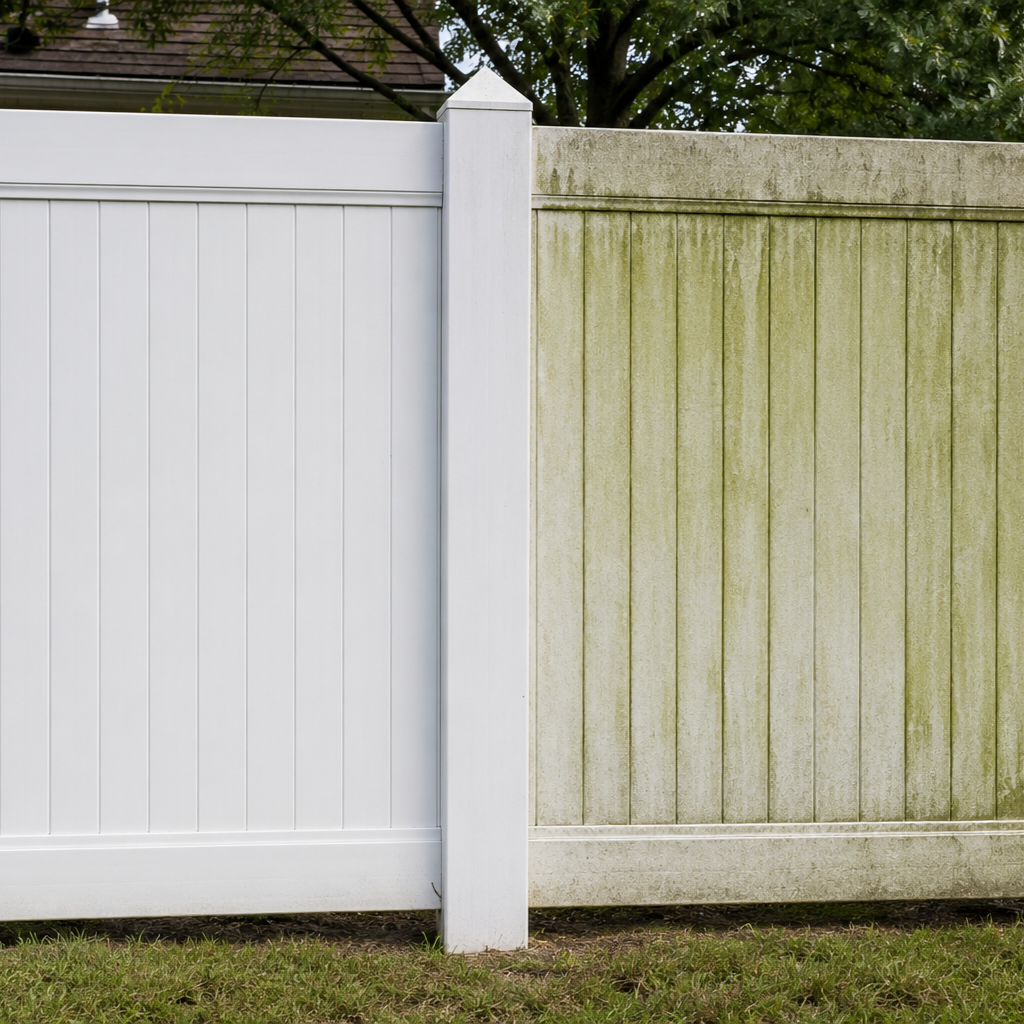
Vinyl fence is supposed to be the no-maintenance fence. Most of them are dead-stick gray within seven years — chalky on the sun side, green on the shade side, a different shade of white from one end of the run to the other. Drag a finger along the top rail and a thin white powder lifts off. Hose it down and the powder is back on your hand the next time you check.
This wasn't supposed to be a maintenance fence.
Here is what's actually going on.
Vinyl chalk and vinyl algae are not the same problem
The chalking and the green growth show up on the same fence, often in the same season, and they get treated as one thing. They aren't. The chalk is the vinyl itself breaking down on the surface. The green is a living colony feeding on what the chalk leaves behind.
A pressure wash hides both for a few weeks. Neither one stays gone.
Five questions that tell you which problem you actually have
Walk up to a panel that looks dingy and ask these in order. Each answer narrows what you're dealing with — and what fix it needs.
Does it come off on your finger as a dry powder? Yes — that's chalk. UV breakdown of the PVC matrix, with titanium dioxide and degraded polymer migrating to the surface. It's cosmetic on its own, but the chalked layer becomes the food base for algae. Address within a season. No — skip to the next question.
Is it worse on the panels facing the sun? Yes — confirms chalking. South- and west-facing panels degrade faster because they take the most UV. Compare a sunny panel against a shaded one. If there's a clear contrast that follows the sun pattern across the yard, you're looking at oxidation, not dirt. No — chalking isn't your primary issue.
Does the green darken to a wet gray-green when you spray it with water? Yes — that's a living colony. Algae or cyanobacteria feeding on chalked polymer, pollen, and airborne organic dust. Moderate urgency — it spreads in humid months and stains the vinyl if left more than a year. No, it stays chalky-white when wet — that's mineral residue, not biological.
Are there black or gray spots inside the green patches that won't rinse off? Yes — mold and mildew have rooted in the same chalky substrate. Moderate to high urgency. A colony that's been entrenched for multiple seasons can permanently discolor the panel where it's been sitting. No — you have got algae alone, which is easier to lift.
Did the chalking get dramatically worse right after a recent pressure wash, and does the surface feel rough now? Yes — the wash stripped the outer UV-stabilized layer of the vinyl. High urgency, and the worst category to be in. The panel is now permanently more porous. Every future cleaning gets harder, and the next round of chalking will be heavier than the first. No — the chalking is following its normal slow curve.
If the chalk and the green look like two parts of one problem, that's because they are — but the fix isn't one cleaning. It's a sequence.
What chalking actually is, and why it never stays gone
Vinyl fence panels are PVC — polyvinyl chloride — with a package of additives mixed in: titanium dioxide (TiO2) for white pigment, calcium-zinc or tin stabilizers to resist heat and UV, impact modifiers, and a small amount of process aid. The additives are uniformly blended through the panel on most economy fence products. Higher-end fences sometimes have a co-extruded outer cap layer with extra UV protection, similar to capped composite decking.
UV light hits the panel every day. The high-energy photons break carbon-chlorine bonds in the PVC chain. The titanium dioxide accelerates the degradation through a photocatalytic reaction at the surface. The polymer at the very top of the panel — usually within the first few microns — loses molecular weight, becomes brittle, and releases as a fine chalky dust.
That dust is the chalk on your finger. It's mostly degraded polymer plus the TiO2 pigment that was bonded to it.
The film is heavier on south- and west-facing panels because those see the most sun. Posts and rails shaded by the house, a fence on the north side of a tree line, sections under deep overhang — those still look closer to the original color. The contrast is the giveaway. If the chalk follows the sun pattern across the yard, you're looking at oxidation, not dirt.
A garden hose lifts the loose powder. The film comes back because the underlying polymer continues to oxidize during the next sunny week. There's no cleaning agent that stops it permanently. What slows it is removing the chalked layer with an oxalic-acid-based vinyl cleaner, then applying a vinyl restorer — a mineral-oil-based product that seeps into the porous surface and re-binds pigment for a season or two. Sanding is not an option. Sandpaper on vinyl exposes more raw polymer and speeds up the next round of breakdown.
Newer cap-extruded vinyl — anything sold as "premium," "weatherable," or with an acrylic capstock — resists the chalking longer. If your fence was installed in the last five years and the boards are already showing heavy chalk, either the panels are economy-grade or the original UV package was undersized for the exposure.
Why the green colony loves a chalky fence
Here is the connection that gets missed. The chalk doesn't just sit there looking ugly. It builds a substrate the algae actively prefers.
A brand-new vinyl panel is glossy and slick. Water beads on it and runs off. Nothing organic gets a grip. After a few summers of UV exposure, the surface is dull, microscopically porous, and slightly textured — exactly the kind of surface algae and lichen colonies need to anchor themselves. Add pollen, airborne dust, and the fine layer of organics that lands on every outdoor surface over a humid Mid-Atlantic summer, and the chalked vinyl becomes a perfect bed for green growth.
Think of it like rust on a painted bumper. The paint stays smooth and the metal stays sealed until the first chip exposes the surface underneath. Once the rust starts, the rough edge of the patch catches more moisture, traps more salt, and the corrosion spreads faster than the original chip suggests. Chalked vinyl works the same way for algae — the texture catches what would have rolled off a new panel.
The green colonies show up first on shaded panels — north sides, sections under tree cover, anywhere the surface stays damp longer after dew or rain. Cyanobacteria (technically not algae, though it's usually grouped with them) is the most common offender. Green algae, white mold, and lichens follow in the same spots.
Wet a green patch with a spray bottle. If it darkens to a wet gray-green and looks slimy, it's organic — algae or mold. If it stays chalky-white when wet, it's mineral residue or polymer.
Pressure washing solves both problems and creates the next one
Here's where homeowners burn a weekend making the fence look worse than when they started.
A pressure washer at 2,500 to 3,000 PSI strips the visible chalk and most of the green off the surface. The fence looks bright when the water dries. The result holds for about three weeks.
What the pressure also does is tear into the outer few microns of the vinyl that hadn't fully degraded yet. The surface that was chalking gets a head start on the next round of chalking — the layer below the original chalk is now exposed and oxidizes faster. Within a season the panel is back to where it was, and the second round is usually worse than the first.
For the algae, the same problem we see on roofs: the pressure knocks the visible colony loose, but the cells embedded in the chalked layer underneath survive. They repopulate from the cells the wash missed. Six to eight weeks later the green is visible again on the shaded panels.
Three specific kinds of pressure damage to watch for:
The narrow fan tip (a 0-degree or 15-degree nozzle) held close to the panel will cut visible parallel streaks into the vinyl. Once those streaks exist they're permanent — they show as bright lines under any future cleaning and trap dirt in the gouged texture.
Oxidation stripes — sometimes called tiger stripes on vinyl — are the second signature. They show up when a crew cleans only the dirtiest streaks at high pressure instead of treating the entire panel evenly. The cleaned strip ends up bright and stripped of its chalked layer, while the panel around it stays oxidized. The sheen mismatch is permanent. A full-panel approach with consistent dwell time and rinse pattern is what avoids them.
Pressure aimed up at the underside of fence panels can drive water behind the panel, into the post pocket, and into the back-rail channels. Most vinyl fences are hollow inside. Water that gets in doesn't come out — it sits, gets warm, and grows the inside of the panel green over a few months. That's the green tint that appears around the seam between rail and panel from the back side, weeks after a fence wash.
A vinyl fence wants low pressure (under 1,200 PSI for most panels), a wide fan tip (40-degree minimum), the nozzle held twelve to eighteen inches off the surface, and the cleaner doing most of the work instead of the water. The water rinses what the chemistry has already loosened.
The cleaning sequence that holds for more than a season
A single cleaning approach can't fix this, because there are two problems on the same surface that need different chemistry. The sequence:
First, kill the algae. A diluted sodium hypochlorite soft wash — the same biocide family we use for roofs — applied with a surfactant that keeps it clinging to the vertical surface for the dwell time. Ten to fifteen minutes is usually enough. The biocide kills the colony at the cellular level, including the cells in the chalked surface that a pressure wash would miss.
Second, remove the chalk. After the algae is dead, an oxalic-acid-based vinyl cleaner pulls the loose oxidized polymer and the dead organic material off the surface together. This is also what brightens the white back to something close to the original tone.
Third, decide on a restorer. On panels less than ten years old, a mineral-oil-based vinyl restorer applied to the cleaned surface will re-bond pigment and slow the next round of chalking for a year or two. On older panels with deep oxidation, the restorer helps less — at some point, the polymer matrix has degraded too far to hold a finish.
The job most pressure-washing companies sell as "vinyl fence cleaning" is just step two with a hose. The result holds about a season. The result of doing all three in sequence holds two to three.
The same dwell-time chemistry that makes deck and fence cleaning actually last is what fixes both problems at once.
Frequently Asked Questions
How to keep a vinyl fence looking white for ten years instead of two
The fence didn't fail because vinyl is bad. It looks the way it does because two slow problems were running at the same time, and a pressure wash was treating them as one.
Catch the algae before it sets into the chalked layer, and the colony comes off cleanly. Wait two more seasons, and what was a wash turns into a panel-replacement job.
That's the order. Diagnose first. Treat the algae with biocide chemistry. Hand-clean the chalk where needed. Then, a UV-protective topical to slow the next cycle. Skip any step, and the fence drifts back to chalk-and-green inside one season.
Superior Power Washing handles vinyl fence cleaning and restoration across Waldorf, MD, and all of Charles County and Southern Maryland — including La Plata, Brandywine, White Plains, Hughesville, and Charlotte Hall. soft wash chemistry on the algae, careful hand-finish on the chalking, owner-operated, fully insured. Call (240) 901-4252 for a free on-site assessment.
